This manual is for DB-FPX8415 Assessment 3, start to submission. The closing deliverable of a doctoral decision course usually asks for the synthesis: assess a decision's quality separately from its outcome, then say what the governance around it should have been. A sound decision can lose and a reckless one can win, and an organization that cannot tell them apart learns nothing from either. Papers concluding that the process was sound while the result was poor, or the reverse, are usually the more sophisticated submissions. Below is how our doctoral desk runs the evaluation, the shape it takes on the page, and an annotated excerpt. Prefer to hand it across? A premium original sample built to the guide in your courseroom comes back inside 24 to 48 hours, reworked at no cost until the criteria are satisfied. Your courseroom may print this as DB FPX 8415 Assessment 3 or DB8415 Assessment 3; it is the same deliverable, and DB-FPX8415 Assessment 3 is what this manual walks through.
One honesty note before the manual: Capella revises courses and scoring guides over time, so always write to the exact scoring guide attached to your assessment in the courseroom. The course identity above is verified on capella.edu; the method and structure below are our tutors' approach to it, not Capella's official rubric text.
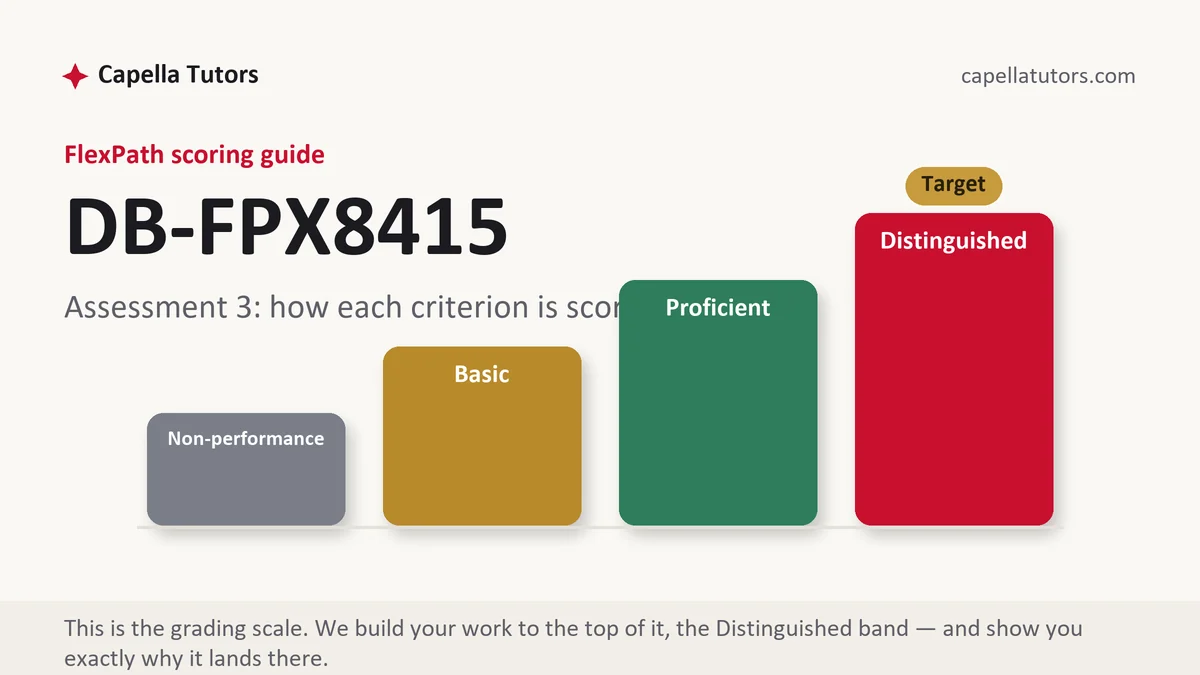
How DB-FPX8415 Assessment 3 is scored
There are four levels for every criterion and nothing between them, and the wording of each one tells you what a reader will look for:
| Level | What it means on a decision quality and governance evaluation |
|---|---|
| Distinguished | Process quality and outcome are assessed as two separate questions, the state of knowledge at the time is reconstructed from documents dated before the decision, the debiasing built into the process is described rather than the biases named, and the authority threshold is evaluated as a finding in its own right. Each criterion holds one more move than it appears to; find it and make it. |
| Proficient | A careful account of what was decided and what followed, with a defensible view on both. Solid work with hindsight still leaking into the process assessment. |
| Basic | A narrative of the decision judged by how it turned out, five biases listed in one paragraph, and a governance section describing the organization chart. What a first attempt nearly always looks like. |
| Non-performance | A required element is absent, most often the governance analysis or the separation of process from result. A criterion asking for two judgments cannot be met with one. |
The judgment the criteria test is how much analysis a decision deserved, and the answer is not always more. A recurring operational choice with quick feedback and a decade of comparable cases is a place to trust practiced judgment. A one-off, irreversible commitment in unfamiliar territory with feedback arriving in three years is where structure earns its cost. Say which the decision was, and tie your expected depth of process to that.
The DB-FPX8415 Assessment 3 method, step by step
-
Rebuild the information set from dated documents
Collect only material written before the decision: board papers, forecasts, contracts, market reports, emails with dates. Memory rewrites itself around the result, so an interview conducted today cannot tell you what was knowable then. The document date is your evidence rule, and stating that rule in the paper is itself a criterion move.
-
Assess the process against four questions
Was the frame right, were the alternatives real, was the uncertainty represented, was the authority correct. Answer each on the evidence available at the time and score it independently of what happened. A process can be found sound on three of four, and saying which one failed is more useful than a verdict.
-
Assess the outcome and apportion it
Say what happened, then divide it between the choice and conditions nobody could have forecast. Where a currency movement, a competitor exit or a demand shift did most of the work, the result tells you little about the decision. Apportioning explicitly, with figures, is what keeps the two judgments from collapsing into each other.
-
Classify the decision type before judging its depth
Name whether this was repeated or one-off, reversible or committed, fast-feedback or slow, familiar or novel. That classification sets the standard you hold the process to, and it protects you from the common error of demanding a full analytical apparatus for a choice practiced judgment handled adequately.
-
Evaluate authority as a finding
Say who decided, who was consulted, who held a veto and what threshold should have sent the matter to a board committee. A sound analysis exercised at the wrong level of authority is a governance failure regardless of how it turned out, and this is the section that most often distinguishes doctoral work from a case write-up.
-
Recommend structure, not resolve, then self-score
Close with the mechanisms you would install: a pre-mortem at a named stage, an assigned dissenter, a reference class of comparable past cases, a decision record written before the result is known, and a threshold table. Then mark each criterion against the top descriptor.
A structure that maps to the criteria
These lengths are our doctoral desk's planning targets for an evaluation of this scope rather than Capella rules; the sections your scoring guide names govern.
| Section | What it must do | Guide |
|---|---|---|
| The decision and its type | What was decided, when, by whom, and the classification that sets the standard for how much process it warranted. | ~200 words |
| The information set | What was knowable at the time, reconstructed from documents dated before the decision, with the evidence rule stated. | ~250 words |
| Process quality | Frame, alternatives, uncertainty and authority assessed one at a time on contemporaneous evidence. | ~400 words |
| Outcome, apportioned | What happened, and how much of it belongs to the choice rather than to conditions nobody forecast. | ~250 words |
| Governance finding | The authority actually exercised against the authority the commitment required, with the threshold that was missing. | ~250 words |
| Structural recommendations and references | The named mechanisms you would install, where each attaches, and current APA cited to primary sources. | ~250 words |
Annotated sample excerpt
A model paragraph from our doctoral desk showing process and outcome held apart on purpose. Follow the structure, then write your own.
Judged on what the board papers of March 2023 contained, the decision to bring ground handling in house at six stations was well framed and poorly represented: the frame named a cost target rather than a method, three genuinely different options were costed, and the reversibility of each was stated, but every volume and turnaround figure appeared as a single number supplied by the operations team that had proposed the change.1 The outcome was good. Handling cost per departure fell 11 percent against a forecast 8 percent, and that result belongs only partly to the choice, because two thirds of the improvement traces to a 2024 fuel and wage settlement the March papers did not anticipate and could not have.2 The governance finding is the one nobody has raised: a $9.4 million commitment across six stations was approved by the chief operating officer under a delegated limit written for single-station capital, so the analysis was sound at a level of authority that should not have been deciding it.3
- 1The evidence rule is in the first six words. The verdict is split, praising the frame and faulting the representation of uncertainty, which is what a criterion-by-criterion process assessment produces.
- 2Reports the good result and immediately apportions it with a figure. Refusing to credit the decision for a settlement it did not foresee is the discipline being marked.
- 3Turns the delegated limit into the central finding. A sound analysis at the wrong authority is a governance defect whether the outcome was good or bad.
The full premium sample for your exact assessment, written fresh to your scoring guide and issue, is free to request. Study it, revise it into your own voice, and submit work you understand.
The five mistakes that cost Distinguished
- The result used as the verdict on the process. A choice that worked out is not thereby a well-made choice, and the entire course rests on that distinction.
- Hindsight smuggled in through interviews. Recollections gathered after the outcome cannot establish what was knowable before it, and the evidence rule has to say so.
- Biases catalogued rather than countered. Naming anchoring and escalation in one paragraph changes nothing; the criterion wants the mechanism you would install.
- Governance described as an organization chart. The finding is the threshold, the veto and the escalation rule, not the reporting lines.
- Outcome credited entirely to the decision. Where an external movement did most of the work, failing to apportion it overstates the choice in both directions.
Pre-submission checklist
- The evidence rule limits the process assessment to documents dated before the decision
- Frame, alternatives, uncertainty and authority are each judged separately
- The decision is classified by repetition, reversibility, feedback speed and familiarity
- The outcome is apportioned between the choice and conditions nobody could forecast
- Authority is evaluated against the size of the commitment, with the missing threshold named
- Recommendations are named mechanisms attached to stages, with APA matched both ways
Want process and outcome kept apart by someone who has done it before?
Send the guide, the decision you are evaluating and any board papers or forecasts dated before it. A team of eight, including a research analyst and two independent reviewers, returns a premium original sample inside 24 to 48 hours with the process scored on contemporaneous evidence and the governance finding written as a finding. Revision is free until each criterion clears.