This manual is for DB-FPX8415 Assessment 2, start to submission. The middle deliverable of a doctoral decision course usually asks you to put uncertainty on the page properly: ranges instead of point estimates, probabilities treated as judgments with a stated basis, an expected value where one is meaningful, and a sensitivity identifying the single assumption the decision actually turns on. Business doctoral work is usually weakest here, and the criteria are written to find it. Below is the method our doctoral desk uses, the shape the analysis takes, and an annotated excerpt at the register the top column pays for. Rather delegate it? One premium original sample, aimed at your own scoring guide, arrives inside 24 to 48 hours with revision free until each criterion clears. Your courseroom may print this as DB FPX 8415 Assessment 2 or DB8415 Assessment 2; it is the same deliverable, and DB-FPX8415 Assessment 2 is what this manual walks through.
One honesty note before the manual: Capella revises courses and scoring guides over time, so always write to the exact scoring guide attached to your assessment in the courseroom. The course identity above is verified on capella.edu; the method and structure below are our tutors' approach to it, not Capella's official rubric text.
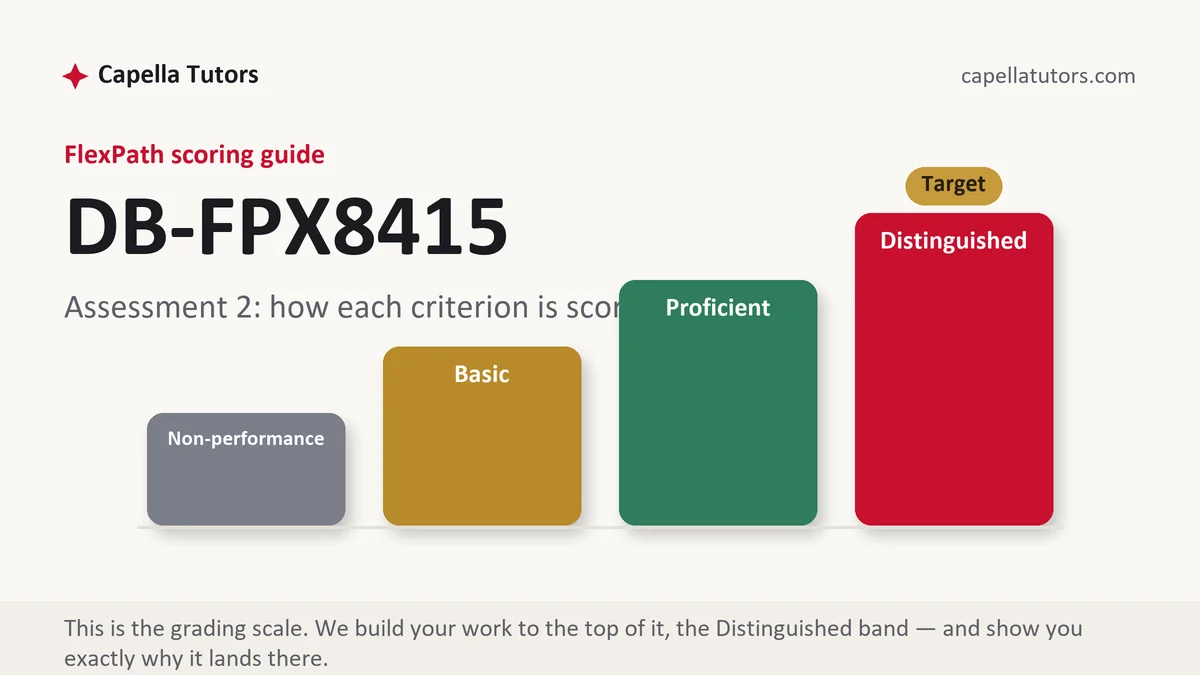
How DB-FPX8415 Assessment 2 is scored
Criterion-referenced marking means the guide is the whole assignment. Four levels per criterion, and the top level describes an object you can build:
| Level | What it means on an uncertainty and sensitivity analysis |
|---|---|
| Distinguished | Every forecast arrives as a range, each probability is attributed to a named judgment with its basis, the sensitivity identifies the assumption the ranking turns on and states the value at which it flips, and the analysis says what result would prove the decision wrong. The extra move is folded into the criterion itself; find it and perform it. |
| Proficient | Ranges present, expected values computed correctly, one sensitivity run. Competent work, with the flip point still unlocated. |
| Basic | Single-point forecasts, a discount rate chosen because it is round, probabilities supplied by the person who wants the project, and confidence in the conclusion. The first submission we see most often. |
| Non-performance | A required element is absent, most often any treatment of uncertainty at all. A criterion asking for a sensitivity cannot be met by a paragraph about risk. |
What separates the top two columns is usually the direction of the finding. A sensitivity that confirms the recommendation is arithmetic; a sensitivity that locates the one number worth spending money to improve is analysis. Once you can say the decision is not a bet on the market but a bet on a particular probability judgment, the case for buying information rather than committing capital writes itself.
The DB-FPX8415 Assessment 2 method, step by step
-
Replace every point estimate with a range
Go through the model and give each forecast a low, central and high value, then say where each figure came from. A single number implies a precision no forecast holds and makes a sensitivity impossible, which means it silently removes the criterion carrying the most weight in this deliverable.
-
Attribute each probability to somebody
A probability is a judgment, so name whose it is and what it rests on: a comparable set of past cases, a pilot result, a customer commitment, an expert view. Forecasts built by asking the person who wants the project are the classic defect, and disclosing whose judgment you used is what allows a reader to discount it appropriately.
-
Compute expected value only where it means something
Expected value earns its place when a decision will be repeated or when the states of the world are genuinely probabilistic, and misleads when a one-off commitment could ruin the firm in the bad state. Say which situation you are in, and where ruin is possible, report the downside separately rather than averaging it away.
-
Find the flip point, not just the range
Move one assumption at a time and record the value at which the ranking changes. The sentence a committee wants is that the recommendation holds while the win rate stays above a stated level and reverses below it. That is what identifies which assumption is worth paying to resolve, which is the real output of the analysis.
-
Price the information against the commitment
Once the pivotal assumption is known, cost a way of learning about it and compare that with the cost of committing. The comparison is rarely between acting and not acting; it is usually between a large irreversible amount now and a small amount spent to find out. Where a staged option exists and you never priced it, the strongest page is missing.
-
Reconcile the exhibits, then self-score
Confirm every figure in the narrative equals the same figure in the tables, since an inconsistency inside a decision document is read as an error in the decision itself. Then mark each criterion against the top descriptor and set your date allowing the two business days an evaluator may take.
A structure that maps to the criteria
Lengths are planning figures our doctoral desk works to for an analysis of this scope rather than Capella requirements; write to the sections your guide specifies.
| Section | What it must do | Guide |
|---|---|---|
| The choice in brief | The decision, the options and the baseline restated in one paragraph, so the model has something to be about. | ~150 words |
| Assumptions register | Every input as a low, central and high value, with its source and whose judgment supplied it. | ~300 words |
| The model | The arithmetic shown for each option at the central case, with the method for combining states stated. | ~350 words |
| Sensitivity | One assumption moved at a time, the flip point named, and what the flip implies about the choice. | ~300 words |
| Value of learning | The cost of resolving the pivotal assumption set against the cost of committing without resolving it. | ~250 words |
| Reversal condition and references | The result that would prove the decision wrong, the review point, and current APA matched both ways. | ~200 words |
Annotated sample excerpt
An original model paragraph from our team showing a sensitivity that finds something rather than confirming something. Take the sequence, then build your own.
The firm reports 84 percent billable utilization across 62 engineers and reads that as a capacity problem, but the central case ranks repricing above hiring, and the ranking rests on one number.1 At the current realized rate of $148 against a $186 standard, a 9 percent rate recovery on the existing book adds about $1.94 million of fee at almost no incremental cost, while adding eight engineers adds roughly $1.31 million of fee at $1.04 million of loaded cost, and both figures move with the share of clients who accept a rate increase without reducing scope, estimated at 0.70 by the two practice leads who negotiate renewals.2 Holding everything else, repricing stays ahead of hiring while acceptance remains above 0.46 and falls behind below it, which means the decision is not a judgment about capacity at all: it is a bet on client acceptance, and a $38,000 structured conversation with the fourteen largest accounts would resolve the pivotal number before $1.04 million is committed to payroll.3
- 1Names what the organization believes, then says the ranking depends on a single input. The paragraph has a finding before it has a table.
- 2Both options carry a fee figure and a cost figure, and the probability is attributed to the people who supplied it. Attribution lets a reader discount it themselves.
- 3States the flip value, reinterprets the decision, then prices the learning against the commitment. This is the sequence the top descriptor is written around.
The full premium sample for your exact assessment, written fresh to your scoring guide and issue, is free to request. Study it, revise it into your own voice, and submit work you understand.
The five mistakes that cost Distinguished
- Probabilities with no owner. A number nobody is credited with is a number nobody can evaluate, and the criterion asks whose judgment it was.
- A discount rate treated as a fact. State it as an assumption, say where it came from, and run the ranking two or three points either side of it.
- Expected value applied to a bet-the-firm commitment. Averaging across a state that would end the company hides the only outcome that matters.
- A sensitivity that only confirms. Moving inputs until the recommendation survives is advocacy, and the criterion is looking for the flip point instead.
- Narrative figures that disagree with the exhibit. Inside a decision document that is not a typographical matter, it is read as an error in the analysis.
Pre-submission checklist
- Every input appears as a low, central and high value with its source recorded
- Each probability is attributed to a named judgment and the basis for it is stated
- Expected value is used only where the situation justifies it, with downside reported separately
- The sensitivity names the pivotal assumption and the value at which the ranking flips
- The cost of resolving that assumption is compared with the cost of committing
- Every narrative figure matches its exhibit, and each criterion is self-scored at the top level
Want the sensitivity run before you commit to a recommendation?
Send the guide, the options and whatever rate, cost or volume figures you can share. A team of eight, a research analyst among them and two reviewers who see the draft cold, returns a premium original sample inside 24 to 48 hours with every input ranged, the flip point located and the cost of learning priced. Revision is free until each criterion clears.