This manual is for DB FPX 8415 Assessment 1, start to submission. The opening deliverable in a doctoral decision course usually asks for the front half of a decision file: the frame, written as a question with a decision maker and a deadline attached, and an alternative set built to be chosen between rather than rejected. Framing is graded first because it silently determines everything downstream, and an option set with one real candidate has already made the decision it claims to analyze. Below is the order our doctoral desk works in, the shape the decision file takes, and an annotated excerpt. Prefer to hand it across? A premium original sample written to the guide you were issued returns inside 24 to 48 hours, revised without charge until the criteria are met. Capella's catalog lists the course as DB-FPX8415, and some courserooms print DB8415; both point to this same Assessment 1.
One honesty note before the manual: Capella revises courses and scoring guides over time, so always write to the exact scoring guide attached to your assessment in the courseroom. The course identity above is verified on capella.edu; the method and structure below are our tutors' approach to it, not Capella's official rubric text.
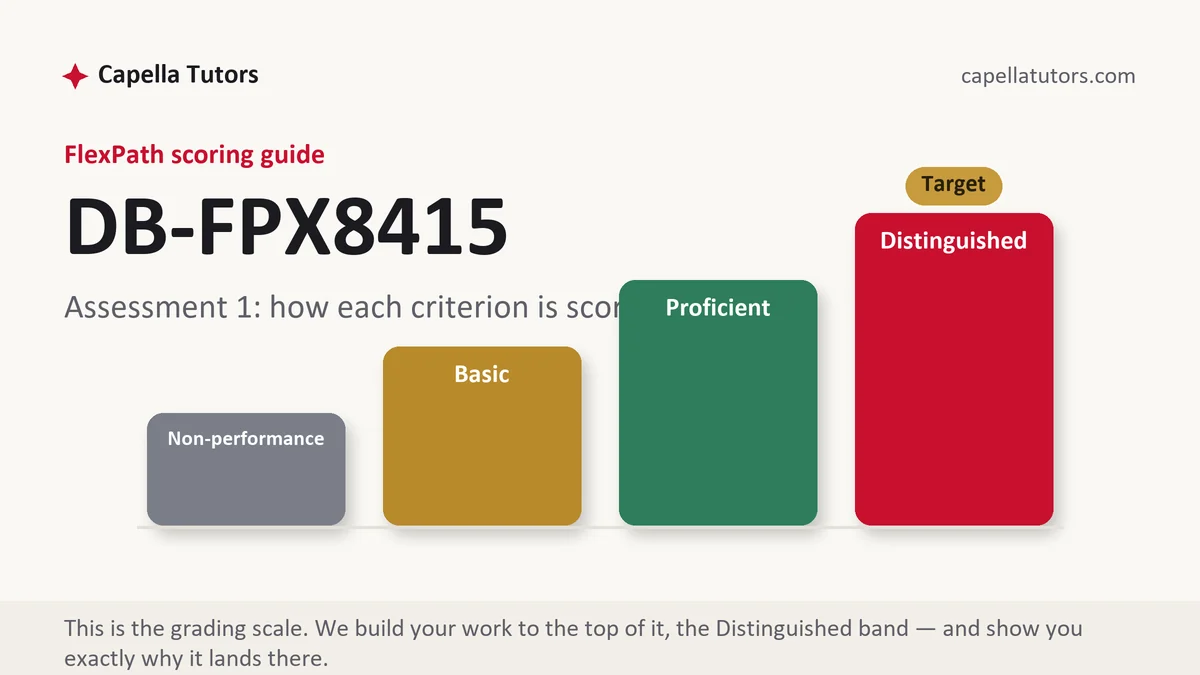
How DB FPX 8415 Assessment 1 is scored
FlexPath grades one criterion at a time and issues no letters. Four levels apply to each, and the descriptors are the specification:
| Level | What it means on a decision frame and alternative set |
|---|---|
| Distinguished | The frame is a question naming the decision maker, the resources at risk and the date, with the options it excludes named and the exclusion defended. The alternatives differ in mechanism, in amount committed and in reversibility, one of them is staged, and the status quo is present with its costs computed. Each criterion holds one further demand; find it and answer it. |
| Proficient | A clear decision statement and three defensible options. Sound work, with the options still variations on one commitment. |
| Basic | A topic presented as a decision, one favored course of action, a straw man and doing nothing described but not costed. The usual first attempt in this course. |
| Non-performance | A required element is absent, most often the criteria that options will be judged against. An evaluator cannot mark a comparison you never set up. |
Framing carries this much weight because a frame is an exclusion device. Should we automate the molding cell forecloses every answer that is not automation, while how do we take fourteen dollars out of this unit cost by 2028 admits at least four. Write the frame, ask what it forbids you from considering, then decide whether you meant to forbid it.
The DB FPX 8415 Assessment 1 method, step by step
-
Write the decision statement before anything else
One sentence naming who decides, what is being chosen, what resources are at risk, the date by which it must be settled and the objective it serves. In this course the frame is a graded object rather than a preamble, and a draft that opens with background has already conceded the criterion that pays for framing.
-
Test the frame by what it forecloses
List the courses of action your wording rules out, then justify each exclusion or widen the frame. A frame naming a technology has excluded every commercial answer; a frame naming a cost target has kept them. Write the excluded set into the document, because showing the reader what you declined to consider is itself evidence of process.
-
Build alternatives that differ in three dimensions
Construct the same objective three ways: one as a full commitment, one staged or piloted so the commitment can be stopped, and one achieved through a contract, a partner or an acquisition rather than through building. Options differing only in size are one option, and a set built that way documents a preference rather than a comparison.
-
Keep the status quo in, with its costs computed
Doing nothing is a choice with consequences, and papers that omit it lose the comparison that would have made the recommendation persuasive. Price it: what unit cost, share or margin does the organization carry forward, and for how long. An uncosted status quo is the tell that the recommendation was chosen before the analysis started.
-
Fix the criteria and the weights before scoring
Write the measures each option will be judged against, weight them, and date the page. If the weights are set after the scores are visible, the matrix records a preference and any reader who has built one will recognize it. Another analyst should be able to apply your weights and reach your ranking.
-
Describe each option well enough to be chosen, then self-score
Every alternative needs the detail a decision maker would require to say yes to it, including what it costs, how long it takes and what it forecloses. Then mark each criterion against the top descriptor and set your submission date knowing an evaluator may hold an attempt for two business days.
A structure that maps to the criteria
These lengths are our doctoral desk's planning targets for a decision file of this scope, not Capella rules; the sections your own guide names are the ones to write.
| Section | What it must do | Guide |
|---|---|---|
| The decision framed | Decision maker, choice, resources at risk, deadline and objective, written as a single question. | ~200 words |
| What the frame excludes | The courses of action the wording rules out, with each exclusion justified or the frame widened. | ~200 words |
| Situation and constraints | The figures, capacity, contracts and dates that bound the choice, each sourced and dated. | ~250 words |
| The alternatives | Three or more options differing in mechanism, commitment and reversibility, each described in enough detail to be selected. | ~450 words |
| The status quo, costed | What continuing unchanged costs, over what horizon, with the arithmetic visible. | ~200 words |
| Criteria, weights and references | The measures, their weights, the date they were fixed, and current APA with frameworks cited to their originators. | ~200 words |
Annotated sample excerpt
A model paragraph from our doctoral desk showing an alternative set that a decision maker could actually choose between. Take the moves, then write your own.
The frame is not whether to automate the molding cell but how the plant removes $14 of standard cost from the enclosure by the 2028 model year, which admits four courses of action rather than two.1 Full automation of all four presses commits $3.8 million of capital across eighteen months and is effectively irreversible once the cell is rebuilt; transferring the part to a contract molder abroad commits $640,000 in tooling transfer and a 22-week qualification, is reversible at the cost of a second transfer, and moves 31 jobs; automating one press while dual-sourcing a second volume band commits $1.1 million, preserves both routes and produces a read on achievable cycle time within nine months.2 Continuing unchanged is the fourth option and it is not free: at the current $61.40 standard against a competitor price point implying $47, the plant carries an estimated $2.1 million of contribution shortfall across the 2027 and 2028 volumes, which is the figure every other option is measured against.3
- 1Replaces a technology frame with a cost-target frame in the first clause, then states how many options that reframing creates. The frame is doing analytical work, not introducing.
- 2Three options separated on commitment, reversibility and mechanism, each with a figure and a duration. The staged option is priced rather than mentioned.
- 3The status quo arrives with arithmetic and becomes the baseline. This is the sentence most drafts omit and the one that makes the comparison persuasive.
The full premium sample for your exact assessment, written fresh to your scoring guide and issue, is free to request. Study it, revise it into your own voice, and submit work you understand.
The five mistakes that cost Distinguished
- A frame naming the answer. Whether to automate has excluded contracting, partnering and repricing before the analysis has taken its first breath.
- Three sizes of one commitment. Options that differ only in scale are a single option, and the criterion asking for genuine alternatives will say so.
- An uncosted status quo. Doing nothing described in a sentence and never priced removes the baseline the recommendation needed.
- Weights written after the scores. A matrix assembled once the preferred answer is visible documents the preference, and experienced readers check the order of work.
- No staged option anywhere in the set. Where a commitment can be taken in parts, omitting the staged version skips the most valuable comparison available.
Pre-submission checklist
- The decision statement names the decision maker, the resources, the deadline and the objective
- The courses of action the frame excludes are listed and each exclusion is justified
- At least three options differ in mechanism, in commitment and in reversibility
- One option is staged or reversible and its cost of learning is calculated
- The status quo appears as a real option with its cost computed over a stated horizon
- Criteria and weights are fixed and dated before scoring, with APA matched both ways
Want the frame tested before the analysis is built?
Send the guide and the choice your organization is facing. A team of eight, including a research analyst and two reviewers who read the draft cold, returns a premium original sample inside 24 to 48 hours with the frame written as a question, the excluded options named, and the staged alternative priced against the committed one. Revision stays free until each criterion clears.