This manual is for CSC FPX 4030 Assessment 3, start to submission. Assessment 3 in CSC FPX 4030, Introduction to Machine Learning, is usually the synthesis deliverable: several candidates compared on identical folds, the spread across those folds reported next to the mean, one model recommended for a stated use, and the limits of the whole exercise written by you rather than discovered by your evaluator. Every criterion is marked on its own against your scoring guide. The remainder of this page holds our tutors' sequence, a layout keyed to the criteria, and an annotated excerpt. Rather have it handled? An original premium sample written against your own criteria takes 24 to 48 hours, and revising it costs you nothing at any point. Capella's catalog lists the course as CSC-FPX4030, and some courserooms print CSC4030; both point to this same Assessment 3.
One honesty note before the manual: Capella revises courses and scoring guides over time, so always write to the exact scoring guide attached to your assessment in the courseroom. The course identity above is verified on capella.edu; the method and structure below are our tutors' approach to it, not Capella's official rubric text.
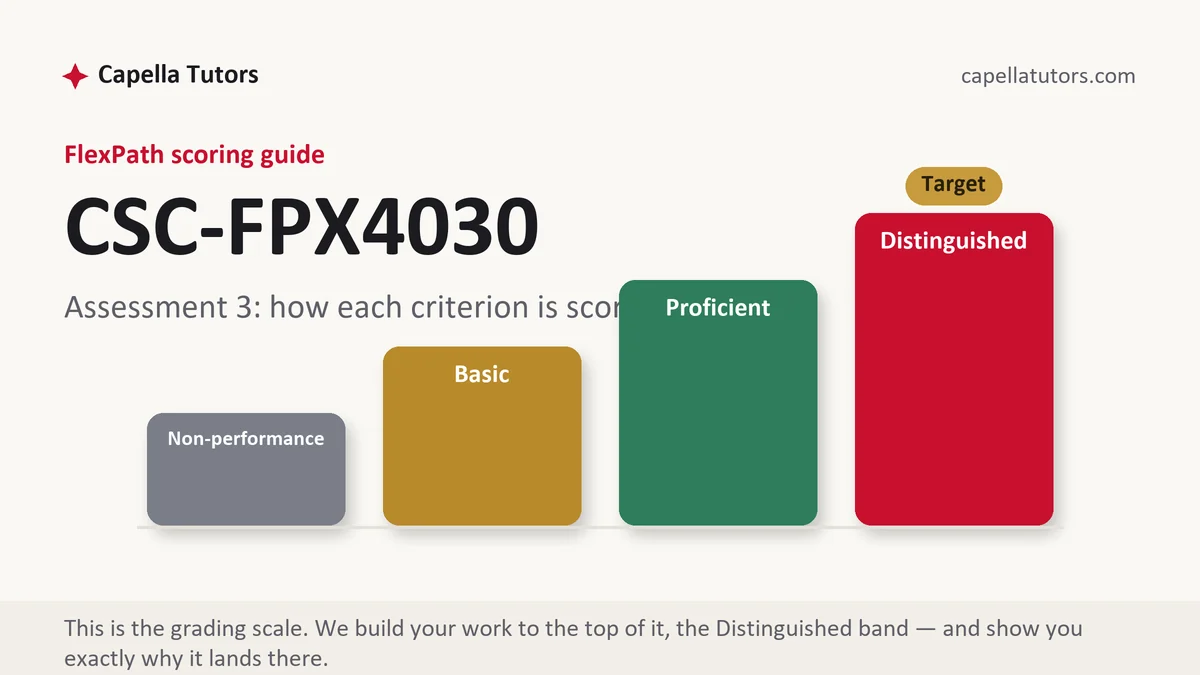
How CSC FPX 4030 Assessment 3 is scored
Four levels per criterion, marked separately, nothing averaged. Here is what those levels usually describe on work of this kind:
| Level | What it means on a model comparison |
|---|---|
| Distinguished | Candidates are compared on identical folds with identical preparation, the spread across folds is printed beside the mean, and the recommendation is justified by what the use case needs rather than by the highest number. The limits are volunteered, including the groups the data is too thin to speak for. |
| Proficient | A fair comparison, a defended choice, cross-validation reported. Sound, with the mean standing in for the distribution behind it. |
| Basic | Several models run and the best score announced, with one number for each and no account of stability. A leaderboard rather than an analysis. |
| Non-performance | A required element is missing, usually the validation procedure or the discussion of where the model should not be used. |
Report the spread, not just the average. On a modest dataset a score that moves several points between folds is telling you something the mean is designed to hide, and naming that instability is the cheapest mark in this deliverable.
The CSC FPX 4030 Assessment 3 method, step by step
-
Criteria into headings, then fix what winning means
Write the measure and the acceptable error before any candidate runs. A comparison with no stated target ends up selecting whichever model happened to score highest, which is a decision made by chance and defended afterwards.
-
Start with something deliberately simple
A linear model or a shallow tree first, always. A plain model that does the job is a result worth reporting, not a shortfall, and it gives everything you try afterwards a reference point.
-
Add candidates that differ in kind, not in degree
Two or three models that work in genuinely different ways teach more than six variations on one idea. Keep the preparation and the folds identical across all of them, because a comparison run on different splits is not a comparison.
-
Report every candidate with its spread
Give the mean across folds and the range or standard deviation beside it, for each model. Where two candidates overlap within their own variation, say so instead of ranking them, since claiming a difference the folds do not support is the error this criterion catches.
-
Recommend on what the use case needs
Accuracy and explainability usually pull against each other, and the criteria are not looking for a winner in general. They are asking which of the two this particular decision cannot do without. Put a number on the exchange, then say why it is or is not acceptable here.
-
Write the limits yourself, then self-score
Say which population the rows describe, which months they span, which groups are represented too thinly to have taught the model anything, and which decision this model must never make by itself. Then mark yourself on each criterion and rewrite whatever is short of the top level.
A structure that maps to the criteria
The counts below are the planning targets our tutors use for a comparison of this shape, not Capella requirements; expand wherever your criteria ask for more.
| Section | What it must do | Guide |
|---|---|---|
| Target and measure | The error measure, the level that would count as good enough, and both fixed before results. | ~200 words |
| Validation procedure | Fold count, how folds were built, and what stayed identical across candidates. | ~200 words |
| Candidates and results | Each model with its settings, its mean, and its spread across the same folds. | ~300 words |
| Recommendation | The model chosen, the property the use case needs, and the exchange stated with a number. | ~300 words |
| Limits | Population, period, thin groups, and the decision the model must not make on its own. | ~250 words |
| References | Method origins, library documentation for the installed version, dataset provenance, current APA. | as needed |
Annotated sample excerpt
A final original excerpt from our team, printed as a model of how a recommendation survives an awkward number. Take the shape and write it against your own results.
Across five folds built from the same 2,900 households, the boosted ensemble averaged 1.7 thousand gallons of absolute error a month and the single regression tree averaged 2.1, but the ensemble ranged from 1.5 to 2.4 across those folds while the tree ranged from 1.9 to 2.3, so the gap between them is smaller than the ensemble's own variation.1 The utility wants these estimates for one purpose, which is answering a resident who disputes a bill, and that purpose needs a reason attached to every number, so the tree is recommended: it costs about four hundred gallons of accuracy a month and returns a path of readable rules a clerk can repeat over the phone.2 Two limits belong on the page rather than in an evaluator's comments. The rows cover twenty-two months of a single service area, and apartments with shared meters make up under three percent of the sample, which is too thin for the model to have learned anything dependable about them.3
- 1Prints the spread next to the mean and then draws the honest conclusion, which is that the ranking is weaker than the averages suggest.
- 2Chooses on the property the use case requires and prices the exchange in the unit the reader cares about. A recommendation, not a leaderboard result.
- 3Volunteers the period and the group the data cannot speak for. An author who marks their own boundary is not waiting for somebody else to mark it for them.
The full premium sample for your exact assessment, written fresh to your scoring guide and issue, is free to request. Study it, revise it into your own voice, and submit work you understand.
The five mistakes that cost Distinguished
- The highest score selected as the answer. A leaderboard is not a recommendation, and the criterion asked which model suits the decision.
- Means reported with no spread. One number per model hides the instability a small dataset guarantees.
- Candidates run on different folds or different preparation. Whatever that table shows, it is not a comparison.
- Six variations on one model. Tuning is not comparison, and the criterion wants candidates that differ in kind.
- Limits left for the evaluator to find. A weakness discovered by the marker costs far more than the same weakness volunteered.
Pre-submission checklist
- The error measure and the acceptable level both fixed before any candidate ran
- A deliberately simple model included as a reference point
- Identical folds and identical preparation across every candidate
- Mean and spread reported for each model, with overlaps acknowledged
- The recommendation tied to the property the use case needs, with the exchange numbered
- Population, period, thin groups, and the decision the model must not make alone, APA reconciled
Several models run and no defensible choice yet?
Send the results, the criteria, and what the prediction will be used for. Back comes the fold procedure, the candidates with their spreads, the recommendation argued from the use case, and the limits written out, inside 24 to 48 hours with revisions free until the guide is met. You pay nothing for the first one.