This manual is for CSC FPX 4030 Assessment 2, start to submission. Assessment 2 in CSC FPX 4030, Introduction to Machine Learning, is usually where a trained model has to prove it found something: a trivial baseline to beat, a confusion matrix given as four counts, and the metrics derived in your own sentences rather than pasted from whatever a library printed. Each criterion is marked on its own against the guide in your courseroom. What follows is the sequence we write in, a section layout keyed to the criteria, and an annotated excerpt. Would you rather hand it off? Ask us and an original premium sample reaches you within 24 to 48 hours, with unlimited free passes until the guide is satisfied. Capella's catalog lists the course as CSC-FPX4030, and some courserooms print CSC4030; both point to this same Assessment 2.
One honesty note before the manual: Capella revises courses and scoring guides over time, so always write to the exact scoring guide attached to your assessment in the courseroom. The course identity above is verified on capella.edu; the method and structure below are our tutors' approach to it, not Capella's official rubric text.
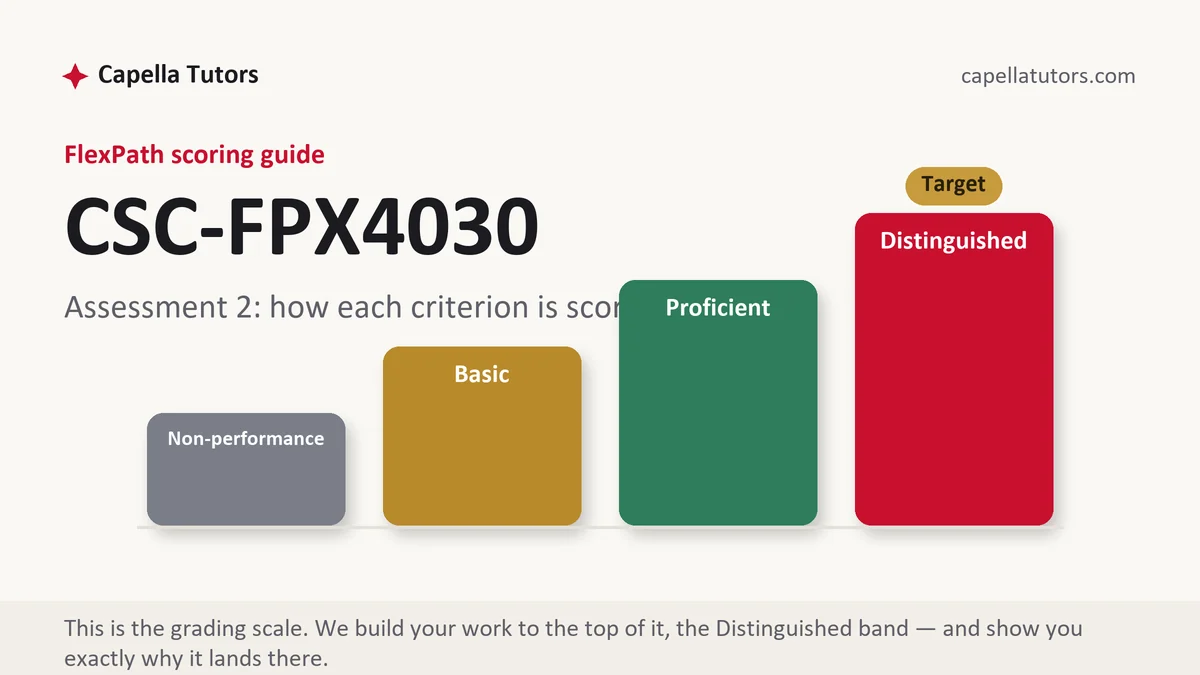
How CSC FPX 4030 Assessment 2 is scored
The guide replaces grades with levels, one for every criterion, and the descriptions tell you what the writing has to do:
| Level | What it means on an evaluation deliverable |
|---|---|
| Distinguished | A trivial baseline sits beside the model in the same table, the four counts are printed, every metric is derived in the text, and the cutoff is fixed by what each kind of error costs instead of by whatever the library shipped with. The paper says what the result is not good enough for. |
| Proficient | Correct metrics, a baseline present, the matrix reported. Complete work that leaves the reader to decide what the numbers mean. |
| Basic | Accuracy quoted on imbalanced data with nothing to compare it against. The figure may be arithmetically right and still describes a model that found almost nothing. |
| Non-performance | A required element never appears, most often the baseline or the confusion matrix the metrics were supposedly drawn from. |
Volunteer the baseline before anybody asks for it. On an imbalanced problem the majority-class score is the number that makes your own figure readable, and a student who prints it first has already answered the criterion about appropriate evaluation.
The CSC FPX 4030 Assessment 2 method, step by step
-
Headings from the criteria, then the metric chosen in writing
Name the metric before you look at any result, and say which error you are more willing to make. A metric selected after the numbers arrive is a metric selected by the numbers, and an evaluator can usually tell.
-
Compute the trivial baseline first
Work out what answering with the most common class alone would score, and put that figure in the document before your model's. It costs one line of arithmetic and it is the reference point every later paragraph needs.
-
Print the four counts
Give true positives, false positives, false negatives, and true negatives as raw numbers, not as a heat map and not as percentages. Every metric in the section comes out of those four, and a reader who has them can check your arithmetic in thirty seconds.
-
Derive the metrics in your own sentences
Precision is the share of the rows you flagged that deserved it, recall is the share of the real cases you caught, and their harmonic mean balances the two. Write each as a fraction with your own counts in it, since a criterion about appropriate metrics is checking that you know where they come from.
-
Set the threshold from the cost of the errors
The cutoff a library ships is a default, not a decision. Lower it and recall rises while precision falls; raise it and the reverse happens. Say which direction your use case can afford and show the counts at two cutoffs so the exchange is visible rather than asserted.
-
Translate the result into a sentence about the decision, then self-score
Finish with what a person should do with a flagged row, given how often the flag is wrong. Then mark yourself criterion by criterion and rewrite anything under the top level.
A structure that maps to the criteria
These are our tutors' planning targets for an evaluation section, not Capella rules; extend whichever part your criteria weight most.
| Section | What it must do | Guide |
|---|---|---|
| The metric and why | The measure chosen before results were seen, and which error the use case tolerates better. | ~200 words |
| Baseline | What the trivial predictor scores, given as arithmetic, in the same table as the model. | ~150 words |
| The four counts | The confusion matrix printed as raw numbers, with the size of the held-out set stated. | ~150 words |
| Metrics derived | Precision, recall, and their harmonic mean written as fractions of your own counts. | ~300 words |
| Threshold and consequence | Counts at two cutoffs, the exchange between them, and what a person does with a flagged row. | ~350 words |
| References | Library documentation for the version installed, method sources, dataset provenance, and current APA. | as needed |
Annotated sample excerpt
Another original excerpt from our team, offered as a model of how counts become an argument. Read the moves, then derive your own metrics the same way.
Of the 12,400 held-back reviews, 248 report a defect, so answering no to every review scores 98.0 percent and finds nothing at all, and that figure belongs in the table before the model's does.1 The classifier flagged 290 reviews and 160 of them were genuine defect reports, leaving 130 false alarms and 88 real reports missed, which makes precision 160 of 290 at 55 percent, recall 160 of 248 at 65 percent, their harmonic mean 0.59, and overall accuracy 98.2 percent against that 98.0 baseline.2 Read plainly, the model catches roughly two of every three defect reports and is wrong about two of every five alerts, which is useful for routing a queue a person still reads and useless as an automatic answer to a customer, and the accuracy figure is the least informative number in the paragraph.3
- 1Puts the trivial baseline first and says out loud what it means, so the model's own accuracy arrives already framed.
- 2Gives the four counts and derives every metric as a fraction of them. A reader can audit the arithmetic without leaving the sentence.
- 3Converts the metrics into what a person may and may not do with the output, and dismisses accuracy explicitly. That judgment is the difference between the top two columns.
The full premium sample for your exact assessment, written fresh to your scoring guide and issue, is free to request. Study it, revise it into your own voice, and submit work you understand.
The five mistakes that cost Distinguished
- Accuracy reported on an imbalanced set. Predicting the common class scores highly and predicts nothing, which is why the baseline has to be beside it.
- Metrics pasted from a library summary. A printed report is not a derivation, and the criterion is asking where the figures came from.
- The confusion matrix left out. Without the four counts nobody can check a single number in the section.
- The default threshold accepted silently. A cutoff is a decision about which error you prefer, and leaving it unexamined leaves the decision unmade.
- A metric chosen after the results. Selecting the measure that flattered the run is fitting the evaluation to the model.
Pre-submission checklist
- The metric named in writing before any result is discussed
- The trivial baseline computed and printed in the same table as the model
- True positives, false positives, false negatives, and true negatives given as raw counts
- Precision, recall, and their harmonic mean derived as fractions of those counts
- Counts shown at two thresholds, with the exchange between them stated
- One sentence on what a person may and may not do with a flagged row, APA reconciled both ways
Model trained and the results section stalled?
Send the held-out counts or the notebook, the prompt, and the criteria. Back comes the baseline, the four counts, every metric derived in prose, the threshold exchange, and the sentence that turns them into a decision, inside 24 to 48 hours with free revisions until your guide is satisfied. The first sample is free to request.