This manual is for CSC FPX 4030 Assessment 1, start to submission. Assessment 1 in CSC FPX 4030, Introduction to Machine Learning, is usually where the data gets handled before any model is allowed near it: the prediction task framed, the rows described, the split defended, and every preparation step audited for the ways it can leak. Criteria here are written about method, so the same dataset can score at the top or the bottom depending on the order you did things in. Below is the order our tutors work in, the section plan that satisfies the criteria, and an annotated excerpt. Prefer to hand it over? An original premium sample matched to your criteria comes to you inside 24 to 48 hours, and the rewrites are free until it holds up. Capella's catalog lists the course as CSC-FPX4030, and some courserooms print CSC4030; both point to this same Assessment 1.
One honesty note before the manual: Capella revises courses and scoring guides over time, so always write to the exact scoring guide attached to your assessment in the courseroom. The course identity above is verified on capella.edu; the method and structure below are our tutors' approach to it, not Capella's official rubric text.
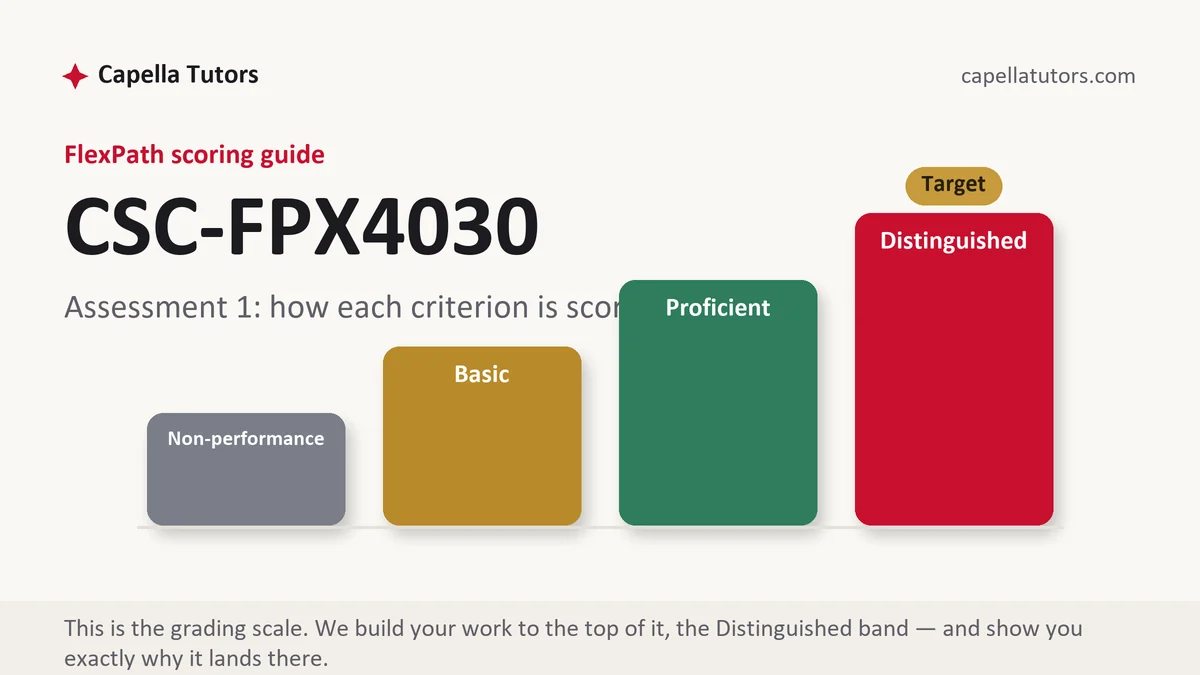
How CSC FPX 4030 Assessment 1 is scored
No letter grade arrives at the end of this. Each criterion in the guide is placed at one of four levels, and the level wording is your specification:
| Level | What it means on a data preparation deliverable |
|---|---|
| Distinguished | The task is framed by what a wrong prediction would cost, the split is made before anything is fitted, and the paper hunts its own leakage and reports what it found. Volunteering a near miss in the pipeline is the move the top column pays for. |
| Proficient | The data is described accurately, the split is reasonable, and the preparation is correct. Nothing wrong, and no evidence the author looked for a way to be wrong. |
| Basic | A description of the columns and a mention that the data was split, with the order of operations left invisible. Accurate reporting that answers none of the method questions. |
| Non-performance | A required element is absent, most often the account of how the split was constructed or the provenance of the rows. |
One rule makes this deliverable honest by construction. Set the evaluation rows aside first, then treat every later step as something that may only look at what remains.
The CSC FPX 4030 Assessment 1 method, step by step
-
Make the criteria your headings, then write the decision the model would serve
A framing criterion wants to know whose hands the prediction lands in and what a wrong one does to them. Answer that in a paragraph before anything technical, because the answer chooses your metric, your threshold, and your conclusion later without further argument.
-
Describe the rows as evidence, not as a file
Give the source, the period covered, the number of rows and columns, how the data came to exist, and who is represented in it. A dataset described this way can answer a data-quality criterion; a file name and a row count cannot.
-
Split before you touch anything
Decide the proportions, decide the mechanism, and do it first. Where the rows carry time, split by date rather than at random, since a random division lets a model learn from records that had not happened yet at the moment it is meant to be predicting.
-
Fit preparation on the training rows only
Scaling, encoding, imputation, and feature selection are all fitted on the training partition and then applied to the others. Fit any of them on the whole table and the rows you meant to hold back have already influenced the model, which leaves the final figure wrong by an unknown margin.
-
Audit the pipeline for leakage and write down what you found
Walk the steps in order and ask of each one whether it saw a row it should not have. Check for duplicate records landing on both sides, for a column that quietly encodes the answer, and for any statistic computed across the whole table. Then report the audit, including the problem you caught and fixed, because a corrected near miss is stronger evidence of understanding than a pipeline that never mentions the risk.
-
Make the run repeatable, then self-score
Record the seed, the library versions, and the split so somebody else could rebuild the partitions exactly. Then read the draft against each criterion, assign yourself a level, and rewrite whatever sits below the top one.
A structure that maps to the criteria
The word targets below are our tutors' planning figures for a preparation deliverable, not Capella limits; grow whichever section your own guide leans on.
| Section | What it must do | Guide |
|---|---|---|
| Framing | The prediction, whose decision it feeds, and the cost carried by each type of mistake. | ~200 words |
| The data | Source, period, size, how the rows were collected, and who they represent or omit. | ~250 words |
| Split | Proportions, mechanism, and why that mechanism suits this data, described precisely enough to repeat. | ~250 words |
| Preparation | Every transformation, what it was fitted on, and what it was applied to, step by step in order. | ~300 words |
| Leakage audit and reproducibility | The checks performed, anything found and corrected, and the seed and versions recorded. | ~250 words |
| References | The library docs, where the dataset came from, the origin of each method, and current APA both ways. | as needed |
Annotated sample excerpt
A model excerpt written by our team, included to show the register an audit is written in. Run the same pass over your own pipeline afterwards.
The circulation export holds 41,000 loans over twenty-six months, and because a late return is a fact about the future of each loan the rows were divided by date rather than at random, the first twenty months training and the last six held back.1 Two problems surfaced when the pipeline was walked step by step. A renewal count had been filled in from the loan record after closure, which meant the column partly encoded the outcome and it was removed, and the scaler had originally been fitted on the full table, so it was refitted on the training months alone and applied to the held-back ones.2 Both fixes lowered the reported score, which is the expected direction and the reason the audit is in this section rather than left out of it, and the run is repeatable from a stated seed, the library versions listed in the appendix, and the two cut dates given above.3
- 1States the split mechanism and the reason for it in one sentence. Time-ordered data divided by date is the decision a method criterion is looking for.
- 2Reports two real defects found by the author, naming what each one was and what was done about it. Volunteered faults score above a clean-looking silence.
- 3Says the corrections lowered the number and treats that as evidence rather than as a loss, then lists what somebody else needs to reproduce the run.
The full premium sample for your exact assessment, written fresh to your scoring guide and issue, is free to request. Study it, revise it into your own voice, and submit work you understand.
The five mistakes that cost Distinguished
- Preparation fitted before the split. A scaler that has already seen the evaluation rows has carried information backwards into training.
- Time-ordered rows divided at random. A model allowed to learn from its own future will look excellent and predict nothing.
- A column that encodes the answer. Any field recorded after the outcome was known is the outcome wearing a different name.
- Duplicate records on both sides of the split. The model is being examined on material it has already seen.
- No seed and no versions. A result nobody can reproduce, the author included, cannot support a claim about method.
Pre-submission checklist
- The prediction framed by who acts on it and what a wrong answer costs
- Source, period, size, collection method, and who the rows represent
- The split made first, with a mechanism that suits the shape of the data
- Every transformation fitted on training rows and applied to the rest, in stated order
- A written leakage audit, including anything found and corrected
- Seed and library versions recorded, references reconciled both ways in current APA
Data ready and the write-up will not start?
Send the dataset or a description of it, the prompt, and the criteria. Back comes the framing, the defended split, the preparation in order with what each step was fitted on, and the leakage audit written out, inside 24 to 48 hours with revisions free until the guide is met. No fee on the first sample.