We write NURS FPX 6624 deliverables to the Distinguished column and then talk you through the reasoning so you can defend it, first premium sample free, delivery in 24 to 48 hours. This is Care Coordination Ethical and Legal Considerations, 2 program points, the third course in the Care Coordination specialization of Capella's FlexPath MSN, a degree built from 27 program points in total. Forward the scoring guide and any case the courseroom supplies and you get a criterion map back within hours. In Capella's catalog the course code is written NURS-FPX6624.
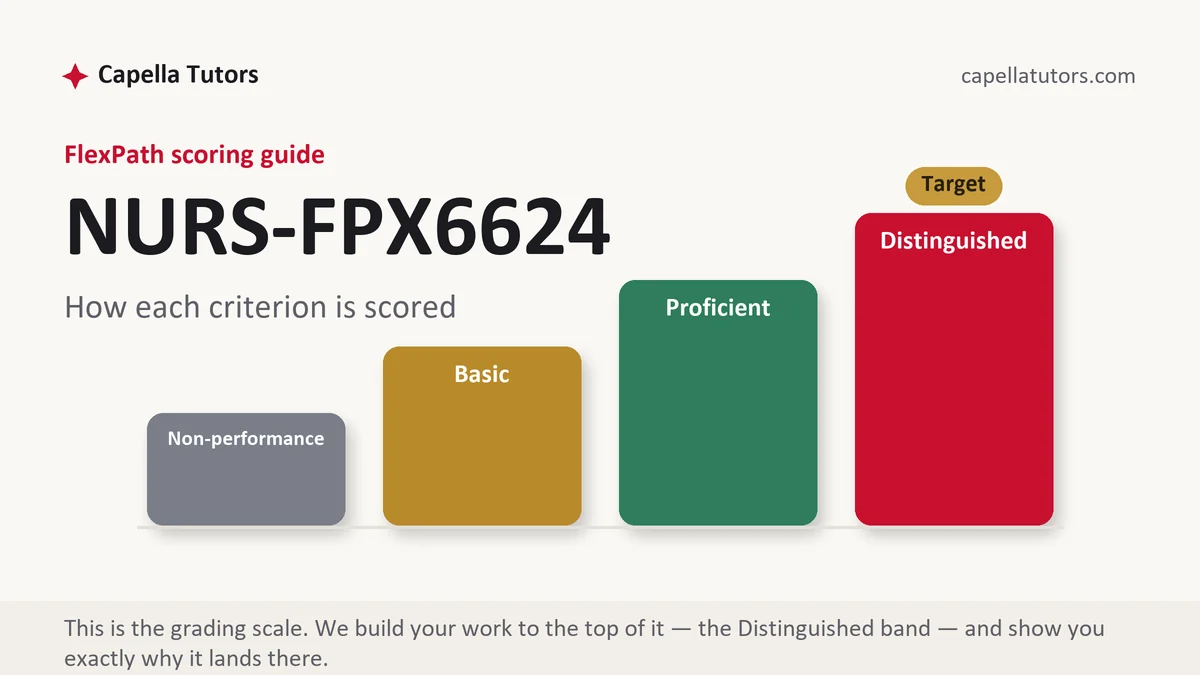
What NURS FPX 6624 actually grades
The criteria here reward decisions, not definitions. Every student can define beneficence and locate the privacy rule. What separates the columns is whether the paper takes a hard call and defends it under pressure. A coordinator learns that a patient's opioid use disorder history is relevant to the receiving skilled nursing facility, and the patient has not authorized that disclosure. That is the shape of the work: two defensible obligations pulling opposite ways, a decision that has to be made anyway, and the reasoning written out so a reader can audit it.
Second, the guides distinguish ethical questions from legal ones and then expect you to hold both at once. Law sets the floor. Ethics often asks for more, and occasionally the two diverge, which is where the interesting paragraph lives. Writing that a disclosure is permitted under the privacy rule answers the legal question and leaves the ethical one untouched. Permitted and right are different findings, and naming the gap between them is a reliable route to the top column.
Third, scope. This is master's coordination work, so the ethics operate at population and system level as well as at the bedside. Who gets the limited care management slots when the panel has three hundred eligible patients and capacity for eighty. Those are the questions the specialization exists to ask, and a paper that stays entirely on one patient reads as undergraduate work no matter how well written it is.
How we help in this course
Our 6624 drafts follow a decision architecture rather than an essay shape. The facts get stated cleanly. The competing obligations get named with the parties who hold them. The legal boundary is established first, with the statute or regulation identified, then the ethical analysis runs inside and sometimes against that boundary.
Each deliverable arrives inside 24 to 48 hours and clears two reviews first, one checking every criterion against your own scoring guide, one checking that every legal claim is attributed to a primary source rather than a summary. Revision passes stay free until you reach the target column. Many clients run this course alongside NURS FPX 6622 in one flat-rate FlexPath session, since a process design gives the ethics work concrete decisions to argue about.
Consent and privacy when the record crosses organizations
Coordination moves information for a living, which is why privacy is the legal spine of this course. Inside one covered entity the analysis is usually simple. The moment a plan spans a hospital, a home health agency, a behavioral health provider, and a community organization that is not a covered entity at all, the questions multiply. Which disclosures fall under treatment, payment, and operations. Where the minimum necessary standard bites. What a business associate agreement actually obligates the downstream partner to do. What the community partner may receive when it sits outside the federal framework entirely.
Then there are the categories with tighter rules. Federal protections on substance use disorder treatment records are stricter than the general privacy rule and require their own consent analysis, and many states add further protection for behavioral health, minors' care, HIV status, and reproductive health. Cite the regulation directly, note the state layer as a variable rather than pretending it is uniform, and show the coordinator's actual workflow changing in response: what gets sent, what gets withheld, what gets asked for in writing first.
Allocation decisions, argued instead of dodged
Resource allocation is the criterion students most often soften into nothing. The temptation is to write that all patients deserve equal access and move on, which decides nothing. The assessment wants the decision rule: eligibility criteria for the coordination program, a stated priority order, and the justification for that order. Highest predicted utilization first is a defensible rule and a utilitarian one. Greatest unmet social need first is defensible and egalitarian. Both leave someone out, and the paper's job is to say who and to explain why that exclusion is tolerable.
The strongest versions of this section examine the tool doing the sorting. Risk models trained on past claims tend to find the patients who already used care, which is not the same set as the patients who most need it, and that distinction has become a well-documented equity problem in population health. Then close the loop procedurally: who reviews the rule, how often, and what appeal a patient or clinician has when the rule produces an obviously wrong result. Substantive fairness plus procedural fairness is the pairing the top column tends to describe.
The assessments, one by one
Assessment 1
Send the scoring guide and any case the courseroom supplies, and a premium original sample comes back inside 24 to 48 hours, revised free until it meets the guide. Read the full Assessment 1 manual.
Assessment 2
We can build this one for you and then walk you through defending it, first premium sample free and back inside 24 to 48 hours. Read the full Assessment 2 manual.
Assessment 3
Hand this one over and a premium original sample lands inside 24 to 48 hours, written to your guide and revised free until it gets there. Read the full Assessment 3 manual.
How to actually write NURS FPX 6624: where to begin
Start from the scoring guide and rebuild it as your outline, criterion by criterion, with the Distinguished language sitting under each heading while you draft. The assessments in this course typically want a case or scenario analyzed, the governing law identified, professional and ethical obligations applied to specific choices, and a recommendation that a reader in a real organization could act on, so the criteria are the structure and the prompt is only the topic.
Pick the case for its difficulty. A scenario where the right answer is obvious gives you nothing to analyze, and the paper spends itself agreeing with itself. Build a composite instead, de-identified completely, with a genuine conflict at its center: a surrogate decision maker whose instructions contradict the patient's earlier stated wishes, an uninsured patient whose safest discharge destination will not take him, a family that wants a diagnosis withheld from the person who has it.
Establish the law before you argue the ethics. Confusing the order is what produces papers that reach an ethical conclusion the law forbids. Once the legal boundary is drawn, the ethical reasoning has a defined space to work in.
| Section | What goes in it | What Distinguished looks like |
|---|---|---|
| Case and stakeholders | The de-identified scenario, everyone with a stake in it, and what each of them stands to lose. | A case with a real conflict at its center, and stakeholder interests stated as tensions rather than a list. |
| Legal analysis | The statutes, regulations, and scope-of-practice rules that set the boundary for the decision. | Primary sources cited by section, with the state layer flagged as a variable and the limits of compliance noted. |
| Ethical analysis | The principles and code provisions in play, applied to the specific choices on the table. | Two or three provisions worked hard against actual decisions, with the conflict between them adjudicated. |
| Equity and allocation | Who gets the limited coordination resource, on what rule, and who is excluded by it. | A stated decision rule with its justification, its excluded group named, and its appeal path defined. |
| Recommendation | The position taken, the actions it implies, and the residual harm it leaves behind. | The strongest counterargument answered on its own terms rather than dismissed in a clause. |
Developing the synthesis
Synthesis in an ethics and law course means holding two authorities in conflict and ruling between them. A privacy analysis may conclude that a disclosure to a receiving facility is permitted for treatment purposes, while the professional obligation to protect a patient's confidence and preserve his trust in the coordination relationship pulls the other way. Put both in one paragraph. Then rule, and give your reason: the severity of the foreseeable harm from silence, the availability of a narrower disclosure that satisfies the clinical need. Ruling in favor of the narrower option and saying so explicitly is the analytic act being graded. Close by naming what your ruling does not resolve, because a decision that leaves no residue was never a dilemma and an evaluator will read it that way.
Citations that survive faculty review
Two source families run in parallel here and both have to be handled properly. Peer-reviewed nursing ethics and health law scholarship comes through the Capella library, with CINAHL carrying the nursing ethics literature and PubMed carrying the empirical work on consent, disparities, and information sharing, generally inside a five-year window. Primary authority is the other family: the code of ethics for nurses cited as its own document and referenced by provision, the privacy and security rules cited by regulation section, your state nurse practice act and state privacy statutes cited as legal references, and federal agency material where it governs practice, including CMS program requirements and Joint Commission standards on rights and communication, all of them taking the agency or association as author in APA 7. Never let a secondary article stand in for a statute you are making a claim about.
The mistakes that land Basic instead of Distinguished
- Defining ethical principles at length and then never applying one to a decision in the case.
- Treating a lawful disclosure as automatically the right thing to do, collapsing law into ethics.
- An allocation section that says access should be equitable without stating any decision rule.
- All clinical information handled as one legal category, with no attention to the protected ones.
- A tidy resolution with no cost named, no dissent answered, and nobody worse off.
NURS FPX 6624 questions students actually ask
How do I use the code of ethics without reciting it?
Quote a provision only once, then spend the rest of the paragraph on a decision. Take the actual call in front of the coordinator, whether to disclose a behavioral health history to a receiving facility that has not asked for it, and show the provision constraining the options. Two or three provisions, worked hard against real decisions, outscore all nine listed and summarized.
Which laws does this course expect me to work with?
Privacy and consent law first, since coordination moves information for a living: the HIPAA privacy and security rules and their minimum necessary standard, the tighter federal protections on substance use disorder treatment records, and whatever your state adds for behavioral health, minors, and reproductive care. Then the law that shapes access and referral: emergency transfer obligations, disability accommodation requirements, and the federal rules that limit financial arrangements between referring organizations. Cite the statute or regulation itself, not a blog summarizing it.
Does the case need a clean resolution?
No, and forcing one is a common way to lose points. Reach a defended position, then state what it costs and who bears the cost. Note the strongest objection to your decision and answer it. Evaluators are reading for structured moral reasoning, and a case resolved without any residue reads as a case that was never actually difficult.
In NURS FPX 6624 right now?
Send the scoring guide and the case you have been given. The first premium sample is on us, returned within 24 to 48 hours.