Our writers build NURS FPX 6622 deliverables to the Distinguished column and walk you through the design logic afterward, first premium sample free, turnaround 24 to 48 hours. The course is Care Coordination Structure and Process, carrying 2 program points inside the Care Coordination specialization of Capella's FlexPath MSN, which adds up to 27 program points overall. Drop in the scoring guide and we return a section-by-section build order before the day is out. In Capella's catalog the course code is written NURS-FPX6622.
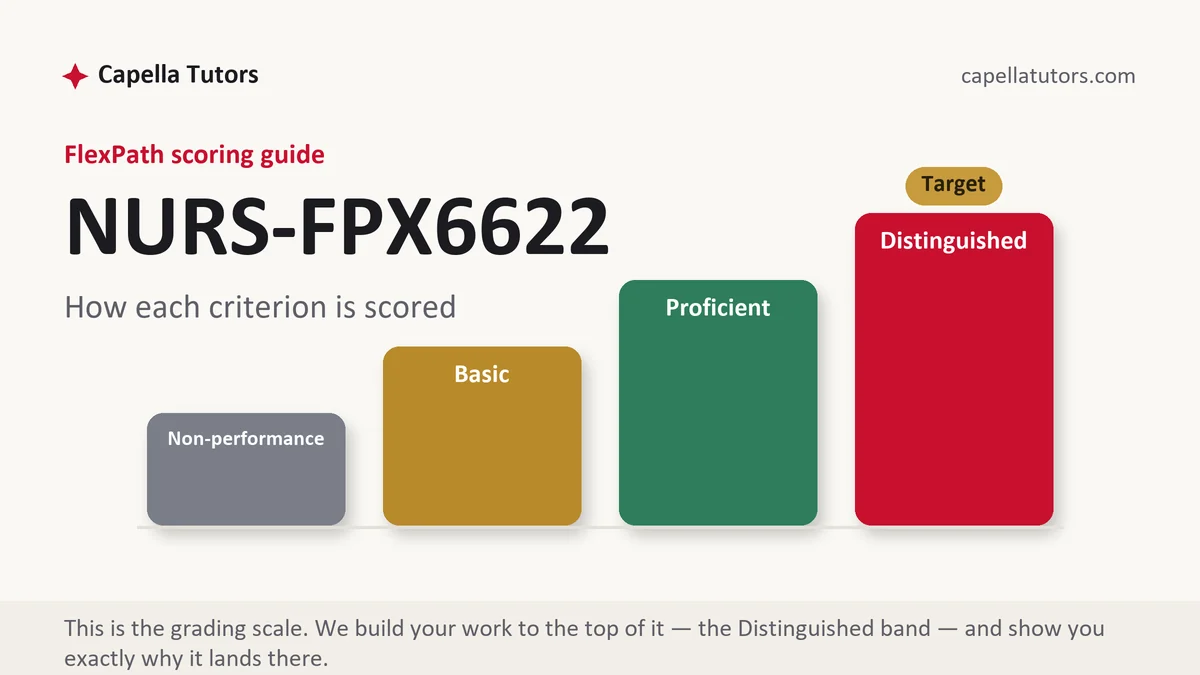
What NURS FPX 6622 actually grades
This is the engineering course of the specialization. Where the models course asks which approach fits a population, 6622 asks you to build the thing: who does what, in what order, on what trigger, recorded where, measured how. The criteria therefore read for operational specificity. A paragraph saying the care coordinator will communicate with the primary care team is not a process. A paragraph saying the coordinator sends a structured discharge summary within one business day, by secure message, to a named role, and logs receipt, is a process. That difference is most of the distance between Basic and Distinguished here.
The second thing under examination is whether structure, process, and outcome stay in their lanes. Evaluators want to see you distinguish the resources and arrangements you are putting in place, the activities those resources perform, and the results you expect, then connect them causally rather than alphabetically. Students who blur the three end up claiming that hiring a coordinator improves readmissions, with nothing in between. The criteria are asking for the in between.
Third, roles. Coordination designs fail on ownership more than on ideas, so the guides reward a design where every step has exactly one accountable role and every gap between steps has been noticed. Two people responsible for the same follow-up call means nobody makes it, and an evaluator who has managed a unit spots that immediately.
How we help in this course
Drafts for 6622 come out of our desk as buildable documents. The process gets written as a sequence with actors and time windows, the roles get a responsibility statement each, the handoff points get named as the risk points they are, and the measurement plan attaches a specific indicator to each step that could quietly fail. Where a criterion asks for a diagram or a table, we supply one that carries information rather than decoration.
Every deliverable ships inside 24 to 48 hours. It passes two separate reviews before you see it, the first against your scoring guide criterion by criterion, the second on APA 7, source currency, and whether the measures cited actually exist as specified. Revisions remain free until the target column is reached. Since FlexPath lets you run two courses at once in a flat-rate session, many clients pair it with NURS FPX 6620 and let the population work feed the design work.
Donabedian used properly, not name-dropped
Almost every paper in this course mentions structure, process, and outcome. Very few use the framework to do work. Using it means writing a chain that survives a skeptical read. Structure: a coordinator role with a defined caseload cap, a shared care plan field in the record, a standing weekly huddle with two hours of protected time. Process: risk stratification at admission, medication reconciliation at every transition, a follow-up contact inside 48 hours of discharge. Outcome: early readmission, follow-up appointment completion, patient-reported confidence in managing the plan.
The move that earns the top column is stating the assumption that links each pair. The coordinator role only improves reconciliation if the caseload cap holds. The huddle only changes decisions if someone with authority attends. Writing those conditions down turns a framework recitation into an analysis, and it also sets you up for the limitations paragraph, because every one of those assumptions is a place your design could fail.
Handoff points, and the measures that prove them
Handoffs are where coordination designs earn or lose their grade. Map yours literally: hospital to skilled nursing, specialist to primary care, clinic to home health, and the quiet one everyone forgets, weekday coordinator to weekend coverage. For each, say what information travels, in what format, who confirms receipt, and what happens when confirmation does not come back. Joint Commission material on communication during transitions gives you standards language for this section, and AHRQ has published toolkit content on structured handoff and discharge processes that reads as a natural authority here.
Then attach measurement. Each handoff wants a process measure with a numerator, a denominator, and a data source you could plausibly obtain. Percentage of discharges with a reconciled medication list transmitted within one business day, denominator all discharges to home health. Percentage of high-risk patients contacted within 48 hours. Measures written at that grain let you argue a balanced set: outcome measures to show the design mattered, process measures to explain why it did or did not, and at least one measure watching for harm elsewhere, since a coordination program that consumes nursing time can degrade something upstream. CMS measure specifications are worth borrowing from directly, because a measure with a published definition already has a benchmark attached.
The assessments, one by one
Assessment 1
Send the scoring guide and we return a premium original sample for this assessment inside 24 to 48 hours, revised free until it satisfies the guide. Read the full Assessment 1 manual.
Assessment 2
Hand this one over and a premium original sample arrives inside 24 to 48 hours, built to your scoring guide and revised free until it reaches the target column. Read the full Assessment 2 manual.
Assessment 3
Send the guide and a premium original sample lands inside 24 to 48 hours, revised free until it meets the criteria. Read the full Assessment 3 manual.
How to actually write NURS FPX 6622: where to begin
Build the outline from the scoring guide, not from the assignment narrative. Paste each criterion in as a heading, put its Distinguished wording underneath, and write into that frame. The assessments in this course tend to ask for some blend of a current-state analysis, a proposed structure and process, a measurement plan, and a piece addressed to stakeholders who would have to approve the design, so the guide is your only dependable table of contents.
Before drafting, do the current state honestly. Write the existing pathway as it actually runs, including the workarounds staff use, then mark the three points where information stops moving. Those three points are your design's reason to exist, and a proposal that never described the broken state has nothing to be measured against.
Draft the process as numbered steps first, in plain language, before you turn any of it into paragraphs. Steps expose gaps that prose hides. Once the sequence holds up, expand each step into the criterion prose the guide asks for and keep the numbered version as your figure.
| Section | What goes in it | What Distinguished looks like |
|---|---|---|
| Current state | The pathway as it runs today, with the points where information or accountability drops. | Named breakdown points with plausible causes, including the workarounds staff already use to survive them. |
| Structure | The roles, caseload assumptions, technology, meeting cadence, and protected time the design needs. | Each structural element justified by the process step that depends on it, with the resource cost admitted. |
| Process | The sequence of activities: actor, trigger, artifact, time window, documentation location. | Steps a stranger could execute on Monday, with exception paths written for when a step fails. |
| Roles and accountability | Who owns each step, who is consulted, and who covers when the owner is unavailable. | One accountable owner per step, with the coverage gaps and their fixes stated explicitly. |
| Measurement plan | Outcome measures, process measures for each fragile step, and the data source for each. | Measures with numerators, denominators, and published specifications, plus one measure watching for harm. |
Developing the synthesis
Synthesis here means reconciling design evidence that points in different directions. Structured handoff tools show benefit in many studies and no effect in others, and the difference usually sits in adoption rather than in the tool. Put both results in one paragraph, then rule on the basis of implementation fidelity: the trials reporting benefit generally describe training, audit, and leadership attention, and the null studies often describe a template dropped into an existing workflow. That verdict should then change your own design, which is the part students skip. If fidelity is the mechanism, your paper needs an audit step and a training plan, and it should say the evidence put them there. Close by naming what the literature cannot tell you, usually whether the effect holds at your staffing level, and say what you would measure to find out.
Citations that survive faculty review
Pull peer-reviewed work from the last five years through the Capella library, CINAHL for the nursing process and handoff literature, PubMed for health services and implementation studies. This course leans harder on non-journal authority than most, which is a strength rather than a compromise: AHRQ toolkits and evidence syntheses, Joint Commission standards and sentinel event material on communication failures, and CMS measure specifications all belong in the reference list, cited as reports with the agency as author in APA 7. Give every citation a job. The sentence that sets your 48-hour follow-up window should carry the source that justifies 48 hours, not a general reference to transitional care. If the deliverable is addressed to stakeholders as a briefing or a presentation, keep the citations in the notes and hold the reference list to the same standard a paper would face.
The mistakes that land Basic instead of Distinguished
- Process steps built on vague verbs like coordinate or follow up, with no actor and no time window.
- Structure, process, and outcome named as a framework but never linked by a stated assumption.
- Two roles sharing accountability for the same step, which in practice means nobody owns it.
- A measurement plan of outcomes only, leaving a flat result impossible to explain.
- No exception path, so the design describes only the days when nothing goes wrong.
NURS FPX 6622 questions students actually ask
How detailed does the workflow have to be?
Detailed enough that a stranger could run it on Monday. Every step needs an actor, a trigger, an artifact, and a time window. Vague verbs are what cost points: coordinate, communicate, follow up. Replace each one with who does what, on what signal, within how long, and recorded where. A workflow that reads like a job aid rather than a description is what the top column is describing.
Which measures belong in the design?
One or two outcome measures, and a process measure for each step where your design could quietly fail. Outcome measures alone leave you unable to explain a flat result. Process measures alone leave you unable to claim benefit. Prefer measures that already exist in national specifications, from CMS or Joint Commission material, because a measure with a published definition and a comparison benchmark is far easier to defend than one you invented.
Can I design the process around my own unit?
Yes, and it usually produces the strongest paper, because you know where the real breakdowns are. Keep it de-identified: no facility name, no manager names, no internal audit numbers or incident details. Describe the setting generically, a 24-bed medical unit in a community hospital, and use published rates rather than internal figures for any number you cite.
In NURS FPX 6622 right now?
Send the scoring guide and the pathway you are redesigning. The first premium sample costs nothing and ships in 24 to 48 hours.