Send us what your courseroom is asking for and a premium original sample comes back inside 24 to 48 hours, with the criterion walkthrough attached. The course: NURS FPX 6016, Quality Improvement of Interprofessional Care, worth 2 program points. It belongs to the MSN core, which means every FlexPath specialization runs through it, and it is scored the FlexPath way inside a 27-point program. In Capella's catalog the course code is written NURS-FPX6016.
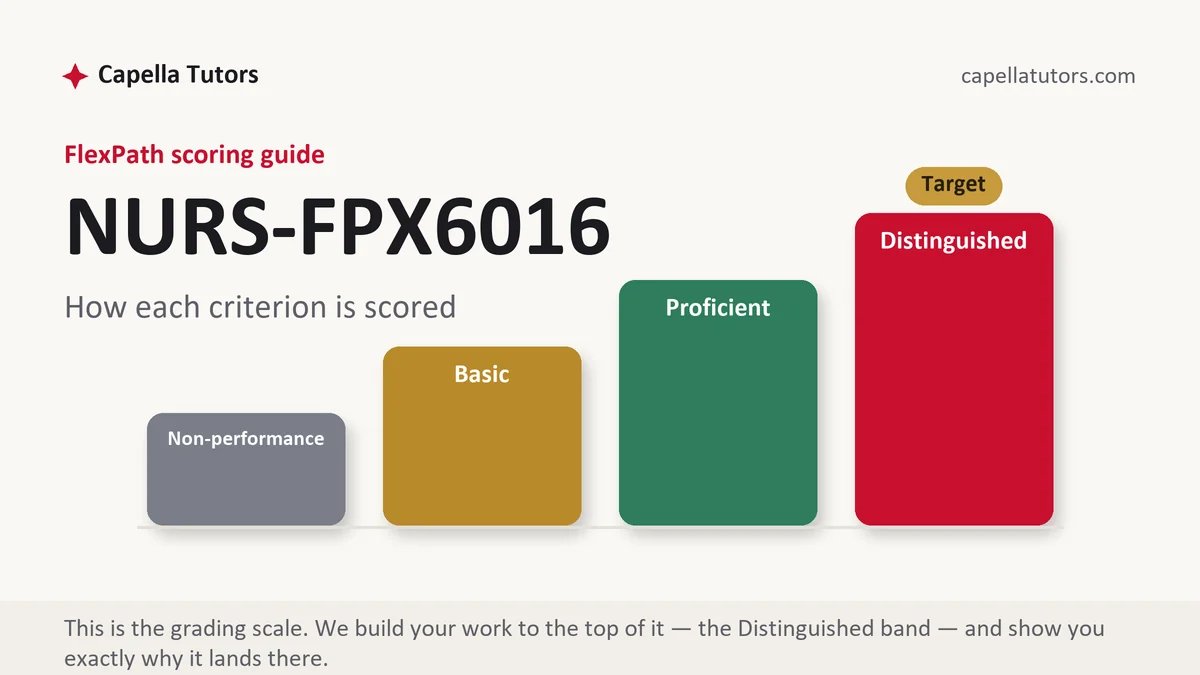
What NURS FPX 6016 actually grades
This is the systems course. The grade turns on whether you can look at something that went wrong, or something that keeps going wrong quietly, and explain it without blaming the nurse who happened to be there. Adverse-event work at master's level means tracing a sequence: what conditions made the error available, which handoff dropped information, which policy existed but was unfindable at two in the morning. Reviewers are watching for whether your analysis reaches system causes or stops at human error, because the Distinguished descriptions are written around the first and Basic collects everything that stops at the second.
Then the course asks for the other half, the part most drafts underbuild. An analysis without a plan earns nothing above Proficient. The assessments in this course usually want a quality improvement initiative attached to your analysis: a model that structures the change, measures that would prove it worked, a reporting rhythm, and named roles across professions. Your scoring guide decides how much of that lives in one deliverable, but the pattern holds. Findings, then a change, then the numbers that would settle whether the change did anything.
How we help in this course
Give us the prompt and the scoring guide and the draft returns in the register a safety committee uses: sequence of events stated in neutral language, contributing factors organized by category, a change plan mapped to a recognized improvement model, and a measure set with numerators, denominators, and data sources spelled out. Our research analyst pulls the safety literature and the agency material, so the argument leans on published incidence and recognized standards rather than on assertion.
The studio promise runs on every deliverable here: a premium original sample in 24 to 48 hours, aimed at the Distinguished column, built through our eight-person pipeline with two quality passes, then revised at no cost until it lines up with your guide.
Interprofessional is a graded criterion, not a garnish
The word sits in the course title for a reason, and drafts that treat it as decoration lose points they never see coming. Writing that the team will collaborate more closely satisfies nothing. What scores is specific: pharmacy owns the reconciliation step at admission, respiratory therapy is paged by a defined trigger rather than by judgment, the hospitalist signs the discharge summary before the nurse begins teaching, and the escalation path names who is called when the first call goes unanswered. Accountability written to that level is auditable, and auditable is what the top column keeps asking for in different words.
The second move is naming the friction honestly. Interprofessional plans fail on predictable ground: competing priorities during rounds, a pharmacist covering three units, a physician group that does not attend nursing huddles, an electronic record where one discipline cannot see another's notes. A plan that anticipates two of those and says how it survives them reads as written by someone who has worked a floor. A plan that assumes goodwill reads as written by someone who has not.
The assessments, one by one
Assessment 1
Send the criteria and tell us which event you are working from, and a premium original sample arrives inside 24 to 48 hours, aimed at the top of the guide and revised free until it lands there. Read the full Assessment 1 manual.
Assessment 2
Give us the prompt and the initiative you have been assigned to look at, and a premium original sample comes back within 24 to 48 hours with its criterion walkthrough, revised free until your guide is satisfied. Read the full Assessment 2 manual.
Assessment 3
Upload the criteria and whatever data set your courseroom supplied, and a premium original sample arrives inside 24 to 48 hours, written to the Distinguished column with free revisions until it fits. Read the full Assessment 3 manual.
How to actually write NURS FPX 6016: where to begin
Pull the scoring guide first and turn it into your document skeleton, one heading per criterion with the Distinguished language sitting underneath as an instruction to yourself. Quality improvement criteria are unusually literal. When one says analyze the factors that contributed to the event, it expects factors, plural, sorted, each connected to the event by a stated mechanism. When another says evaluate the outcome measures, it expects judgment about whether those measures can actually be collected. Answer the verb that is written, not the topic you assume is behind it.
Choose the problem before you write, and choose one with a measurable failure. Medication administration errors, central line infections, patient falls with injury, missed sepsis recognition, readmission inside thirty days, wrong-site procedures: each has published incidence, recognized prevention practice, and a metric your reader already knows. Then find the numbers before drafting. Agency for Healthcare Research and Quality material carries national rates and safety-practice evidence, the Institute for Healthcare Improvement supplies the improvement method and change concepts, and Joint Commission standards and safety goals give you the compliance layer that makes a recommendation sound obligatory rather than optional.
Only then write the analysis, and keep it structurally separate from the plan. Two habits protect the grade. Order the event as a timeline before you interpret it, because interpretation written on top of a muddled sequence never becomes convincing. And keep the language systemic throughout, conditions and processes and handoffs, so no criterion can be read as blame narrative. When the analysis is clean, the improvement plan almost writes itself: each contributing factor you identified needs a change aimed at it, and every change needs a measure that would move if the change worked.
| Section | What goes in it | What Distinguished looks like |
|---|---|---|
| Event or problem summary | What happened or what keeps happening, in neutral sequence, with the harm named. | A timeline a stranger could follow, de-identified, with the harm category and its published incidence. |
| Contributing factors | The system conditions behind the event, sorted rather than listed. | Factors grouped by category, each tied to the event by a stated mechanism, no individual blamed. |
| Improvement model and plan | The QI model chosen, its phases, and what changes in the workflow. | Plan phases that actually follow the model named, with a first test small enough to run. |
| Measures and reporting | Outcome, process, and balancing measures, with sources and intervals. | Every measure has a numerator, a denominator, an owner, a baseline, and a target. |
| Interprofessional roles | Which profession does what, and where escalation goes. | Accountability by role and trigger point, with the predictable friction named and answered. |
Developing the synthesis
Quality improvement synthesis is an argument about transferability, and that is where most drafts go thin. You will find studies that report a bundle cutting infection rates in academic intensive care units, and a report that the same bundle stalled in community hospitals where staffing ratios differed. Putting both on the page and moving on is Basic. Distinguished work adjudicates: the effect is real, the mechanism is the reduction in line-access episodes, and that mechanism survives lower staffing only if the audit step is automated rather than added to a charge nurse's shift. Now the evidence has told you something about your own plan. Build the same tension into the measure discussion, since process measures are easy to collect and prove little on their own, while outcome measures prove much and move slowly, and saying which trade-off you accepted and why is analysis a reviewer can award. Close by naming what the evidence cannot settle, usually whether an improvement holds after the attention fades, and say what in your plan is meant to keep it in place.
Citations that survive faculty review
This course runs on two source layers, and strong papers keep them visible. Peer-reviewed studies come through the Capella library from CINAHL and PubMed, with Cochrane reviews where an intervention has been reviewed, generally inside a five-year window. Agency and standards material supplies the rest: the Agency for Healthcare Research and Quality for national rates and safety practices, the Institute for Healthcare Improvement for improvement method, the Joint Commission for accreditation standards and national patient safety goals. Cite agency documents as the reports they are, in APA 7, with the publication or update year rather than the day you retrieved them, and check that your version is the current one, because these bodies revise and an outdated standard is a visible error. Give each source a task in the argument, one establishing the incidence, one justifying the intervention, one defining the standard you are held to, and drop the rest.
The mistakes that land Basic instead of Distinguished
- An analysis that ends at human error, which no amount of later planning repairs.
- A named improvement model followed by a plan whose steps do not match its phases.
- Measures with no numerator, no denominator, and no data source, so nobody could collect them.
- Only outcome measures, with no process measure to show whether the change was even carried out.
- Interprofessional collaboration asserted as a value rather than assigned as a duty with a trigger.
- Identifiable details from a real event, which risks a professionalism problem on top of a scoring one.
- A dashboard section that shows what would be displayed but never says who reviews it, or when.
NURS FPX 6016 questions students actually ask
Can I use an event from my own hospital?
Yes, and it usually produces the strongest paper, provided you strip it down to the system facts. No names, no unit identifier, no dates precise enough to locate the case, no detail a colleague could use to recognize a patient or a coworker. Write the sequence, the contributing conditions, and the harm category, and leave everything else out. If you would rather not touch a real case at all, a composite built from a documented event type carries the same analytic weight, because the criteria grade your reasoning about causes, not your access to an incident report.
Which quality improvement model should I use?
Whichever one your scoring guide names, and if it names none, pick by the shape of your problem and say why in a sentence. Plan-Do-Study-Act fits a small change you intend to test and adjust on a real unit. Lean fits waste, delay, and steps that add nothing. Six Sigma and DMAIC fit variation in a process that already has usable data. What loses points is naming a model in one paragraph and then writing a plan that does not follow its steps, because evaluators check whether the phases in your plan match the model you claimed.
What makes the measures and dashboard section score well?
Three things. Each measure states its numerator, its denominator, and where the number comes from, so a quality analyst could pull it. The set covers more than one type, an outcome measure paired with at least one process measure and a balancing measure that would reveal harm elsewhere. And every measure has an owner and a reporting interval, because a dashboard nobody reviews on a schedule is a table, not a control system. Add the target and the baseline and that criterion is finished.
In NURS FPX 6016 right now?
Upload the criteria and tell us which event or process you are analyzing. The first premium sample costs nothing and lands inside 24 to 48 hours.