Help for every MBA FPX 5002 deliverable lives on this page — a premium original sample with a walkthrough, back in 24 to 48 hours. The course itself: Core MBA Leadership, listed at 2 pts / 4 quarter credits in Capella’s MBA catalog, offered in FlexPath. In Capella's catalog the course code is written MBA-FPX5002.
What MBA FPX 5002 actually grades
The MBA opens with leadership self-assessment turned into strategy: instrument results, reflection, and a development plan argued like a business case. The criteria reward candor with structure, weaknesses named and costed, development actions with timelines and measures, and punish the résumé-polish tone most managers instinctively write in.
How we help in this course
Send your instrument results and a sketch of your role; the draft returns as a development case a board would respect, reflective where the rubric wants it and ruthlessly concrete where it counts. It sets the analytical register the rest of the core will keep demanding.
Every deliverable in the course follows our standard promise: a premium original draft in 24 to 48 hours, written to the Distinguished column on FlexPath or the A rubric row on GuidedPath, through the eight-person pipeline with both QA passes, revised free until it meets target.
Assessment manuals for this course
Every assessment in MBA FPX 5002 has its own manual now: the walkthrough, the structure that maps to the criteria, an annotated sample excerpt, and the done-for-you door. Open Assessment 1, Assessment 2, Assessment 3, or start from the list in the sidebar.
In MBA FPX 5002 right now?
Send the assessment number and the scoring guide from your courseroom. First premium sample free, back in 24 to 48 hours.
The register this course is quietly setting
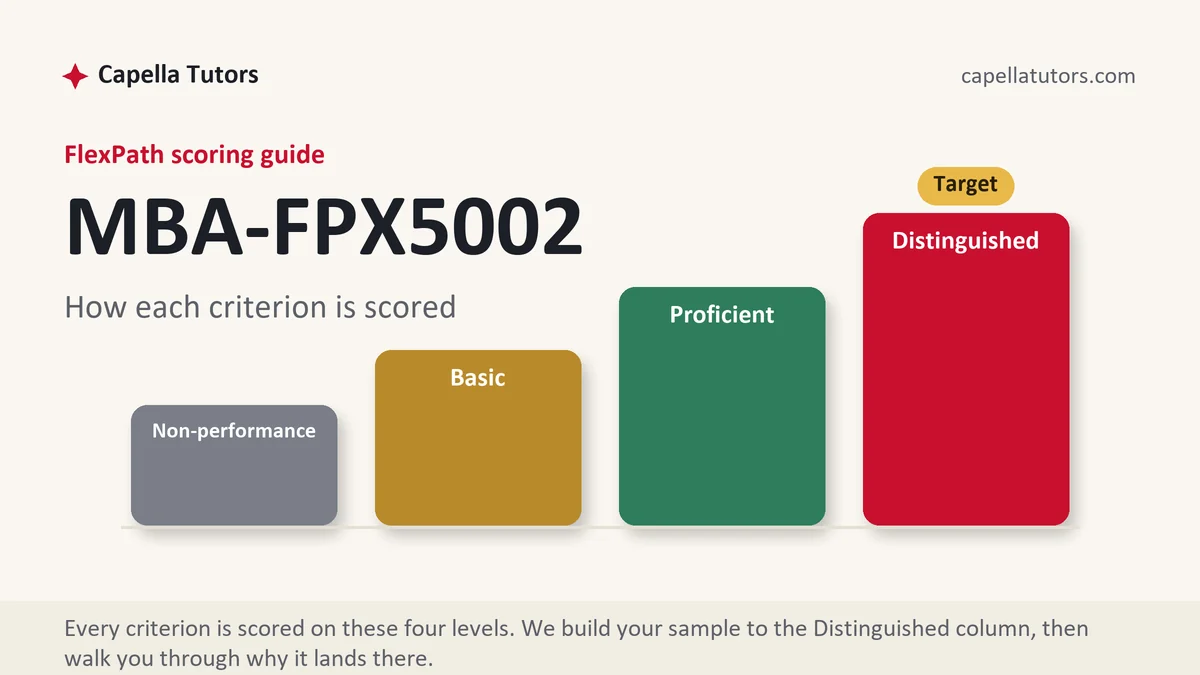
As the MBA's opening move, 5002 establishes the analytical voice every core course after it will demand: candor with structure. The scoring guides reward weaknesses named and costed, development actions with timelines and measures, and they mark the polished-résumé tone most managers default to as Basic, because self-promotion summarizes where the criteria ask for analysis. A draft that treats your own leadership data the way a consultant would treat a client's is what Distinguished looks like here, and it sets a register you will reuse through the entire core.
What to send so the scope lands same day
Three inputs: your assessment instrument results, a sketch of your current role, and the scoring guide from the courseroom. The reply maps criteria to sections, flags where the Distinguished extras belong, and quotes the 24 to 48 hour delivery slot. This is a FlexPath course, so there is no external deadline to race, only the submit-evaluate-next loop that keeps your 2-point course closing inside the flat-rate session.
Is it worth using help on a reflective assessment?
Reflection is the content; structure is the grade. The draft supplies the case architecture, your instrument data supplies the substance, and the walkthrough shows how the two meet each criterion.
What does the free first draft prove?
That business writing to a scoring guide is a learnable genre: read the sample against the columns and the method is visible on every page. Keep it; the register maps onto every later core course.
The assessments, one by one
Assessment 1: Critical Thinking in Action
Analyze how leaders at real companies used, or failed to use, critical thinking in a business situation. Read the full Assessment 1 manual.
Assessment 2: Defining Yourself as a Leader
Analyze your top leadership strengths from the course's strengths assessment with workplace examples, and write a personal leadership statement. Read the full Assessment 2 manual.
Assessment 3: Using Stories to Build Relationships
Explain why storytelling matters for leaders, how it builds trust, morale and engagement, and tell a leadership story of your own. Read the full Assessment 3 manual.
How to actually write MBA FPX 5002: where to begin
Start with the scoring guide, not the assessment instructions. In the courseroom, open the assessment, download the scoring guide, and rebuild it as your outline, one section heading per criterion, the Distinguished description parked underneath. That outline is the paper; the instructions only supply the scenario and the format. Students who begin with the instructions write an essay about leadership, students who begin with the guide write a document built to be graded, and in FlexPath those are different documents.
Then gather the raw material this course runs on. A typical 5002 assessment is built from three inputs: your results from a leadership self-assessment instrument, a leadership model from the course readings, and a workplace scenario, usually your own. Pull the instrument results out as numbers, not impressions. Note which model the courseroom features, transformational, servant, situational, or another, and list its named components, because the components become your analytical categories. Sketch the scenario in five sentences: the organization, your role, the problem, who was involved, what happened. With those three inputs in front of you, every criterion in the guide has raw material waiting.
The register matters as much as the structure. 5002 grades candor with structure: weaknesses named plainly and tied to consequences, development actions with dates and measures. The polished self-portrait most managers default to reads as Basic here, because self-promotion is summary and the criteria ask for analysis. Write about your own leadership data the way a consultant would write about a client's.
| Section | What goes in it | What Distinguished looks like |
|---|---|---|
| Introduction | The model you are using, the scenario, and a one-sentence claim about your leadership profile. | A thesis about yourself, not an announcement of topics. |
| Self-assessment results | Instrument scores reported against the model's named components. | Scores interpreted, not just reported: what a low score on one component predicts in practice. |
| Application to the scenario | Your leadership behavior in the workplace situation, read through the model. | The model explains what happened, including the parts that went badly. |
| Strengths and gaps | Both, with evidence from the instrument and the scenario. | Each gap tied to a business cost: a decision delayed, a team member lost, a result missed. |
| Development plan | Actions, timelines, resources, and measures for each named gap. | Every action has a date and a measure someone else could verify. |
Developing the analysis
Run the model instead of describing it. A paragraph explaining that transformational leadership has four components is Basic, a paragraph scoring yourself against each component with instrument evidence is Distinguished. The move is the same in every section: name the component, state your evidence, draw the conclusion the evidence supports. Quantify where the material allows it. An instrument percentile, a team turnover figure, a project that ran six weeks late under your watch, these give the development plan something to fix and the evaluator something to verify. Then close the loop: every gap named in the analysis must reappear in the development plan with an action attached, and every section should open by answering its criterion in the first sentence, because evaluators read criterion by criterion, not page by page.
Citations that survive faculty review
Leadership is a heavily published field, so thin sourcing is a choice the guide will notice. The working standard: peer-reviewed sources from roughly the last five years, each doing named work for a specific criterion, the model's components cited to the scholars who defined them, and any claim about what a leadership behavior produces backed by a study, not an intuition. Integrate citations into argument sentences, author and date inside the claim, rather than parking them at paragraph ends. Find sources through the Capella library rather than open search: ABI/INFORM and the business databases return the peer-reviewed leadership literature evaluators expect. The self-assessment instrument itself gets cited too, and so does the model's source text.
The mistakes that land Basic instead of Distinguished
- Writing the résumé instead of the analysis. Strengths polished and weaknesses softened reads as summary, and the candor criteria are where 5002 separates its levels.
- Describing the leadership model without applying it. The components must score your data, not fill a background section.
- A development plan without measures. Improving communication is a wish; a named action with a date and a verifiable measure is a plan.
- A generic scenario. If the workplace situation could belong to anyone, the application sections have nothing specific to analyze.
- Instrument results reported but never interpreted. Numbers on the page are description; what they predict about your leadership is the analysis.
MBA FPX 5002 questions students actually ask
Do I really have to write about my weaknesses?
Yes, and it is the highest-scoring thing you can do. The criteria reward candor with structure: a weakness named, evidenced from your instrument results, costed in business terms, and answered in the development plan. Evaluators read hedged self-portraits every week and mark them Basic, because a paper that finds nothing to develop has no development plan to grade.
Which leadership model should I build the paper around?
The one your courseroom readings feature; when the choice is open, pick a model with distinct named components, because the components become your section structure and your scoring categories. A model you can score yourself against beats a model you admire. State the choice in the introduction and cite the model's source, then stay inside it, since switching frameworks mid-paper reads as not having run any of them.
Can I use a workplace scenario where I failed?
It is usually the stronger choice. A scenario that went badly gives the model something to explain, gives the gaps section its evidence, and gives the development plan its purpose. The guide does not grade the outcome of the story, it grades the quality of the analysis, and failure analyzed honestly outscores success described proudly.