This manual is for BUS FPX 4801 Assessment 1, start to submission. Issue Identification asks you to identify an ethical issue in the workplace: the kinds of policies organizations use to address ethical issues, an example of unethical behavior you have seen or researched, why it is a problem for the organization and its people, and what policy would address it, often in a short paper with an abstract. The grade turns on a precise, well-supported issue. A specific example with its consequences scores above general statements about ethics. Below is the method our tutors use, a structure that maps to the criteria, and an annotated sample excerpt. Prefer to hand it off? A premium original sample for this exact assessment comes back in 24 to 48 hours, revised free until it meets the guide. Capella's catalog lists the course as BUS-FPX4801, and some courserooms print BUS4801; both point to this same Assessment 1. In current courserooms this assessment typically appears as "Issue Identification".
One honesty note before the manual: Capella revises courses and scoring guides over time, so always write to the exact scoring guide attached to your assessment in the courseroom. The course identity above is verified on capella.edu; the method and structure below are our tutors' approach to it, not Capella's official rubric text.
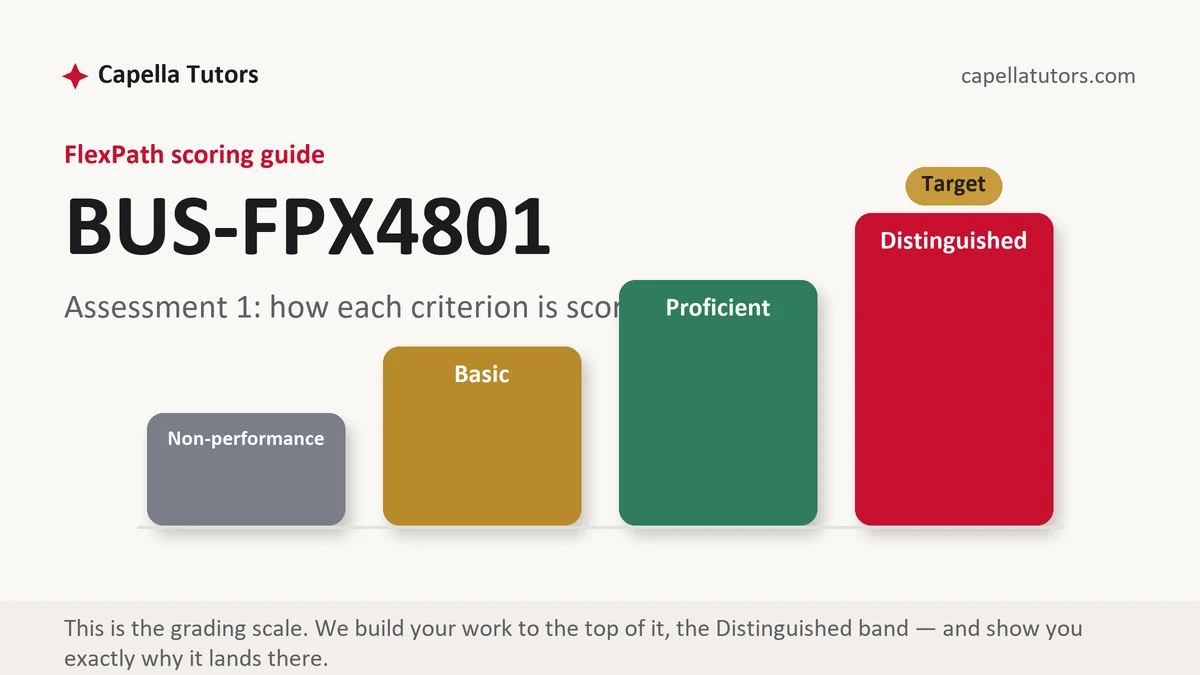
How BUS FPX 4801 Assessment 1 is scored
FlexPath does not use letter grades. Each criterion in the scoring guide lands on one of four levels, and the level descriptions are the real writing brief:
| Level | What it means on a ethical issue paper |
|---|---|
| Distinguished | The ethical issue paper is specific to the organization or case, applies course concepts accurately with credible sources, and ends in justified conclusions or recommendations. |
| Proficient | The ethical issue paper is accurate, but the application or recommendations are general. |
| Basic | The ethical issue paper describes concepts with little application. |
| Non-performance | A required part of the ethical issue paper is missing. |
Use a de-identified example from experience or a documented case.
The BUS FPX 4801 Assessment 1 method, step by step
-
Describe workplace policies
Codes of conduct, conflict of interest and reporting policies.
-
Choose an example
A specific unethical behavior, de-identified.
-
Explain why it is a problem
Harm to people, trust, legal risk and performance.
-
Connect to policy
Which policy applies and where it fell short.
-
Support with sources
Research on workplace ethics.
-
Write an abstract
If your guide asks for one.
A structure that maps to the criteria
Word counts are planning targets our tutors use, not Capella rules; follow the length and format your scoring guide states.
| Section | What it must do | Guide |
|---|---|---|
| Abstract and introduction | Purpose. | ~75 words |
| Policies regarding ethical issues | Types of policies. | ~100 words |
| Example of unethical behavior | The example. | ~100 words |
| Why it is an issue and conclusion | Consequences, then references. | ~150 words |
Annotated sample excerpt
An original model excerpt from our team, written to show the register that reaches the top of the guide. Learn the moves, then write your own version.
When a manager regularly approved overtime for friends while denying it to others, the cost went beyond the extra payroll.1 Employees who were passed over concluded that effort did not matter, two of them left within the year, and the pattern exposed the company to discrimination claims if the favored group shared a protected characteristic.2 A conflict-of-interest policy existed but had no review step for overtime approvals, which is the gap a policy fix would need to close.3
- 1Describes the behavior concretely.
- 2Traces its consequences for people and the organization.
- 3Connects it to a policy gap.
The full premium sample for your exact assessment, written fresh to your scoring guide and topic, is free to request. Study it, revise it into your own voice, and submit work you understand.
The five mistakes that cost Distinguished
- Definitions without application. Apply each concept to the organization or case.
- No sources. Cite credible business sources.
- Vague recommendations. Make them specific and justified.
- A vague issue. Use a specific example.
Pre-submission checklist
- Policies described
- Specific example
- Consequences explained
- Policy connection
- Sources
- Abstract if required
Want the ethical issue paper written?
Send the scoring guide and any materials from your courseroom. Our team returns a premium original ethical issue paper in 24 to 48 hours, revised free until it meets the guide.