This manual is for BUS FPX 4070 Assessment 2, start to submission. A middle assessment in this course usually asks you to compute and interpret the cost of capital. The assessment usually wants each component estimated with a named method and a stated source for every input, because the resulting rate is the number every other calculation in the course depends on. Delegation is on the table, and a premium original sample building the cost of equity component by component arrives inside 24 to 48 hours, with free revision until it clears. Capella's catalog lists the course as BUS-FPX4070, and some courserooms print BUS4070; both point to this same Assessment 2.
One honesty note before the manual: Capella revises courses and scoring guides over time, so always write to the exact scoring guide attached to your assessment in the courseroom. The course identity above is verified on capella.edu; the method and structure below are our tutors' approach to it, not Capella's official rubric text.
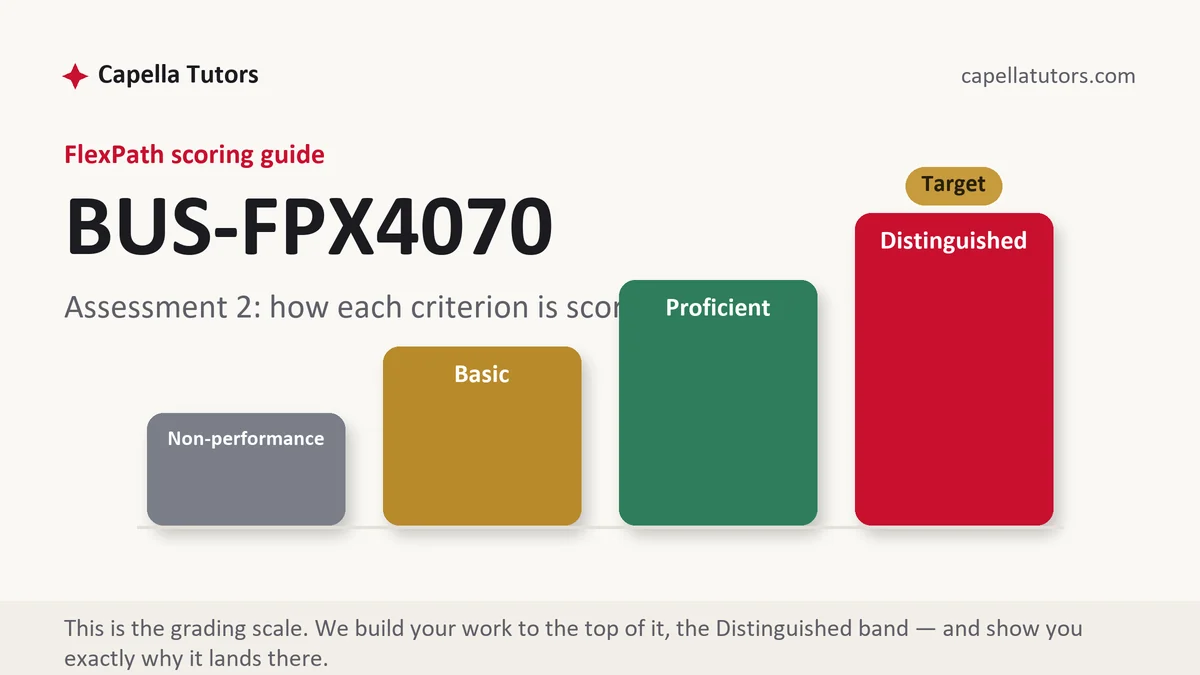
How BUS FPX 4070 Assessment 2 is scored
Each criterion is scored on its own at one of four levels, and the level wording is your specification:
| Level | What it means on a cost of capital deliverable |
|---|---|
| Distinguished | Each component estimated with a named method and a dated source, the result presented as a range, and the effect of the range on a downstream decision shown. |
| Proficient | The components estimated correctly and weighted properly. |
| Basic | A single rate produced to two decimal places with no source for its inputs. Where most first attempts at a discount rate land. |
| Non-performance | A required element absent, most often the cost of equity method or the weights. |
A paper stating a cost of equity to two decimal places without acknowledging the range is claiming a precision it does not have. The model has been questioned in the empirical literature for decades and the market risk premium is estimated differently by different sources, with a spread wide enough to change any conclusion built on it.
The BUS FPX 4070 Assessment 2 method, step by step
-
Turn the criteria into headings and list every input you will need
Risk-free rate, market risk premium, beta, any size premium, pre-tax cost of debt, the tax rate and the weights. Writing the list first stops the paper from reaching the end of a calculation and discovering an input was assumed.
-
Take the risk-free rate from published yields
The Treasury publishes daily yield curve rates, which is where a risk-free rate should come from rather than from a rounded number in a textbook. State the maturity you used and the date you retrieved it, because both change the figure.
-
Build the cost of equity from observable pieces and name each method
Start from the risk-free rate, add a market risk premium cited by source and date, scale it with a beta drawn from comparable public companies in the same industry, and add a premium for the additional risk of a smaller and less liquid business. Every step involves judgment and the paper should say so.
-
Get the cost of debt and the tax effect right
The pre-tax cost is what the company actually pays, available from its own schedule or from filings for a comparable, and the deduction reduces the effective cost. Multiply by one minus the tax rate and state which rate you used and why.
-
Weight by value, not by book
The weights are the proportions in which the firm is financed, and using book equity where market or estimated equity value belongs is a common and material error. Say what you used, and where an estimate was necessary, say how you produced it.
-
Present a range and run the decision at both ends
Vary the least certain input, usually the market risk premium or the beta, report the resulting band, and then run a project or a valuation at both ends to show whether the decision changes. Then grade every row yourself and submit early.
A structure that maps to the criteria
Planning targets our tutors use for a cost of capital deliverable, not Capella requirements; the guide attached to your assessment governs.
| Section | What it must do | Guide |
|---|---|---|
| Inputs and sources | Every input listed with its publisher, its date and the reason for the choice. | ~200 words |
| Cost of debt | The pre-tax rate, its source, the tax rate applied, and the after-tax figure. | ~220 words |
| Cost of equity | The method named, each component with its source, and the resulting figure. | ~300 words |
| Weights | The proportions used, whether market or estimated, and how any estimate was produced. | ~230 words |
| The rate and its range | The weighted figure, the band produced by varying the least certain input, and both ends. | ~250 words |
| Use and references | What the rate is for, whether a decision changes across the band, and current APA. | as needed |
Annotated sample excerpt
A model excerpt from our team showing a rate reported honestly as a band. Learn the structure, then rebuild it with the company and the inputs your criteria supply.
Debt of $6.2 million carries a pre-tax cost of 6.4 percent from the company schedule, which at a 24 percent tax rate is 4.86 percent after tax, and estimated equity value of $11.8 million gives weights of 34.4 percent debt and 65.6 percent equity.1 The cost of equity is built rather than observed: a 4.3 percent risk-free rate from the ten-year Treasury yield on a stated date, a 5.0 percent market risk premium cited to a published estimate with its date, a beta of 0.85 from three comparable public bakers, and a 3.0 percent premium for the additional risk of a smaller and less liquid business, which totals 11.55 percent and produces a weighted average of 9.25 percent.2 Reported honestly that figure is a band rather than a point, because moving the market risk premium across a plausible 4.5 to 6.0 percent range moves the weighted rate from about 9.0 to about 9.8 percent, and the fleet project in the previous section stays positive across all of it, which is the sentence that makes the estimate useful rather than decorative.3
- 1States the pre-tax cost with its source, applies the tax effect, and derives the weights from values rather than from book figures.
- 2Names four components, each with a source or a comparable basis, and says explicitly that the cost of equity is built rather than observed. Naming the method is what the criterion pays for.
- 3Converts the point estimate into a band, then tests a real decision at both ends. Showing that the decision survives the range is more useful than any single figure.
The full premium sample for your exact assessment, written fresh to your scoring guide and issue, is free to request. Study it, revise it into your own voice, and submit work you understand.
The five mistakes that cost Distinguished
- A rate quoted to two decimal places with no range. Every input is an estimate, and false precision is the error this material is written to catch.
- A risk-free rate taken from a textbook. Published yields are free and dated, and a rounded number from a chapter cannot be checked.
- Book equity used as a weight. The weights are the proportions in which the firm is financed by value, and book figures can be materially different.
- A market risk premium with no source. Different publishers estimate it differently, and the spread is wide enough to change any conclusion built on it.
- The rate produced and never used. A cost of capital exists to discount something, and a figure with no application answers half the row.
Pre-submission checklist
- Every input is listed with a publisher and a date
- The cost of debt is after tax, with the tax rate stated
- The cost of equity names its method and sources each component
- Weights are by value, with any estimate explained
- A band is reported and a decision is run at both ends
- Each number agreeing with the workbook behind it, APA checked in both directions
Cost of capital deliverable due?
Send the criteria and whatever company data you have, filings included. We take the risk-free rate from published yields, build the cost of equity component by component with dated sources, weight by value and report the result as a range with a decision tested at both ends. Back within 24 to 48 hours, with unlimited rework until every criterion is satisfied.