This manual is for BUS FPX 4070 Assessment 1, start to submission. An opening assessment in a foundations of finance course usually asks you to evaluate an investment. The assessment usually wants the cash flows identified correctly, the decision measures computed and compared rather than listed, and a recommendation aimed at somebody who has to act on it. Your scoring guide decides whether that arrives as a report, a memo, a workbook with commentary or a presentation. Or hand the model across: a premium original sample with the schedule laid out year by year lands inside 24 to 48 hours, revised free until the guide is satisfied. Capella's catalog lists the course as BUS-FPX4070, and some courserooms print BUS4070; both point to this same Assessment 1.
One honesty note before the manual: Capella revises courses and scoring guides over time, so always write to the exact scoring guide attached to your assessment in the courseroom. The course identity above is verified on capella.edu; the method and structure below are our tutors' approach to it, not Capella's official rubric text.
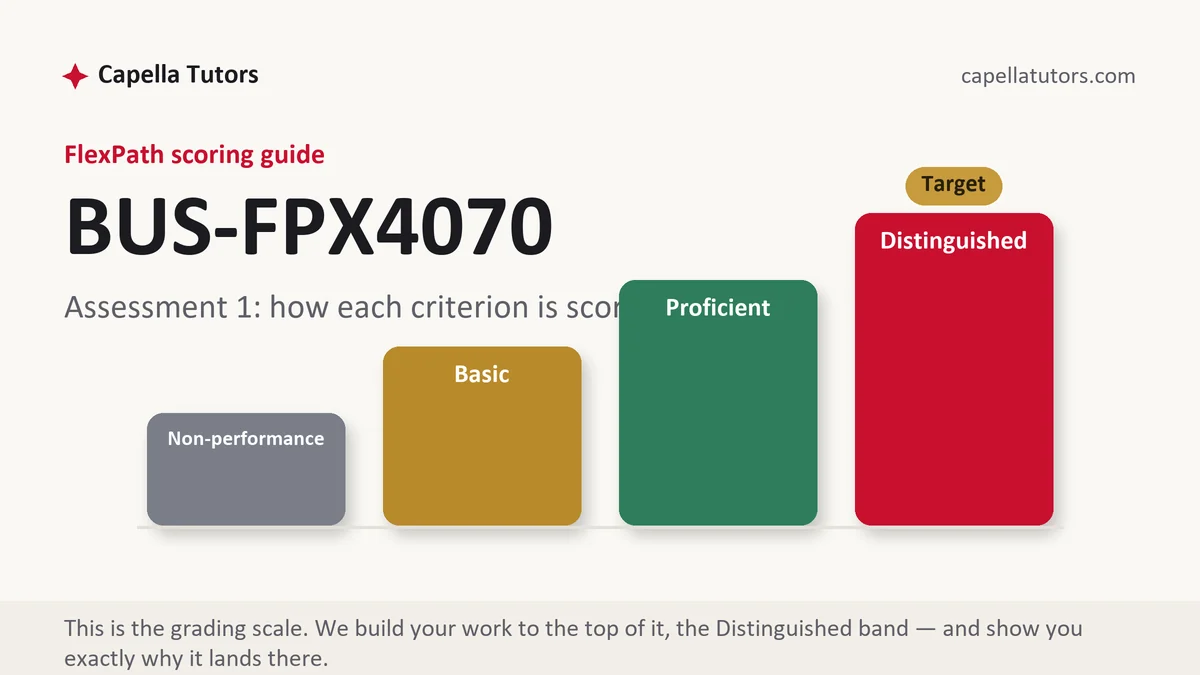
How BUS FPX 4070 Assessment 1 is scored
FlexPath results are recorded row by row and no letter is issued. Every row settles at one of four levels:
| Level | What it means on a capital budgeting deliverable |
|---|---|
| Distinguished | Measures compared with a stated reason for which one governs, a sensitivity test on the input the answer depends on, and a recommendation with the condition that would reverse it named. |
| Proficient | Cash flows built correctly and the measures computed accurately. |
| Basic | A net present value produced with no interpretation and no comparison. The commonest first attempt at an investment appraisal. |
| Non-performance | A required element absent, most often the sensitivity analysis or the recommendation. |
A learner who can compute the figure and cannot say what it means sits in the middle of every guide in this subject. A paper that ends with a figure and no sentence saying what the board should do has produced a number rather than an analysis.
The BUS FPX 4070 Assessment 1 method, step by step
-
Put every assumption on one page before computing anything
The discount rate, the project life, the tax rate, the treatment of working capital and any terminal value all belong there, with a source or a reason beside each. Stating them up front is what makes the rest of the paper checkable.
-
Get the cash flows right before worrying about the discounting
Use cash rather than accounting profit, which means adding back depreciation and accounting for the tax it shelters. Include working capital tied up at the start and released at the end, include salvage and the tax on it, and exclude financing costs because the discount rate already accounts for them.
-
Exclude sunk costs and include opportunity costs
Money already spent does not belong in the decision, and a resource the project consumes does even where no invoice is issued. The rental income foregone on a bay the vans will occupy is a real cost, and leaving it out overstates the case.
-
Lay the schedule out year by year with every line labelled
A cash flow schedule with named lines is the single most useful table in this kind of paper, because it lets a reader follow the arithmetic instead of trusting it. Keep the period and the rate on the same basis throughout.
-
Compare the measures and say which governs
Report net present value, internal rate of return and payback, then say which one decides and why. Value added in dollars handles projects of different sizes correctly; a percentage communicates the margin above the hurdle; payback is a liquidity check and never the primary rule.
-
Test the fragile input, then self-score
Identify the input the answer depends on most, usually the discount rate or the volume assumption, and show the result across a plausible range rather than at a single point. Then confirm every figure in the narrative matches the schedule, grade each row yourself, and submit early.
A structure that maps to the criteria
Word counts are our tutors' planning targets for a capital budgeting deliverable, not Capella rules; your scoring guide decides where the length goes.
| Section | What it must do | Guide |
|---|---|---|
| Assumptions | Discount rate, project life, tax rate, working capital treatment and terminal value, each with a source. | ~180 words |
| Cash flow schedule | Initial outlay, operating flows year by year, working capital, salvage and tax effects, labelled. | ~280 words |
| Decision measures | The value added in dollars, the return expressed as a rate, and the recovery period, all three worked and displayed. | ~280 words |
| Comparison | The measures set against each other, with a stated reason for which one governs. | ~230 words |
| Sensitivity | The input tested, the range examined, and whether the decision changes across it. | ~230 words |
| Recommendation and references | What the firm should do, what would reverse it, what to monitor, and current APA. | as needed |
Annotated sample excerpt
A model excerpt from our team, showing three measures compared rather than reported in a row. Read it for the arithmetic, then rebuild it with the project data your prompt supplies.
The outlay is $728,000 for fourteen vans plus $34,000 of working capital, and each year the project produces $178,080 of after-tax operating cash flow, being $196,000 of pre-tax savings less $121,333 of straight-line depreciation, taxed at 24 percent, with the depreciation added back.1 Discounted at the required return of 10.5 percent the six-year annuity factor is 4.2924, giving $764,244, and the year six terminal flow of $100,880, comprising $66,880 of after-tax salvage and the $34,000 of working capital released, adds $55,413, so against a total outlay of $762,000 the net present value is about $57,700 and the project adds value.2 The internal rate of return sits just under 13 percent and payback is about 4.3 years, and net present value governs the recommendation because it measures value added in dollars, while the useful thing the other two contribute is a margin of roughly 2.4 points above the hurdle and a warning that a required return of 13 percent would take the net present value to approximately zero without a single operating assumption changing.3
- 1Builds the operating cash flow from pre-tax savings, depreciation and tax in one sentence, so the reader can reproduce $178,080 rather than accept it.
- 2Shows the annuity factor, the terminal flow and its two components, then reconciles to the net present value. Every figure here can be checked with a calculator.
- 3Reports all three measures, states which governs and why, and converts the others into a margin and a fragility. Comparing rather than listing is what the top column describes.
The full premium sample for your exact assessment, written fresh to your scoring guide and issue, is free to request. Study it, revise it into your own voice, and submit work you understand.
The five mistakes that cost Distinguished
- A rate and a period on mismatched bases. A yearly rate used against monthly flows with no conversion throws the result out by a factor of ten or more.
- Accounting profit discounted where cash flow belongs. Depreciation moves no cash while the tax it shelters does, and net income runs the two together.
- Financing costs placed inside the project cash flows. Interest is already reflected in the discount rate, and putting it in the flows charges the project twice.
- One figure offered as the result with nothing tested around it. Each input is a judgment, and a conclusion with nothing varied around it conceals how easily it moves.
- Sunk costs included and opportunity costs left out. Money already spent is irrelevant and a resource consumed without an invoice is not, and drafts routinely get both backwards.
Pre-submission checklist
- Every assumption sits on one page with a source or a reason
- Cash flows are cash, with depreciation added back and financing excluded
- Working capital, salvage and the tax on salvage all appear
- All three measures are computed and one is named as governing
- A sensitivity range is shown on the input the answer depends on
- Every narrative figure matches the schedule, APA matched both ways
Investment appraisal due this week?
Send the project data, the statements and the criteria. The model is built in a spreadsheet with inputs on their own sheet, the schedule is laid out year by year, the measures are compared and a sensitivity table runs on whichever input the answer is most exposed to. Returned within 24 to 48 hours, and reworked without charge until the guide is fully met.