How to write BUS-FPX4068 Assessment 3

The short answer

This manual is for BUS-FPX4068 Assessment 3, start to submission. Assessment 3 in BUS-FPX4068, Contemporary Auditing Using Investigative Accounting Practices, usually asks you to investigate a suspected irregularity, which is a different exercise from an audit: the question is defined and narrow, the whole population gets tested rather than a sample, the documents have to be handled so they would still be usable later, and the report has to say what the evidence establishes and what it does not. Your guide decides whether the deliverable is an investigative report, a memo or a set of procedures with findings. Below is the way our tutors run an investigation on paper, a structure the criteria can be traced through, and an annotated sample excerpt. Want this one taken off your desk? Send the allegation and the data and a premium original sample comes back in 24 to 48 hours, revised free until the criteria are met. Your courseroom may print this as BUS FPX 4068 Assessment 3 or BUS4068 Assessment 3; it is the same deliverable, and BUS-FPX4068 Assessment 3 is what this manual walks through.

One honesty note before the manual: Capella revises courses and scoring guides over time, so always write to the exact scoring guide attached to your assessment in the courseroom. The course identity above is verified on capella.edu; the method and structure below are our tutors' approach to it, not Capella's official rubric text.
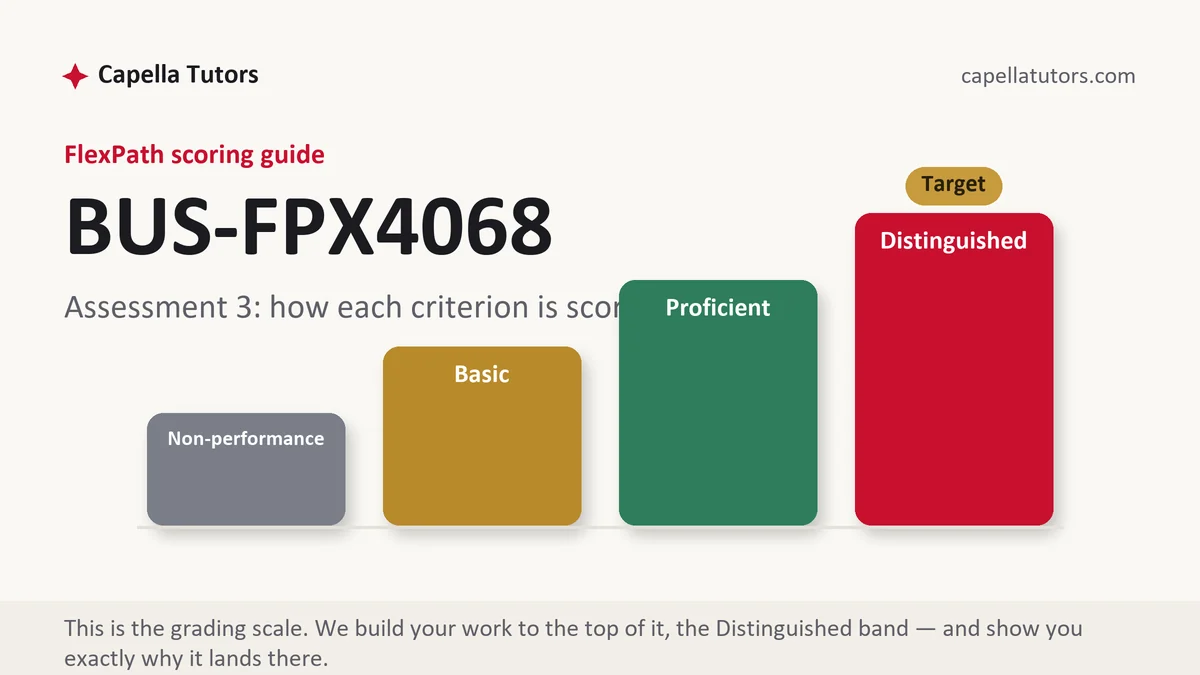
BUS-FPX4068 Assessment 3 grading scale at Capella FlexPath, the criterion levels this assessment is scored on, from Capella Tutors
How Capella FlexPath grades BUS-FPX4068 Assessment 3, visualized by Capella Tutors.

How BUS-FPX4068 Assessment 3 is scored

Each criterion returns at one of four FlexPath levels, and the level wording tells you what the section owes the reader:

LevelWhat it means on an investigative report
DistinguishedThe scope is stated as a question, the three conditions behind the suspected conduct are tied to facts in the scenario, the analysis runs the whole population with the arithmetic shown, and the report separates what the evidence establishes from what it only suggests before naming who must be told.
ProficientProcedures designed, findings reported and a conclusion reached. Competent work, one step below distinguishing proof from inference.
BasicThe fraud framework described in general terms with an assertion that the conduct probably occurred, and no population analysis. The most frequent first submission.
Non-performanceA finding reported with no reporting consequence, or investigative steps proposed with no trigger. A missing required element drops the criterion to the floor.

What separates this work from an audit is that concealment is assumed. Procedures built to find honest mistakes will not reliably find someone actively hiding something, which is why an investigation reaches for complete populations, for records the subject cannot edit, and for relationships between figures that should move together and did not. Sampling is a reasonable way to form an opinion on a set of statements and a poor way to answer a specific accusation.

The BUS-FPX4068 Assessment 3 method, step by step

  1. Rebuild the criteria as headings, then write the scope as a question

    One sentence: what are you being asked to establish, over what period, about which accounts or people. An investigation without a boundary expands until it finds something unrelated, and a stated scope is what lets you say at the end whether you answered it.

  2. Tie the three conditions to the facts you were given

    Pressure, opportunity and rationalisation are only useful when they are attached to something specific. Name the incentive visible in how someone is paid or measured, name the exact step in the process that lets one person act unchecked, and note any circumstance that would make the conduct feel justifiable to the person doing it.

  3. Say which mode you are operating in

    State clearly that this is an investigation with a trigger and not a routine audit procedure, because the criteria watch for students who propose investigative techniques with no indicator to justify them. If part of the work is audit and part is investigation, label each part where it appears.

  4. Test the whole population and look for concentration

    Run every transaction of the relevant type rather than a sample, then look for where they cluster: one person, one site, one time of day, one amount just under an approval limit, one customer with no verifiable address. Concentration against a fair expectation is the finding, and the arithmetic that demonstrates it belongs on the page.

  5. Handle the documents as though somebody else will read them later

    Record where each item came from, who provided it and when, keep originals unmarked, work from copies, and plan interviews in sequence so the person with the most to explain is not the first to know an investigation exists. Say all of this in the report, because the criteria treat it as part of the method rather than as housekeeping.

  6. Separate proof from inference, escalate, then self-score

    Write what the records establish, then write what they suggest but cannot settle, and keep the two in different sentences. Name who has to be told and why, remembering that the route changes when the person involved sits above the reporting line. Then read the report back against every criterion, assign it a level yourself, and rewrite the sections that do not reach Distinguished before you submit.

A structure that maps to the criteria

These word targets are how our tutors plan an investigative deliverable of this size, not Capella requirements; widen whichever section your own guide presses on.

SectionWhat it must doGuide word target
Scope and triggerThe question being answered, the period, and the indicator that started the work.~200 words
Conditions presentPressure, opportunity and rationalisation each tied to a named fact from the scenario.~250 words
Procedures performedThe populations tested, the fields analysed, and why complete testing replaced sampling here.~300 words
Findings and concentrationWhat the data shows, where it clusters, and the arithmetic that establishes the concentration.~300 words
Evidence handlingSource and custody of documents, interview sequencing, and the limits of what was available.~200 words
Conclusion, escalation and referencesProof separated from inference, who must be informed, next steps, and APA both ways.~250 words

Annotated sample excerpt

An original model excerpt from our team, showing what a population analysis reads like when the concentration is measured rather than alleged. Take the moves and rebuild them from your own data.

Sample excerpt: population analysis and concentration Original model · Capella Tutors

Rather than sampling, we extracted every late fee event across the five Ironwood Self Storage sites for the twelve months to 30 June, giving a population of 3,180 assessable fees of which 412 were waived, and we tested each waiver against the site, the user who entered it and the time of entry.1 The Denton Road site accounts for 21 percent of the company's occupied units but 268 of the 412 waivers, or 65 percent of them, and every one of those 268 entries carries the same user credential, giving a waived amount of 9,380 dollars at the standard 35 dollar fee.2 The records establish that the waivers were entered under that credential and that no supporting note exists for any of them, since the system permits a waiver without a reason field; they do not establish who was physically at the keyboard, and resolving that will require the site access log and an interview conducted after the log has been obtained.3

  • 1Complete population stated with its size and period, and the fields tested named. The first clause also explains why sampling was set aside, which is the distinction between this deliverable and an audit plan.
  • 2Concentration measured against a fair expectation, with the share, the count and the dollar value all shown. Twenty-one percent of units producing sixty-five percent of waivers is the finding, and the comparison is what makes it one.
  • 3Proof and inference in separate clauses, then the next procedure named in the right order. Saying what the evidence cannot yet settle is the mark of professional scepticism that the top level describes.

The full premium sample for your exact assessment, written fresh to your scoring guide and issue, is free to request. Study it, revise it into your own voice, and submit work you understand.

Get the full sample free

The five mistakes that cost Distinguished

  • A sample used to answer a specific allegation. Concealed activity hides in the items a sample misses, and the whole population is usually available in the system anyway.
  • The three conditions described in the abstract. Pressure and opportunity are only findings when attached to a named incentive and a named step in the process.
  • Concentration asserted without a comparison. A count means nothing until it is set against what a fair share would have been, and the arithmetic has to appear.
  • Proof and inference written in the same sentence. Merging what the records establish with what they hint at overstates the finding and undermines everything around it.
  • No escalation route. Identifying an irregularity is half the professional obligation, and the report has to name who is informed, especially when the subject sits above the reporting line.

Pre-submission checklist

  • The scope written as a question, with the period and the trigger stated
  • Pressure, opportunity and rationalisation each tied to a fact from the scenario
  • The complete population tested, with its size and the fields analysed named
  • Concentration measured against a fair expectation, arithmetic shown
  • Document custody and interview sequencing described in the method
  • What the evidence establishes separated from what it suggests, plus the escalation route

Investigative report due?

Send the allegation, whatever transaction data the case supplies and the criteria. We write the scope as a question, tie the conditions to named facts, run the full population, measure the concentration and keep proof separate from inference. The first premium sample is free, and it is with you inside 48 hours.

Keep going

Online now