How to write BUS-FPX4068 Assessment 2

The short answer

This manual is for BUS-FPX4068 Assessment 2, start to submission. Assessment 2 in BUS-FPX4068, Contemporary Auditing Using Investigative Accounting Practices, usually asks you to evaluate controls, which means working out who in the operation can do what, deciding whether the design of the control could prevent or detect a misstatement at all, testing whether it actually operates, and saying what remains exposed once management can override the whole arrangement. Your guide decides whether the deliverable is a control evaluation, a memo to management or a working paper. Below is how our tutors work an evaluation like this, a structure the criteria sit inside, and an annotated sample excerpt. Prefer to work from a model? Send the scenario and a premium original sample comes back in 24 to 48 hours, revised free until the criteria are met. Your courseroom may print this as BUS FPX 4068 Assessment 2 or BUS4068 Assessment 2; it is the same deliverable, and BUS-FPX4068 Assessment 2 is what this manual walks through.

One honesty note before the manual: Capella revises courses and scoring guides over time, so always write to the exact scoring guide attached to your assessment in the courseroom. The course identity above is verified on capella.edu; the method and structure below are our tutors' approach to it, not Capella's official rubric text.
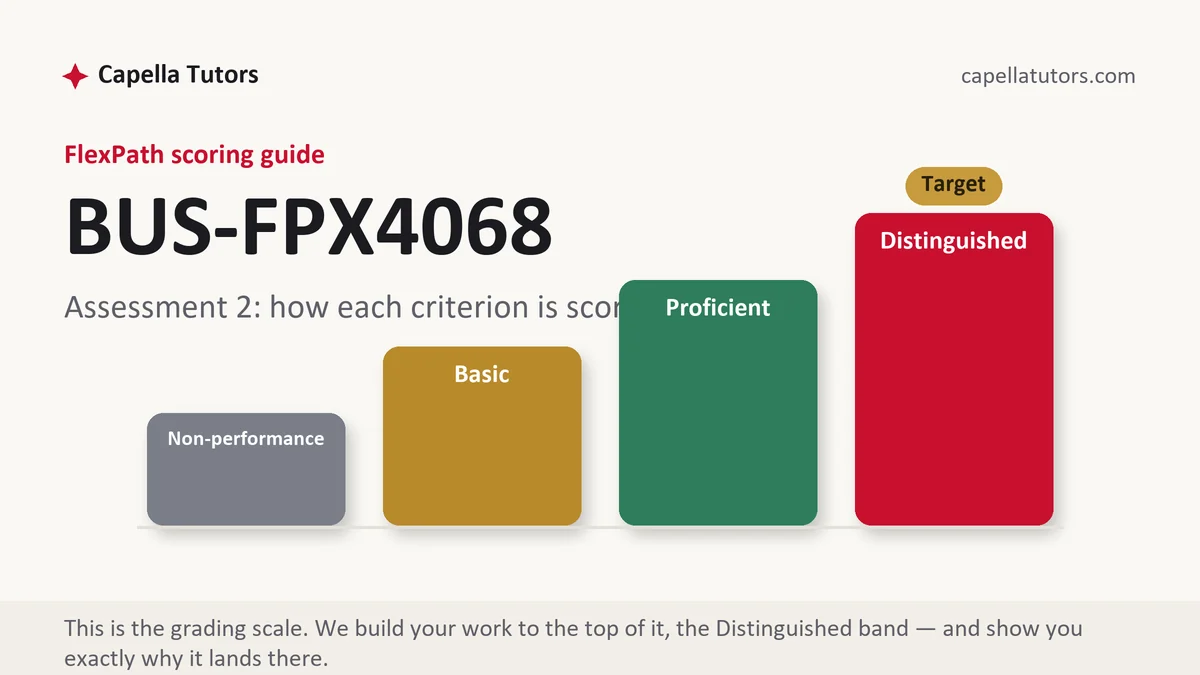
BUS-FPX4068 Assessment 2 grading scale at Capella FlexPath, the criterion levels this assessment is scored on, from Capella Tutors
How Capella FlexPath grades BUS-FPX4068 Assessment 2, visualized by Capella Tutors.

How BUS-FPX4068 Assessment 2 is scored

Four levels per criterion, no letter grade, and the level language is the specification for the section:

LevelWhat it means on a control evaluation
DistinguishedDuties are examined by who can perform which step rather than by job title, each control is judged on design and on operation separately, a deficiency is sized against what it could allow, and management override is addressed rather than assumed away.
ProficientThe controls are identified, weaknesses found and improvements recommended. Sound work, one step below quantifying the exposure.
BasicA list of the controls present and absent, with segregation of duties mentioned as a general principle. That is where most first submissions sit.
Non-performanceNo deficiency identified where the scenario plainly contains one, or no recommendation given. Absence floors the criterion however well the description reads.

Two distinctions carry most of the marks in this deliverable. The first is design against operation: a control can be perfectly conceived and never performed, and the two failures need different recommendations. The second is a deficiency against its consequence. Saying that one person handles cash alone is an observation. Saying what that person could remove before anybody would notice, and how much, is the finding, and the criteria are written to reward the second.

The BUS-FPX4068 Assessment 2 method, step by step

  1. Turn the criteria into headings, then map the transaction

    Follow one transaction from the moment value enters the business to the moment it lands in the bank and in the records, listing every point where a person touches it. The map is the evaluation. Controls assessed without one tend to be assessed against a checklist rather than against this business.

  2. Test segregation by function, not by job title

    The four functions to keep apart are authorising a transaction, having custody of the asset, recording it, and reconciling the record to the asset. Write each function against the individual who performs it, and where one name appears against three functions you have found the deficiency without needing to argue for it.

  3. Judge design before operation, and say which you are judging

    Ask first whether the control could catch the misstatement it is aimed at even if performed perfectly. Only then ask whether it is being performed, by whom, how often, and with what evidence. A control with no trace of having been carried out cannot be relied on, whatever the manual says.

  4. Find an independent figure and reconcile to it

    The strongest control test in a cash-handling environment uses a number the person handling the money cannot influence: a machine counter, a scale reading, a systems log, a third-party statement. Compare the independent measure to what was banked and show the difference. This is the single most productive procedure in the deliverable.

  5. Size what the deficiency could permit

    Estimate the exposure with arithmetic, whether that comes from the reconciliation gap you found or from the volume passing through the weak point over a period. A recommendation attached to a number gets implemented, and a recommendation attached to a principle gets filed.

  6. Address override, recommend, then self-score

    Say what an owner or manager with authority over the system could still do regardless of the controls beneath them, because that is why no control environment is complete. Recommend fixes that fit the size of the business, since a nine-employee operation cannot staff four separate functions and needs compensating measures instead. Then score yourself against the guide one criterion at a time, be honest about the rows sitting at Basic, and fix them before the file goes anywhere.

A structure that maps to the criteria

The word targets below are our tutors' planning figures for a control evaluation of this size and not Capella rules; stretch whichever section your own guide emphasises.

SectionWhat it must doGuide word target
The process mappedThe transaction traced from first receipt to bank and to ledger, with every person who touches it named.~250 words
Segregation by functionAuthorisation, custody, recording and reconciliation set against the individuals who perform them.~250 words
Design and operating effectivenessEach control judged twice, with the evidence that it is actually performed stated or its absence noted.~300 words
The independent reconciliationA figure the handler cannot influence, compared to what was recorded, with the gap computed.~250 words
Exposure and overrideWhat the deficiency could permit in dollars, plus what someone with system authority could still do.~250 words
Recommendations and referencesFixes proportionate to the size of the business, compensating measures, and APA both ways.~200 words

Annotated sample excerpt

An original model excerpt from our team, showing what a control finding reads like when it carries a reconciliation instead of an opinion. Take the moves and apply them to the process your own case describes.

Sample excerpt: reconciling to an independent count Original model · Capella Tutors

Every washer at the Suds Avenue Laundry site on Rossiter Street carries a non-resettable cycle counter, and the counters recorded 41,820 wash cycles for the year at a posted price of 4.25 dollars, which implies 177,735 dollars of wash revenue against coin deposits of 168,410 dollars, a shortfall of 9,325 dollars or 5.2 percent.1 The same attendant empties the coin boxes, counts the coin, prepares the deposit slip and performs the monthly comparison to the counter readings, which places custody, recording and reconciliation with one person and leaves nobody in a position to detect a difference except the person who would have caused it.2 The stored-value card system the owner is installing removes coin from three of those four steps and creates a processor record the attendant cannot alter, but it does not address the owner's own ability to issue promotional card balances without a second approval, and that is now the largest remaining exposure.3

  • 1An independent measure the handler cannot influence, converted to expected revenue, compared to what was banked, and the gap given in dollars and percent. This is the procedure that turns a suspicion into a finding.
  • 2Segregation tested by function against one named role, with the consequence spelled out in the second clause. Naming the functions rather than saying duties are not segregated is what the criterion is looking for.
  • 3The proposed remedy credited for what it fixes and then held to what it does not, ending on management override. A control evaluation that stops before override has left out the reason sound systems still fail.

The full premium sample for your exact assessment, written fresh to your scoring guide and issue, is free to request. Study it, revise it into your own voice, and submit work you understand.

Get the full sample free

The five mistakes that cost Distinguished

  • Segregation discussed as a principle. The criterion wants the four functions set against actual names, and a general statement about separating duties tests nothing.
  • Design and operation treated as one question. A well-designed control that nobody performs and a poorly designed one performed diligently need different fixes.
  • No independent figure used. Without a measure outside the handler's control there is nothing to reconcile to, and the evaluation rests on inspection of the paperwork that person prepared.
  • A deficiency with no exposure attached. Reporting that a weakness exists leaves management with no basis for deciding how urgently to fix it.
  • Management override omitted. Authority above the control layer is why otherwise sound systems fail, and an evaluation that ignores it is incomplete by construction.

Pre-submission checklist

  • The transaction mapped end to end with every person who touches it named
  • Authorisation, custody, recording and reconciliation assigned to individuals
  • Each control judged separately on design and on whether it is performed
  • An independent figure identified and reconciled to what was recorded
  • The exposure sized with arithmetic rather than described
  • Management override addressed, and recommendations scaled to the business

Control evaluation due?

Send the scenario, whatever process detail the case gives and the criteria. We map the transaction, test segregation by function against names, judge design and operation separately, reconcile to an independent figure and size the exposure. First premium sample free of charge, delivered within two working days.

Keep going

Online now