This manual is for BUS-FPX4068 Assessment 1, start to submission. Assessment 1 in BUS-FPX4068, Contemporary Auditing Using Investigative Accounting Practices, usually asks you to plan an audit area, which means setting materiality with a basis you can defend, assessing risk one assertion at a time rather than one account at a time, and designing procedures specific enough that somebody else could run them and reach the same conclusion. Your guide decides whether the deliverable is a planning memo, a set of procedures or both. Below is the planning order our tutors use, a structure each criterion answers to, and an annotated sample excerpt. Would rather not start from a blank page? Send the client scenario and a premium original sample comes back in 24 to 48 hours, revised free until the criteria are met. Your courseroom may print this as BUS FPX 4068 Assessment 1 or BUS4068 Assessment 1; it is the same deliverable, and BUS-FPX4068 Assessment 1 is what this manual walks through.
One honesty note before the manual: Capella revises courses and scoring guides over time, so always write to the exact scoring guide attached to your assessment in the courseroom. The course identity above is verified on capella.edu; the method and structure below are our tutors' approach to it, not Capella's official rubric text.
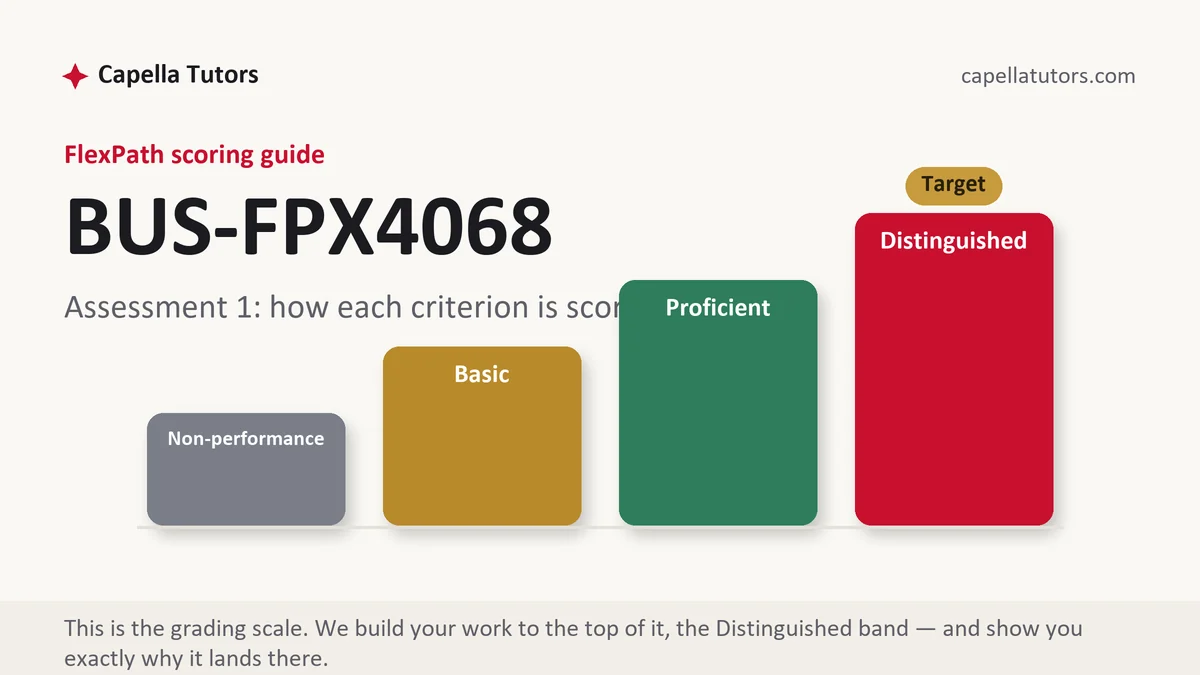
How BUS-FPX4068 Assessment 1 is scored
FlexPath scores each criterion at one of four levels and never issues a letter, and the level wording is the brief:
| Level | What it means on an audit plan |
|---|---|
| Distinguished | Materiality is computed from a base matched to the users of these statements, risk is assessed assertion by assertion with facts from the scenario behind each judgment, and every procedure names its population, its selection and what counts as an exception. |
| Proficient | Materiality set, risk assessed and appropriate procedures designed. Competent planning, one level below linking each procedure to a named assertion. |
| Basic | An account labelled high risk and a list of standard procedures underneath it. This is where the majority of first attempts land in this course. |
| Non-performance | No materiality figure, or procedures listed with no risk assessment to justify them. A missing element floors the criterion regardless of the rest. |
An audit never verifies everything and does not claim to, so a plan is a resource allocation against risk and it should read like one. Every hour you propose spending has to be answerable to a specific thing that could be wrong. That is why the assertion-level habit matters so much here: an account cannot be tested, but the claim that the entity owns what it lists, or that what it lists is worth what it says, can be.
The BUS-FPX4068 Assessment 1 method, step by step
-
Rebuild the criteria as headings, then name the users
Write down who reads these statements and what they are deciding, because materiality is defined by what would change their decision. A bank testing a covenant, an owner considering a sale and a grant funder checking compliance care about different things, and the base you pick should follow from that.
-
Set materiality with the arithmetic visible
Choose a base, apply a percentage, show the multiplication and say why that base suits this client. Then set a lower figure for designing individual procedures, so several small misstatements cannot aggregate past your overall number, and a much smaller threshold below which findings are treated as trivial and not accumulated.
-
Assess risk assertion by assertion
For each significant account, take the assertions one at a time and say which are at risk and which are not, with a fact from the scenario attached to each judgment. Stock held at a third-party site raises existence. A slow-moving range raises valuation. Strong receiving controls lower completeness. Written this way, the procedures write themselves.
-
Design procedures that answer the assertions you flagged
Match the test to the claim. Observing a count addresses existence, confirming with an outside party addresses existence and rights, tracing forward from source documents addresses completeness, and recalculation against market addresses valuation. A procedure that does not answer the assertion you assigned it to is a substantive error rather than a wording problem.
-
Write each procedure so a stranger could perform it
Name the population, how items are selected and how many, the source of the comparison data, what constitutes an exception and what happens when one appears. Test inventory valuation is not a procedure. The specific version of that sentence is four lines long and it is the criterion's actual target.
-
Rank the evidence, plan for control failure, then self-score
Say how strong each procedure's evidence is, remembering that what the auditor obtains directly beats what the client hands over and that external beats internal. Where you rely on a control, test it first and state your fallback if it fails. Then walk the guide criterion by criterion, put your own D, P, B or N against each one, and rebuild anything short of the top level before submitting.
A structure that maps to the criteria
These word targets are how our tutors plan an audit planning deliverable of this size, not Capella requirements; add to whichever section your own guide emphasises.
| Section | What it must do | Guide word target |
|---|---|---|
| Client, users and engagement risk | The business, its industry pressures, who relies on the statements, and any independence issue. | ~200 words |
| Materiality | The base, the percentage, the arithmetic, the procedure-level figure and the trivial threshold. | ~250 words |
| Risk at the assertion level | Each significant assertion rated, with a fact from the scenario supporting every rating. | ~300 words |
| Procedures designed | The tests, each tied to a named assertion, written with population, selection and exception defined. | ~350 words |
| Evidence quality and control reliance | How strong each procedure's output is, what is being relied on, and the fallback if a control fails. | ~200 words |
| Timing, staffing and references | What is done at interim against year end, who is competent to do it, and APA both ways. | ~200 words |
Annotated sample excerpt
An original model excerpt from our team, showing how planning reads once materiality carries arithmetic and risk is written at the assertion level. Take the moves and rebuild them from your own scenario.
Kestrel Ag Equipment is profitable and its statements are read primarily by the lender holding its floor-plan facility, so pre-tax income is the base a user would care about, and 5 percent of the 1,840,000 dollars reported gives overall materiality of 92,000 dollars, with 64,400 dollars used for designing individual procedures and findings under 4,600 dollars treated as trivial and not accumulated.1 Inventory of 6,300,000 dollars is the dominant balance, and the existence assertion is high risk because 940,000 dollars of it sits at four dealer lots the company does not staff.2 Valuation is separately high risk because the prior-year listing shows tillage units with no movement in eighteen months while the write-down judgment is made by the sales manager whose bonus is calculated on gross margin, and completeness is assessed as lower risk given that every unit arrives with a serialised manufacturer invoice matched by a second person on receipt.3
- 1The user named first, then the base chosen because of that user, then three thresholds with the arithmetic shown. A percentage applied without saying who cares about that base is a number rather than a judgment.
- 2One assertion, one rating, one fact from the scenario. Naming the consigned amount rather than saying inventory is high risk gives the procedure that follows something specific to answer.
- 3Two more assertions rated in opposite directions, including one rated lower with the control that justifies it. Being willing to call an assertion low risk is what shows the assessment was actually performed.
The full premium sample for your exact assessment, written fresh to your scoring guide and issue, is free to request. Study it, revise it into your own voice, and submit work you understand.
The five mistakes that cost Distinguished
- Risk assessed for an account rather than an assertion. Calling a balance high risk gives the procedures nothing precise to respond to, and the criteria are written at the assertion level.
- Materiality with no stated base or user. A percentage applied to a figure without saying who relies on it skips the reasoning the concept exists for.
- A procedure that tests something other than what it claims. Confirmation reaches existence and rights and never completeness, and mismatching the two is a real error.
- Procedures written in three words. Without a population, a selection basis and a definition of an exception, nobody could perform the test or repeat it.
- Controls relied on without being tested. A plan that assumes controls operate is a hope, and it needs a stated fallback for the case where they do not.
Pre-submission checklist
- The users of the statements named and used to justify the materiality base
- Overall materiality, a procedure-level figure and a trivial threshold all computed
- Every risk rating written at the assertion level with a scenario fact behind it
- At least one assertion rated lower, with the control that justifies it
- Each procedure tied to a named assertion and written so a stranger could perform it
- Evidence strength stated, and a fallback given for any control being relied on
Audit plan due?
Send the client scenario, whatever financial data the case gives and the criteria. We name the users, set the three materiality thresholds with the arithmetic, rate risk assertion by assertion and write procedures specific enough to be performed. Your first premium sample costs nothing and returns in 24 to 48 hours.