This manual is for BUS-FPX4065 Assessment 3, start to submission. Assessment 3 in BUS-FPX4065, Income Tax Concepts and Strategies, usually asks you to explain a treatment to a client, which is a different job from computing one: the reader is not an accountant, the conclusion has to be stated before the reasoning, the authority still has to be there, and the client needs to finish the document knowing what to keep in a drawer. Your guide decides whether that arrives as a memo, a letter or a short advisory report. Below is the method our tutors write these in, a structure the criteria can be walked through, and an annotated sample excerpt. Want a model of it first? Send the client's question and a premium original sample comes back in 24 to 48 hours, revised free until the criteria are met. Your courseroom may print this as BUS FPX 4065 Assessment 3 or BUS4065 Assessment 3; it is the same deliverable, and BUS-FPX4065 Assessment 3 is what this manual walks through.
One honesty note before the manual: Capella revises courses and scoring guides over time, so always write to the exact scoring guide attached to your assessment in the courseroom. The course identity above is verified on capella.edu; the method and structure below are our tutors' approach to it, not Capella's official rubric text.
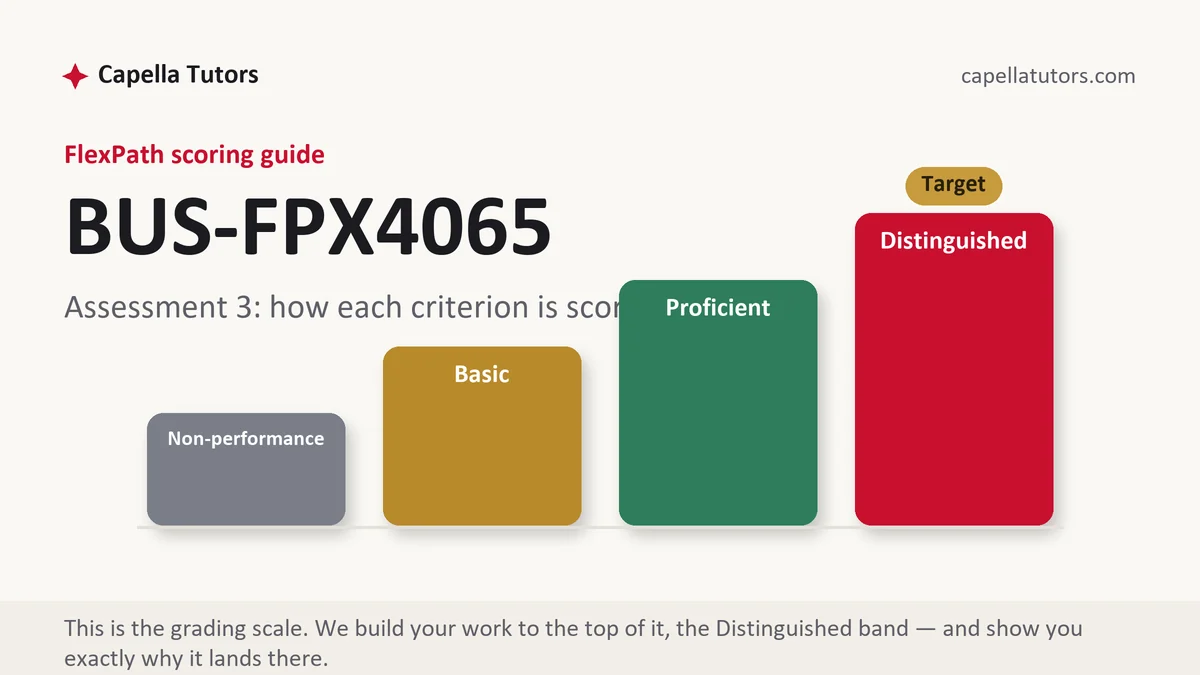
How BUS-FPX4065 Assessment 3 is scored
Each criterion returns at one of four FlexPath levels, and the level language is the brief for that section:
| Level | What it means on a client explanation |
|---|---|
| Distinguished | The answer comes first, the reasoning is traceable to authority without reading like a statute, the available methods are quantified so the client can see which is better, and the document names the records that have to exist for the position to hold. |
| Proficient | The treatment is explained correctly and supported. Clear work, and one step below telling the client what to do next. |
| Basic | An accurate summary of the rule with the client's actual question never directly answered, or answered in the last line. The common first attempt. |
| Non-performance | No conclusion given, or the explanation rests on nothing citable. An unsupported conclusion floors the criterion even when it happens to be right. |
The register is the hardest part of this deliverable and it is worth practising deliberately. A client memo written in statutory language is unreadable, and a client memo written with no authority behind it is worthless. What the criteria want is the middle: the conclusion in the first line, plain sentences carrying the reasoning, and a reference sitting quietly at the end of each operative point so a reviewer can check the work without the client having to.
The BUS-FPX4065 Assessment 3 method, step by step
-
Turn the criteria into headings, then write the client's question in their words
Restate what was actually asked in one sentence at the top, using the client's framing rather than a technical translation of it. If the question has three parts, number them and answer them in that order, because a memo that reorganises the question makes the client hunt for their own answer.
-
Answer in the first paragraph
Lead with the conclusion. A client reads the opening lines and skims the rest, and a memo that builds suspense before arriving at yes or no has misjudged its reader. Where the answer is conditional, say what it depends on in the same paragraph rather than saving the condition for page two.
-
Separate the facts you were given from the facts you assumed
Set out the facts as a short list, then state your assumptions separately and say that the conclusion depends on them. Any professional memo does this, and it protects the advice: if the mileage log turns out not to exist, everybody can see which part of the analysis just changed.
-
Explain the rule without quoting it
Paraphrase the operative rule in your own words and put the reference after it. Block quotations demonstrate that you located the provision rather than that you understood it, and a memo made of them reads as padding. Keep one short quotation in reserve for wording that genuinely cannot be paraphrased.
-
Quantify the choice where the rules offer one
Wherever a taxpayer may compute something two ways, compute it both ways and show the arithmetic, because the client's real question is usually which one leaves them better off. Note any constraint the first-year choice imposes on later years, since that turns a simple comparison into a decision with consequences.
-
Tell the client what to keep, then self-score
List the specific records the position depends on, whether that is a contemporaneous log, invoices, a written policy or a diary of business purpose. A legitimate deduction with nothing behind it fails on review exactly as an illegitimate one does. Then take the guide row by row, assign your own level to each criterion, rewrite whatever sits below Distinguished, and submit early enough that a second attempt still fits your week.
A structure that maps to the criteria
The word targets below are planning figures for a client document of this size, not Capella rules; lengthen whatever section your own guide leans on.
| Section | What it must do | Guide word target |
|---|---|---|
| The question and the answer | The client's question restated in their words, then the conclusion in the opening paragraph. | ~200 words |
| Facts and assumptions | What you were told, listed, then what you assumed, listed separately and flagged as such. | ~200 words |
| The rule, in plain words | The operative provision paraphrased, with the reference attached to each point it supports. | ~300 words |
| Applying it to these facts | The rule run against the client's situation, with the conditions that could change the answer named. | ~250 words |
| The methods compared | Both permitted computations worked with figures, plus any constraint the first-year choice creates. | ~250 words |
| Records and references | The documentation the position requires, the next step for the client, and APA both ways. | ~200 words |
Annotated sample excerpt
An original model excerpt from our team, showing what a client comparison reads like when both methods are worked instead of described. The per-mile figure stands in for whatever your stated year publishes; substitute the real one and cite it.
You asked whether the van you use for Marigold Staging Co. can be claimed in full, and the short answer is no, but the business share of it can, and on your figures the better of the two permitted methods gives you a noticeably larger deduction than the one you have been using.1 Your log shows 21,400 total miles for the year with 16,050 on staging jobs, which puts business use at 75 percent, so under the actual expense method your 9,860 dollars of fuel, insurance, servicing and registration supports a deduction of 7,395 dollars.2 Computed on the standard per-mile allowance published for the stated year instead, 16,050 business miles at 0.67 dollars a mile gives 10,753 dollars, roughly 3,358 dollars better, and the reason to raise it now rather than next year is that the method you choose the first year the van is in service limits which method you may use for it afterwards.3
- 1The client's question restated in their language and answered inside the first sentence, including the part they will not enjoy. Leading with no, but sets up the useful half of the advice immediately.
- 2The business percentage derived from the log rather than asserted, then applied. Showing the division is what lets a reviewer confirm the figure without asking for the workings.
- 3The second method computed, the two compared in dollars, and the timing constraint named. That final clause is the difference between reporting a rule and advising a client, and the criterion is written to find it.
The full premium sample for your exact assessment, written fresh to your scoring guide and issue, is free to request. Study it, revise it into your own voice, and submit work you understand.
The five mistakes that cost Distinguished
- The answer withheld until the end. A client memo states the conclusion first, and one that builds toward it has ignored how the document will actually be read.
- Assumptions folded in with facts. The advice depends on which is which, and a memo that blends them cannot show what changes if an assumption fails.
- The provision quoted rather than explained. Block quotations prove you found the text, and the criterion is asking whether you can render it in a sentence the client understands.
- A choice described instead of computed. Where two methods are permitted, the client wants both numbers, and naming the options without working them leaves the decision unmade.
- No substantiation section. A supportable position with no records behind it fails on review, and the memo has to say what the client keeps and for how long.
Pre-submission checklist
- The client's question restated in their own framing at the top
- The conclusion delivered in the opening paragraph, conditions included
- Facts and assumptions listed separately, with assumptions flagged
- Each operative point paraphrased with its reference attached
- Both permitted methods computed, with the arithmetic on the page
- The specific records the position depends on named, plus the next step
Client memo or letter due?
Send the client's question, the facts you were given and the criteria. We answer in the first paragraph, separate assumptions from facts, paraphrase the authority with references attached, compute every permitted method and list the records the position needs. The opening premium sample is free of charge.