This manual is for BUS-FPX4065 Assessment 2, start to submission. Assessment 2 in BUS-FPX4065, Income Tax Concepts and Strategies, usually asks you to evaluate a planning option, which means modelling the taxpayer's position under each available path, putting a dollar figure on the difference, subtracting what the better path costs to comply with, and then saying whether the saving survives. Your guide decides whether the output is a memo, a comparison schedule or a recommendation letter. Below is how our tutors put the comparison together, a structure with a section per criterion, and an annotated sample excerpt. Prefer somebody else ran the numbers? Send the facts and the option on the table and a premium original sample comes back in 24 to 48 hours, revised free until the criteria are met. Your courseroom may print this as BUS FPX 4065 Assessment 2 or BUS4065 Assessment 2; it is the same deliverable, and BUS-FPX4065 Assessment 2 is what this manual walks through.
One honesty note before the manual: Capella revises courses and scoring guides over time, so always write to the exact scoring guide attached to your assessment in the courseroom. The course identity above is verified on capella.edu; the method and structure below are our tutors' approach to it, not Capella's official rubric text.
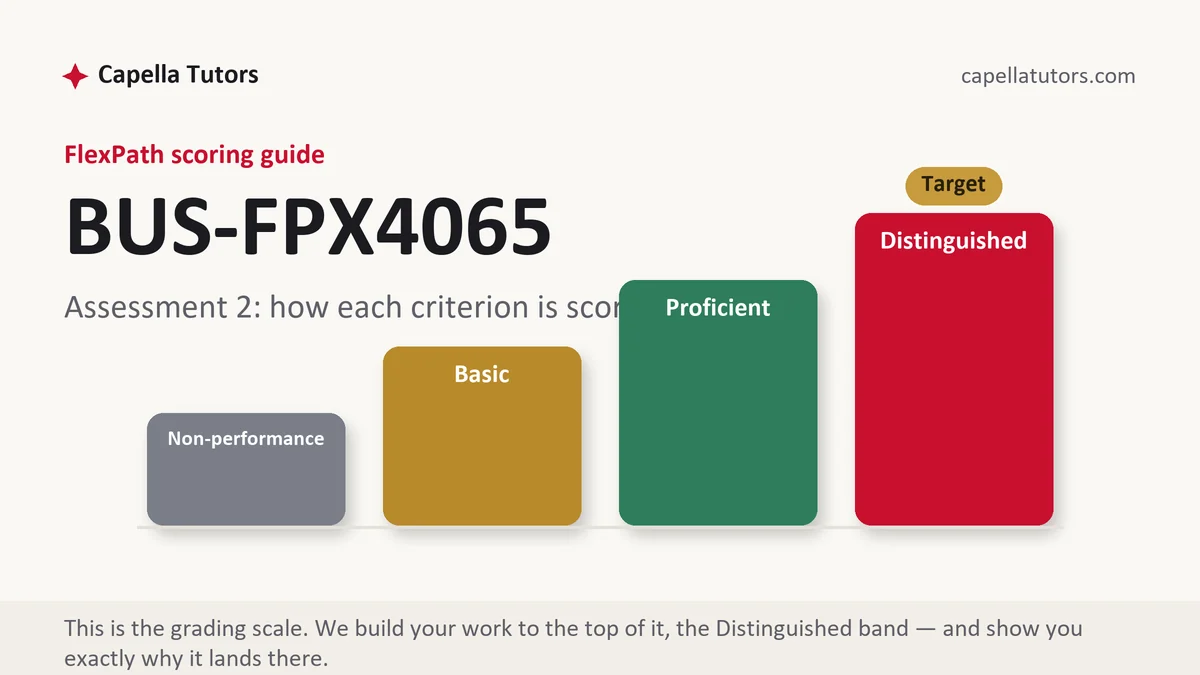
How BUS-FPX4065 Assessment 2 is scored
Levels rather than letters come back from FlexPath, four of them per criterion, and the wording of the level is the instruction:
| Level | What it means on a planning evaluation |
|---|---|
| Distinguished | Both paths are modelled with figures, the difference is quantified, the compliance cost of the better path is subtracted rather than mentioned, the year-one and ongoing effects are separated, and the line between planning and misstatement is drawn explicitly. |
| Proficient | The options are compared numerically and a recommendation follows. Sound work, one step below netting off what the strategy costs to run. |
| Basic | The strategy described as advantageous, with no model, no dollar figure and no compliance cost. This is where most first attempts land. |
| Non-performance | Only one path modelled, or no recommendation reached. A comparison missing one side floors the criterion regardless of how the other side reads. |
Tax planning is arithmetic wearing a recommendation, and the criteria are built to find out whether you know that. The word beneficial has no place in this deliverable unless a number stands next to it. Two paths, both costed, the difference netted of what the better one costs to administer, and a conclusion that is willing to be no: that is the shape of the answer at the top of the guide.
The BUS-FPX4065 Assessment 2 method, step by step
-
Turn the criteria into headings, then write the baseline path
Model what happens if the taxpayer changes nothing, because a saving only exists relative to something. State the year and the source of the figures you are applying, and keep that year consistent across both models so the difference reflects the strategy rather than a change in the law.
-
Model the alternative on the same facts
Change one thing at a time. Hold the profit, the household situation and the year constant, alter only the structure or the timing the option proposes, and recompute. Anything else that moves between your two models is noise that will make the comparison unreadable.
-
Identify what the option changes and what it does not
An entity election changes the employment tax base and not the income tax on the profit. Accelerating a deduction changes the year rather than the amount. Converting ordinary income to capital gain changes the rate rather than the receipt. Say plainly which lever the option pulls, since a paper that claims the wrong mechanism can reach the right number and still lose the criterion.
-
Price the compliance burden and subtract it
A more efficient structure has running costs: payroll filings, an extra return, registered agent fees, bookkeeping that has to be tighter than it was. Put figures on them and take them off the gross saving. This subtraction is where the criterion separates advice from enthusiasm, and it sometimes reverses the recommendation entirely.
-
Split the first year from the years after
Some costs happen once and some recur, and some benefits arrive as a capital item recovered slowly rather than as a deduction now. Set out the year-one net effect and the steady-state annual effect separately, because a client deciding whether to sign this month is looking at the first of those and living with the second.
-
Draw the line, then self-score
Close by stating what makes this strategy lawful planning rather than something else: the arrangement is real, the amounts are supportable, and the records exist. Note where a position is defensible but uncertain and say that disclosure is the response. Then grade your own comparison criterion by criterion, mark each one D, P, B or N, lift anything short of D and submit with days to spare.
A structure that maps to the criteria
These word targets are how our tutors plan a comparison deliverable of this size, not Capella requirements; grow whichever section your own guide weights hardest.
| Section | What it must do | Guide word target |
|---|---|---|
| Facts, year and the question | The taxpayer, the profit, the option on the table, and the year whose published figures apply. | ~200 words |
| Baseline path modelled | The current structure computed in full, with the working shown line by line. | ~250 words |
| Alternative path modelled | The same facts under the proposed structure, with only the intended variable changed. | ~300 words |
| The mechanism named | Which lever the strategy actually pulls, and what it leaves untouched. | ~200 words |
| Compliance cost and net effect | Each running cost priced and subtracted, with year one separated from the steady state. | ~250 words |
| Planning limits and references | Substantiation, the disclosure position where a treatment is uncertain, and APA both ways. | ~200 words |
Annotated sample excerpt
An original model excerpt from our team, showing what a planning comparison reads like once the saving has been netted down. The rates stand in for whatever your stated year publishes; substitute the real ones and cite them.
Halverson Moving & Storage is weighing a regional franchise offer that would require a 45,000 dollar initial fee and a change of entity, and on 132,000 dollars of profit the current sole proprietorship pays self-employment tax on 121,902 dollars, which at the combined 15.3 percent rate for the stated year is 18,651 dollars.1 Electing to be taxed as an S corporation and paying the owner a defensible salary of 78,000 dollars leaves 54,000 dollars distributed outside the employment tax base, so employment taxes fall to 11,934 dollars and the gross saving is 6,717 dollars a year.2 Against that sit a payroll service at 1,320 dollars and an additional entity return at roughly 1,150 dollars, which reduces the recurring benefit to 4,247 dollars, while the franchise fee itself is a capital outlay recovered over fifteen years at 3,000 dollars a year rather than a deduction in the year the cheque clears.3
- 1The baseline computed first with the working shown, and the rate tied to the stated year. A saving described without the starting position has nothing to be a saving from.
- 2Only the structure changes, the profit and the year hold still, and the salary is described as defensible rather than chosen. The split between salary and distribution is the mechanism, and naming it is what the criterion rewards.
- 3Compliance costs priced and subtracted, then the capital item separated from the annual one. The last clause corrects the most common misreading of a franchise fee and does it in half a sentence.
The full premium sample for your exact assessment, written fresh to your scoring guide and issue, is free to request. Study it, revise it into your own voice, and submit work you understand.
The five mistakes that cost Distinguished
- The strategy called advantageous with no figure. A planning criterion is asking what the option saves in dollars, and an adjective is not an answer to that question.
- Only the preferred path modelled. A comparison needs both sides computed on the same facts, and the baseline is the half students skip.
- Compliance cost mentioned but not subtracted. Payroll filings and an extra return are real annual outlays, and a modest gross saving can disappear entirely underneath them.
- A capital outlay treated as a current deduction. An initial franchise fee is recovered over a period rather than expensed on payment, and the difference changes the first year completely.
- Two years mixed in one comparison. Applying this year's rate to one path and last year's threshold to the other makes the difference meaningless.
Pre-submission checklist
- Both paths modelled on identical facts, with the same year applied to each
- The baseline position computed in full before the alternative appears
- The lever the strategy pulls named, along with what it leaves unchanged
- Every compliance cost priced and subtracted from the gross saving
- Year-one effects separated from the recurring annual effect
- A closing statement on substantiation and on disclosure where a position is uncertain
Planning memo due?
Send the taxpayer facts, the option being considered and the criteria. We model both paths on the same year, name the mechanism, price the compliance burden, net the saving down and say plainly whether it is worth doing. Nothing to pay on the first premium sample, and it comes back inside two days.