How to write BUS-FPX4065 Assessment 1

The short answer

This manual is for BUS-FPX4065 Assessment 1, start to submission. Assessment 1 in BUS-FPX4065, Income Tax Concepts and Strategies, usually asks you to compute a liability from a set of facts, which means sorting every item the case gives you before touching a calculator, working down from total income through the adjustments to taxable income, applying the rate bands one at a time, and only then taking credits off the tax itself. Your guide decides whether the output is a schedule with commentary, a memo or a client letter. Below is the order our tutors compute in, a structure the criteria can be read against, and an annotated sample excerpt. Would rather hand the whole thing across? Send the taxpayer facts and a premium original sample comes back in 24 to 48 hours, revised free until the criteria are met. Your courseroom may print this as BUS FPX 4065 Assessment 1 or BUS4065 Assessment 1; it is the same deliverable, and BUS-FPX4065 Assessment 1 is what this manual walks through.

One honesty note before the manual: Capella revises courses and scoring guides over time, so always write to the exact scoring guide attached to your assessment in the courseroom. The course identity above is verified on capella.edu; the method and structure below are our tutors' approach to it, not Capella's official rubric text.
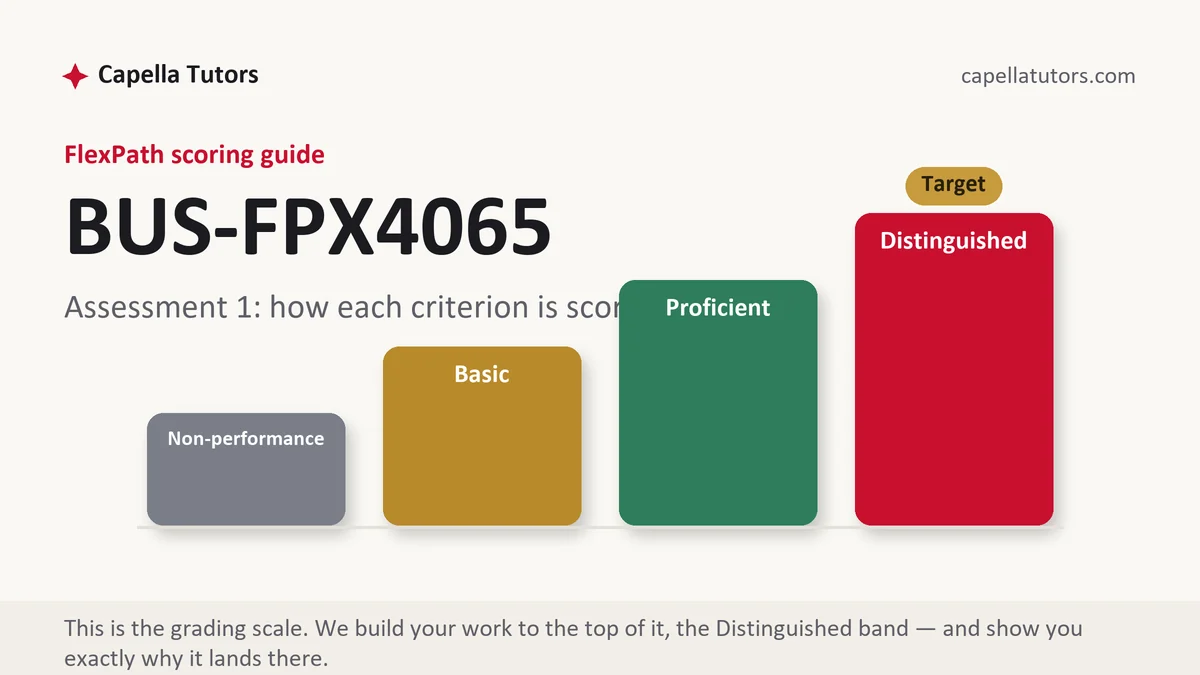
BUS-FPX4065 Assessment 1 grading scale at Capella FlexPath, the criterion levels this assessment is scored on, from Capella Tutors
How Capella FlexPath grades BUS-FPX4065 Assessment 1, visualized by Capella Tutors.

How BUS-FPX4065 Assessment 1 is scored

FlexPath returns a level for each criterion rather than a grade for the paper, and the level wording is the specification:

LevelWhat it means on a tax computation
DistinguishedThe tax year is stated with its source, every item is classified with authority behind the classification, the bands are applied one at a time with the working shown, and both the marginal and the effective rate are reported and distinguished.
ProficientThe computation is complete and arrives at the right liability. Correct work, and one step short of explaining what the rates mean.
BasicA single rate applied to taxable income, with deductions and credits treated as interchangeable. Most first submissions in this course sit here.
Non-performanceNo year identified, or a required element of the computation missing entirely. An absent component floors the criterion however careful the rest is.

Every figure in this deliverable belongs to a year, and that is the discipline the criteria test first. Rate bands, standard deduction amounts, phase-out thresholds and credit limits are adjusted annually, so a computation without a year attached cannot be checked by anybody, including you. Name the year in your opening paragraph, name where the published figures came from, and use that one year everywhere. Nothing in this manual invents a rate for you, and neither should your paper.

The BUS-FPX4065 Assessment 1 method, step by step

  1. Rebuild the criteria as headings, then state the year and the source

    Pick the most recent completed year for which figures are published, say so in the first paragraph, and cite where the bands and thresholds came from. Mixing a standard deduction from one year with the bands from another is a common and completely avoidable failure.

  2. Sort every item before computing anything

    Make a list of the receipts and payments the case supplies and tag each one: includible in income, excluded by a provision, an adjustment against gross income, an itemised deduction, a credit, or irrelevant. The sorting is the analysis. Once the list is right the arithmetic is clerical work.

  3. Ask what excludes an item rather than what includes it

    Income is defined broadly, so the useful question is never whether a receipt is income but whether a provision takes it out. That reversal changes how you write the section: each exclusion you claim needs a reference, and an exclusion asserted without one is the criterion's easiest target.

  4. Work down the page in order and take the larger deduction

    Total income, then the adjustments that reach adjusted gross income, then the greater of the standard deduction or the itemised total, then any qualified business income deduction, then taxable income. Show both deduction figures and say which one you used, because a paper that quietly takes the smaller one has an error nobody can see.

  5. Apply the bands one at a time, then take credits off the tax

    Tax the first band at its rate, the next slice at the next rate, and only the amount above the last threshold at the top rate, showing each line. Credits come off after the tax is computed and refundable credits can go past zero, which is precisely why a credit and a deduction of the same size are worth different amounts.

  6. Report both rates, then self-score

    Divide the tax by taxable income to get the effective rate and set it beside the marginal rate, then explain in one sentence why they differ. Add self-employment tax where a business is involved. Then score the draft yourself against each criterion, marking it D, P, B or N, and rework every row that comes back below D before you submit early in the week.

A structure that maps to the criteria

The targets below are how our tutors plan a computation deliverable of this size, not Capella rules; enlarge whichever section your own guide presses hardest on.

SectionWhat it must doGuide word target
Facts, year and filing statusThe taxpayer profile, the year the analysis applies to, and the source of the published figures used.~200 words
Income classificationEach receipt marked includible or excluded, with a reference attached to every exclusion claimed.~300 words
Adjustments and deductionsItems reaching adjusted gross income, then standard against itemised with both totals shown.~250 words
Tax computationTaxable income, the bands applied line by line, credits after the tax, and any additional taxes.~300 words
Marginal and effective ratesBoth rates computed, set beside each other, and the difference explained in plain terms.~200 words
Authority and referencesThe provisions relied on, the substantiation the taxpayer needs, and current APA both ways.~200 words

Annotated sample excerpt

An original model excerpt from our team, showing what the band calculation reads like when it is written out rather than summarised. The amounts stand in for whatever your stated year publishes; substitute the real ones and cite them.

Sample excerpt: the band calculation Original model · Capella Tutors

Dana Cordell operates Cordell Signworks as a sole proprietorship and files jointly with a spouse whose wages are the household's second income, and after the adjustments and the deduction described above the couple's taxable income for the stated year is 118,400 dollars.1 Applying the published bands for that year in order, the first 23,200 dollars is taxed at 10 percent for 2,320 dollars, the next 71,100 dollars up to the 94,300 dollar threshold is taxed at 12 percent for 8,532 dollars, and only the remaining 24,100 dollars is taxed at 22 percent for 5,302 dollars, giving a tax before credits of 16,154 dollars.2 The Cordells are in the 22 percent bracket and pay an effective rate of 16,154 divided by 118,400, or 13.6 percent, and the gap between those two figures is the answer to the question the couple actually asked, which was whether taking on more sign work would push their whole income into a higher rate.3

  • 1Taxpayer, filing status and business form in one sentence, with taxable income carried forward from the schedule above. The sole proprietorship is flagged early because it drives the self-employment tax section later.
  • 2Three bands, three multiplications, one total, with the thresholds named. Writing it as three lines demonstrates the marginal rate concept better than any paragraph explaining it, and the bands are identified as the stated year's published figures.
  • 3Both rates reported, the division shown, and the difference tied back to the client's real question. The last clause is what turns a computation into advice, and it is the part most drafts never write.

The full premium sample for your exact assessment, written fresh to your scoring guide and issue, is free to request. Study it, revise it into your own voice, and submit work you understand.

Get the full sample free

The five mistakes that cost Distinguished

  • No year identified. Bands, standard deduction amounts and thresholds move annually, and a liability with no year attached cannot be verified by anybody.
  • The top rate applied to everything. Only the income above the last threshold is taxed at the top rate, and treating the whole amount that way overstates the liability substantially.
  • A deduction and a credit treated as equal. One reduces the income the rates apply to and one reduces the tax, so their values differ by the taxpayer's bracket.
  • Exclusions claimed without support. Income is broadly defined, so an item left out of the total needs a provision behind it rather than an assumption.
  • Taxpayer publications cited as authority. Plain-language guides summarise the law usefully and are not the law, and a conclusion resting only on one is unsupported.

Pre-submission checklist

  • The tax year stated in the opening paragraph with the source of the figures used
  • Every item from the case classified before any arithmetic begins
  • Each exclusion claimed carrying a reference to the provision behind it
  • Standard and itemised totals both shown, with the larger one used
  • The bands applied line by line, and credits taken after the tax is computed
  • Marginal and effective rates both reported, with the difference explained

Tax computation due?

Send the taxpayer facts, the year the prompt specifies and the criteria. We sort every item, support each exclusion, work the schedule down the page, apply the bands line by line and report both rates with the arithmetic visible. First premium sample at no cost, turned around in 24 to 48 hours.

Keep going

Online now