How to write BUS-FPX4064 Assessment 3

The short answer

This manual is for BUS-FPX4064 Assessment 3, start to submission. Assessment 3 in BUS-FPX4064, Cost Accounting for Planning and Control, usually asks you to advise on a responsibility or transfer pricing question, which means working out who a given cost or margin genuinely belongs to, and whether the price one division charges another is steering both of them toward a decision the whole company would want. Your guide decides whether that arrives as a memo, a report or a recommendation with supporting schedules. Below is the approach our tutors take to it, a structure that gives every criterion a home, and an annotated sample excerpt. Rather hand it off? Send the divisional figures and a premium original sample comes back in 24 to 48 hours, revised free until the criteria are met. Your courseroom may print this as BUS FPX 4064 Assessment 3 or BUS4064 Assessment 3; it is the same deliverable, and BUS-FPX4064 Assessment 3 is what this manual walks through.

One honesty note before the manual: Capella revises courses and scoring guides over time, so always write to the exact scoring guide attached to your assessment in the courseroom. The course identity above is verified on capella.edu; the method and structure below are our tutors' approach to it, not Capella's official rubric text.
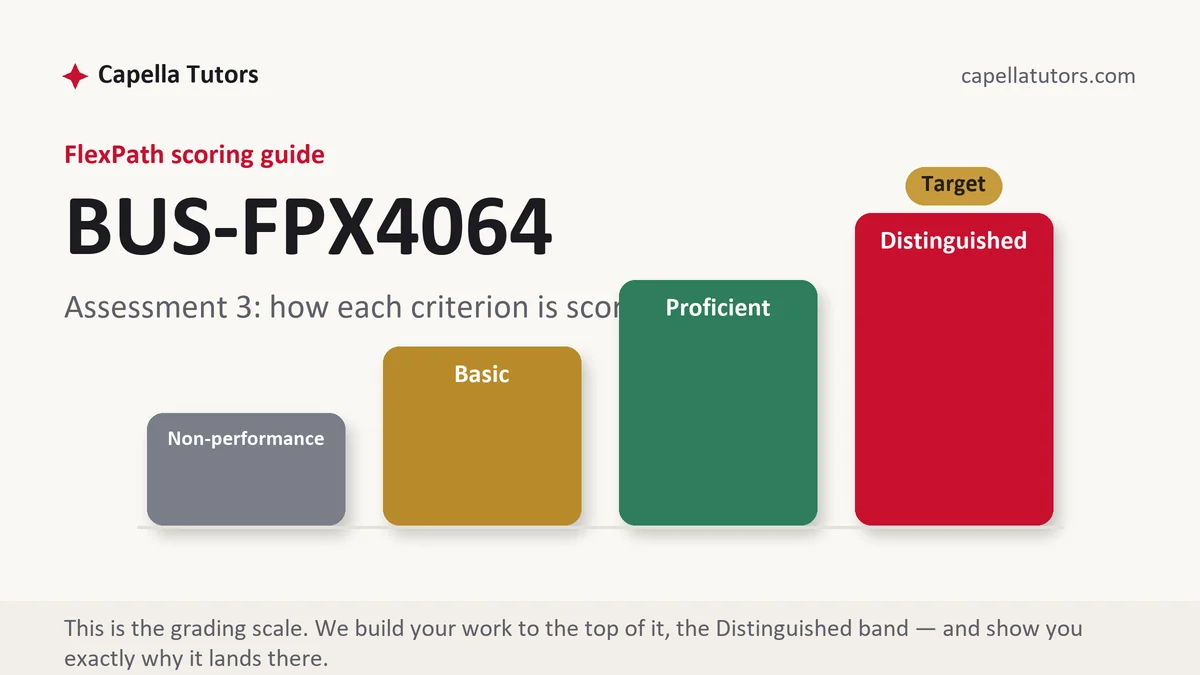
BUS-FPX4064 Assessment 3 grading scale at Capella FlexPath, the criterion levels this assessment is scored on, from Capella Tutors
How Capella FlexPath grades BUS-FPX4064 Assessment 3, visualized by Capella Tutors.

How BUS-FPX4064 Assessment 3 is scored

FlexPath scores criteria, not papers, and each one comes back at one of four levels whose wording is the brief:

LevelWhat it means on a responsibility or transfer pricing memo
DistinguishedEach figure is traced to the manager who could actually change it, the acceptable price range is computed from both divisions' positions, the cost to the company of the current arrangement is quantified, and the recommendation names the behaviour the measure will produce.
ProficientThe pricing options are compared and a defensible recommendation follows. Solid, and one step below quantifying what the current arrangement costs.
BasicThe methods listed in general terms with a preference asserted, and no range computed from the case figures. This is the usual first attempt.
Non-performanceResponsibility assigned by department label with no reasoning, or no recommendation reached at all. Absence of the required element floors the criterion.

Everything in this deliverable follows from one idea: a manager should be measured on what a manager controls. Charging a division for a cost it cannot influence produces resentment and no better decisions, and rewarding a division for a margin it did not create produces confident reporting of somebody else's work. The criteria in this assessment are written to find out whether you can tell those two situations apart on the facts in front of you.

The BUS-FPX4064 Assessment 3 method, step by step

  1. Rebuild the criteria as headings, then classify each centre

    A centre answerable for costs only, for costs and revenues, or for the capital tied up in it is measured three different ways, and the case will tell you which is which. Write that classification down first, because a division judged on return while its manager cannot approve equipment purchases is already the finding.

  2. Separate controllable from attributable for every line

    Go through the divisional statement and mark each item as controllable by that manager, attributable to the division but set elsewhere, or allocated from the centre on a formula. An allocated head-office charge belongs in the divisional total and does not belong in the manager's evaluation, and saying so explicitly earns a criterion most students never notice is there.

  3. Find the seller's floor

    The lowest price the supplying division should accept is its own variable cost plus whatever it gives up by selling internally. With spare capacity it gives up nothing, so the floor is variable cost. With no spare capacity it gives up the external contribution, and the floor rises to the market price. Establish which case the facts describe before you compute anything.

  4. Find the buyer's ceiling, then state the range

    The highest price the buying division should pay is whatever an outside supplier would charge it for the same item. Between that ceiling and the seller's floor sits the range in which an internal transfer makes both divisions and the company better off. If the ceiling is below the floor, the honest answer is that the company should buy outside.

  5. Quantify what the present arrangement costs

    This is the sentence that lifts the memo. If the current price sits outside the range and the buying division goes to the market, multiply the contribution lost per unit by the annual volume and put the figure on the page. A number that size ends an argument that no amount of principle will settle.

  6. Recommend, predict the behaviour, then self-score

    Say which pricing basis you would use, name who arbitrates a disagreement, and predict what managers will do once the measure is in place, including the things you would rather they did not. Then read the memo against each criterion, mark it D, P, B or N yourself, revise anything under D and submit early in the week.

A structure that maps to the criteria

The word targets below are how our tutors plan a divisional memo of this size, not Capella requirements; extend whichever section your own guide emphasises most.

SectionWhat it must doGuide word target
Centres and how each is judgedWhat each division is answerable for, and the measure that follows from that classification.~200 words
Controllable against allocatedEach line of the divisional statement sorted, with allocated charges named and set aside for evaluation.~250 words
The seller's minimumVariable cost plus opportunity cost, with the capacity position established from the facts first.~250 words
The buyer's maximum and the rangeThe outside quote, the range that results, and what it means if the range is empty.~250 words
Cost of the current arrangementContribution lost per unit multiplied by volume, with the calculation shown.~200 words
The recommendation and referencesThe basis chosen, the arbitration route, the behaviour predicted, and current APA both ways.~250 words

Annotated sample excerpt

An original model excerpt from our team, showing what a pricing recommendation reads like when the range is computed rather than argued. Take the moves and rebuild them from your own divisional figures.

Sample excerpt: the transfer price range Original model · Capella Tutors

The Components division of Verdant Flow Irrigation makes the pressure valve assembly for 42.00 dollars of variable cost and is running roughly 30 percent below capacity, so an internal transfer displaces no outside sale and its true minimum acceptable price is 42.00 dollars rather than the 68.00 dollars it charges external customers.1 The Systems division can buy an equivalent assembly from a regional supplier at 64.00 dollars, which sets its ceiling, so any price between 42.00 and 64.00 leaves both divisions better off than the alternative and the current internal price of 68.00 sits outside that range entirely.2 Systems is therefore buying 9,000 assemblies a year on the open market, and each one costs the company 64.00 in cash to acquire something it could have produced for 42.00, a contribution loss of 22.00 a unit and 198,000 dollars a year created purely by an internal price.3

  • 1The capacity position established before the floor is set, then the floor stated. With spare capacity there is no opportunity cost to add, and getting this order wrong invalidates every figure after it.
  • 2The ceiling taken from the buying division's real alternative, the range stated as an interval, and the current price located outside it. An interval is the answer the criterion wants, not a single preferred number.
  • 3The company-level cost quantified per unit and annually. This is the sentence that turns a technical memo into a decision document, and most submissions stop one sentence earlier.

The full premium sample for your exact assessment, written fresh to your scoring guide and issue, is free to request. Study it, revise it into your own voice, and submit work you understand.

Get the full sample free

The five mistakes that cost Distinguished

  • Opportunity cost added when there is none. A division with idle capacity gives up nothing by transferring internally, and starting from market price sends the buying division outside.
  • A single price recommended with no range behind it. The criterion is asking for the interval the case figures define, and a preference asserted without it has nothing supporting it.
  • Allocated head-office charges used to judge a manager. They belong in the divisional result and not in the evaluation of somebody who cannot influence them.
  • The company-level consequence left uncounted. A misaligned internal price has an annual dollar cost, and a memo that never multiplies it out understates the whole problem.
  • No prediction of behaviour. Every measure creates an incentive, and a recommendation that does not say what managers will do next has not been thought through.

Pre-submission checklist

  • Each centre classified by what it is answerable for, with the measure that follows
  • Every line sorted into controllable, attributable or allocated
  • The capacity position established before the seller's minimum is computed
  • The range stated as an interval between the seller's floor and the buyer's ceiling
  • The annual cost of the current arrangement multiplied out on the page
  • The behaviour the recommended measure will produce named, including the unwelcome part

Transfer pricing memo due?

Send the divisional cost data, the capacity position, any outside quote and the criteria. We classify the centres, separate controllable from allocated, compute the range from both sides and put a dollar figure on what the current price is costing the company. The first one is free, and it arrives inside two working days.

Keep going

Online now