How to write BUS-FPX4064 Assessment 1

The short answer

This manual is for BUS-FPX4064 Assessment 1, start to submission. Assessment 1 in BUS-FPX4064, Cost Accounting for Planning and Control, usually asks you to compute and interpret variances, which means flexing the budget to the output actually achieved, splitting each difference into a price effect and a usage effect, and then saying which manager can do something about which half. Your guide decides whether that arrives as a schedule, a report or a memo. Below is the order our tutors work in, a structure each criterion can be ticked against, and an annotated sample excerpt. Would rather not build it yourself? Send the standards and the actuals and a premium original sample comes back in 24 to 48 hours, revised free until the criteria are met. Your courseroom may print this as BUS FPX 4064 Assessment 1 or BUS4064 Assessment 1; it is the same deliverable, and BUS-FPX4064 Assessment 1 is what this manual walks through.

One honesty note before the manual: Capella revises courses and scoring guides over time, so always write to the exact scoring guide attached to your assessment in the courseroom. The course identity above is verified on capella.edu; the method and structure below are our tutors' approach to it, not Capella's official rubric text.
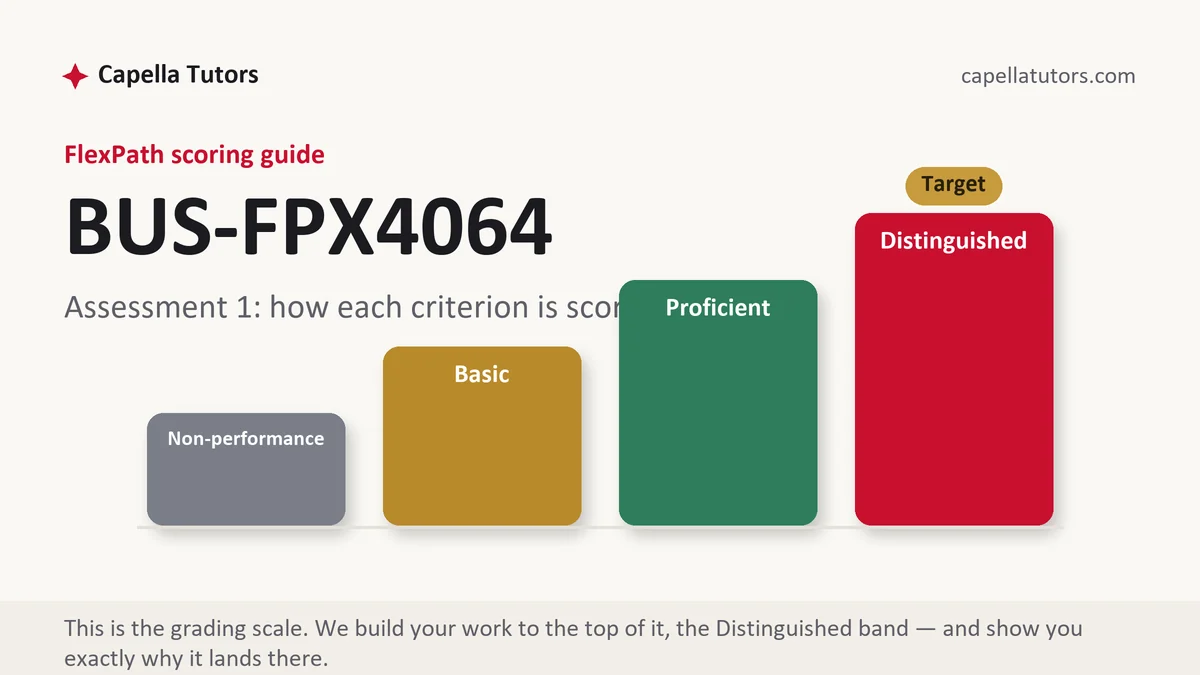
BUS-FPX4064 Assessment 1 grading scale at Capella FlexPath, the criterion levels this assessment is scored on, from Capella Tutors
How Capella FlexPath grades BUS-FPX4064 Assessment 1, visualized by Capella Tutors.

How BUS-FPX4064 Assessment 1 is scored

FlexPath gives you levels instead of letters. Each criterion returns at one of four, and the level wording is the writing brief:

LevelWhat it means on a variance analysis
DistinguishedThe budget is flexed before anything is compared, every variance is decomposed with its formula visible, the parts reconcile to the total, and the write-up traces which variance appears to have caused another. The criterion names the extra move; find it and make it.
ProficientEvery variance computed correctly, labelled favourable or unfavourable, and commented on. Accurate work, one analytical step below the top row.
BasicActual costs held against the original budget and the total difference described in adjectives. This is where most first attempts in the course land.
Non-performanceA required variance is absent, or the figures do not reconcile to the total difference. Absence rather than imprecision is what puts a criterion on the floor.

The arithmetic in this deliverable is unusually unforgiving, and that works in your favour. A variance has one correct value, so a reviewer can confirm it in seconds, which means the marks separate on interpretation rather than on calculation. Two students can produce identical numbers and score two levels apart because one of them noticed that a favourable price variance and an unfavourable usage variance on the same input are almost certainly the same event described twice.

The BUS-FPX4064 Assessment 1 method, step by step

  1. Rebuild the criteria as headings, then find the output figure

    Before any calculation, locate the units actually produced, because that single number drives every standard allowance in the analysis. Cases often bury it among the cost data, and a variance report built on budgeted output rather than actual output is wrong in every line.

  2. Flex the budget first, and say that you did

    Recalculate what the variable costs should have been at the output achieved, then compare. Skipping this step folds a volume effect into every figure and the report ends up blaming managers for making a different quantity than someone forecast months earlier. State in the paper that flexing happened and why it matters.

  3. Split each input into price and usage, with the formula on the page

    For materials, the price effect is the rate difference applied to the quantity bought, and the usage effect is the quantity difference applied to the standard rate. Labour works identically with rate in place of price and efficiency in place of usage. Write the formula beside each figure so a reader can follow the calculation without rebuilding it.

  4. Keep the overhead pools apart

    Split variable from fixed before you start, because they behave differently and their variances mean different things. The variable spending figure asks whether the rate paid was right, the variable efficiency figure is really a story about the allocation base, and the fixed volume figure exists only because a predetermined rate spread fixed cost over an activity level that did not happen.

  5. Reconcile the parts to the whole

    Add the individual variances and confirm they equal the difference between the actual cost and the standard cost allowed for the output achieved. If they do not, something is double counted or missing, and finding it now is cheaper than having an evaluator find it. Show the reconciliation as a short table so the criterion has something to point at.

  6. Interpret, set a threshold, then self-score

    Say which variances are large enough to investigate and state the rule you used, whether that is a dollar floor, a percentage of standard cost, or both together. Name the interactions. Then read the draft against each criterion, mark it D, P, B or N yourself, revise anything below D, and submit early in the week.

A structure that maps to the criteria

The word targets below are how our tutors plan a variance deliverable of this size, not Capella requirements; expand whichever section your own guide leans on hardest.

SectionWhat it must doGuide word target
Standards and actual resultsThe standard quantity and rate per unit for each input, the actual results, and the output achieved.~200 words
The flexible budgetCosts recalculated at actual output, with the volume effect separated out and named.~200 words
Material and labour variancesPrice and usage for materials, rate and efficiency for labour, each with its formula and its label.~350 words
Overhead variancesVariable spending and efficiency, fixed budget and volume, with the two pools kept separate.~250 words
Reconciliation and interactionThe parts summed to the total, plus which variances appear to have produced which others.~250 words
Recommendation and referencesAn investigation threshold with a reason, standard revision advice, and current APA both ways.~200 words

Annotated sample excerpt

An original model excerpt from our team, showing what a decomposition reads like when the working sits inside the sentences. Take the moves and run them on your own standards.

Sample excerpt: material variances, decomposed Original model · Capella Tutors

Stonecrest Surfaces allows 18.5 square feet of quartz slab per installed countertop at a standard 9.40 dollars a square foot, and the month completed 1,240 installations, so the standard allowance for the output achieved is 22,940 square feet.1 The plant actually drew 24,180 square feet and paid 9.85 dollars for it, which gives a price variance of 24,180 multiplied by the 0.45 rate difference, or 10,881 dollars unfavourable, and a usage variance of the 1,240 excess square feet at the standard 9.40, or 11,656 dollars unfavourable.2 Together they account for 22,537 dollars of material cost above standard, and the split points in two directions: purchasing paid above the agreed rate, and the shop consumed a fifth of a slab more per job than the standard allows, which is consistent with a harder stone that chips at the sink cutout.3

  • 1The standard allowance computed from actual output before anything is compared. This is the flexing step written into a sentence, and reports that skip it compare figures that were never comparable.
  • 2Both variances with the multiplication visible and each labelled unfavourable. The price effect uses the quantity bought and the usage effect uses the standard rate, and swapping those two is the most common error in the deliverable.
  • 3The reconciliation to the total, then the interaction named. Suggesting that a cheaper or harder input caused the usage overrun is the analytical move the top level is describing.

The full premium sample for your exact assessment, written fresh to your scoring guide and issue, is free to request. Study it, revise it into your own voice, and submit work you understand.

Get the full sample free

The five mistakes that cost Distinguished

  • Actuals compared with the original budget. Without flexing to the output achieved, a volume effect nobody managed contaminates every line of the report.
  • One total difference reported and left there. The technique exists to separate a rate effect from a usage effect, and a single figure does neither.
  • The two quantities swapped in the formulas. The price variance runs on the quantity purchased and the usage variance on the standard rate, and reversing them changes both answers.
  • Favourable variances waved through. A large favourable price figure frequently explains an unfavourable usage figure downstream, and passing over it hides the cause.
  • Comment offered on every variance equally. A report with no investigation threshold treats a 200 dollar difference and a 12,000 dollar difference as equally worth management time.

Pre-submission checklist

  • Actual output identified and used to compute every standard allowance
  • The budget flexed before any comparison, with that step stated in the text
  • Each variance decomposed, labelled favourable or unfavourable, formula shown
  • Variable and fixed overhead handled in separate pools
  • The individual variances reconciled to the total difference
  • An investigation threshold stated with the reasoning behind the number

Variance analysis due?

Send the standards, the actual results, the units produced and the criteria. We flex the budget, decompose every input with the formulas visible, reconcile the parts to the total and write the interaction the criteria are looking for. First sample at no charge, returned within 24 to 48 hours.

Keep going

Online now