How to write BUS-FPX4063 Assessment 3

The short answer

This manual is for BUS-FPX4063 Assessment 3, start to submission. Assessment 3 in BUS-FPX4063, Advanced Financial Accounting Topics and Trends, usually asks you to apply the reporting rules of a specialised entity, meaning an organisation whose readers want something other than profit: a not-for-profit accounting for resources a donor attached strings to, a government segregating money by the purpose it was raised for, a partnership tracking capital accounts, or a subsidiary keeping its books in another currency. Below is the sequence our tutors work through on it, a structure built around the criteria, and an annotated sample excerpt. Want it built for you? Send the prompt and the figures and a premium original sample comes back in 24 to 48 hours, revised free until the criteria are met. Your courseroom may print this as BUS FPX 4063 Assessment 3 or BUS4063 Assessment 3; it is the same deliverable, and BUS-FPX4063 Assessment 3 is what this manual walks through.

One honesty note before the manual: Capella revises courses and scoring guides over time, so always write to the exact scoring guide attached to your assessment in the courseroom. The course identity above is verified on capella.edu; the method and structure below are our tutors' approach to it, not Capella's official rubric text.
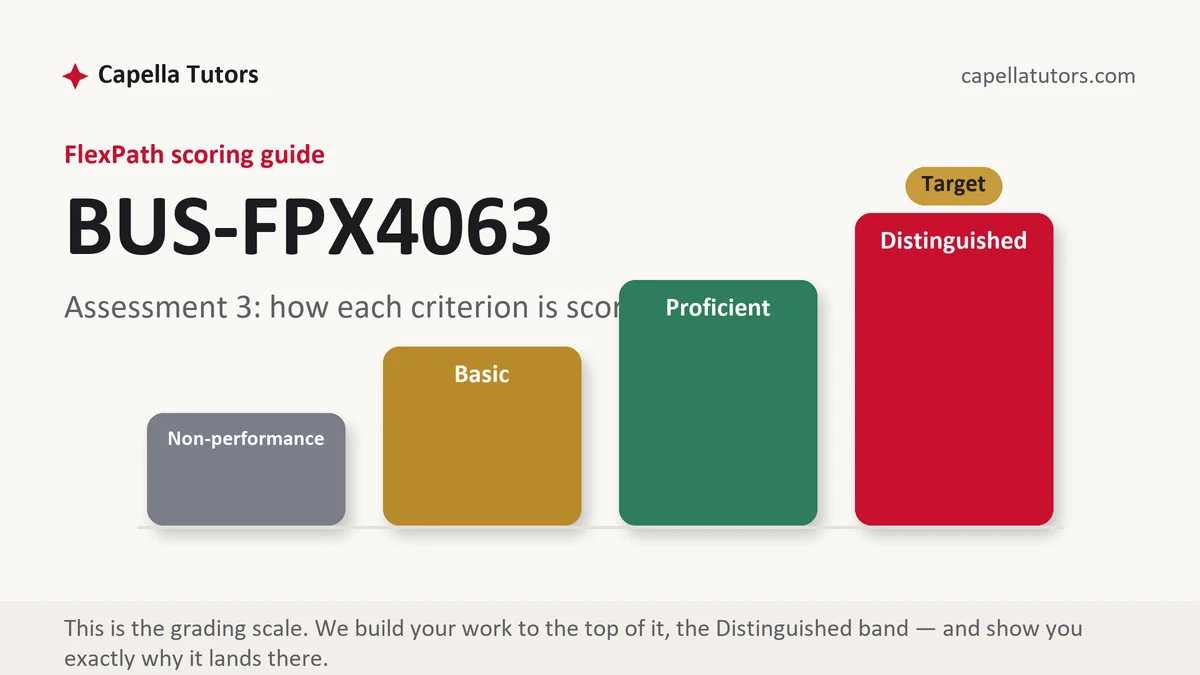
BUS-FPX4063 Assessment 3 grading scale at Capella FlexPath, the criterion levels this assessment is scored on, from Capella Tutors
How Capella FlexPath grades BUS-FPX4063 Assessment 3, visualized by Capella Tutors.

How BUS-FPX4063 Assessment 3 is scored

FlexPath produces levels rather than letters. Each criterion returns at one of four, and the wording of the level is the instruction:

LevelWhat it means on a specialised entity report
DistinguishedThe entity type is identified from the facts, the reporting objective is named before any figure appears, the restrictions or capital movements are tracked with arithmetic, and the paper says what a reader of these statements is trying to decide.
ProficientThe correct framework applied and the statements prepared accurately. Complete work, and one step below explaining who the statements serve.
BasicCorporate reporting habits carried across unchanged, with restricted and unrestricted resources pooled or capital accounts treated as a single equity line.
Non-performanceThe wrong framework applied, or the restriction and allocation element absent altogether. An absent component floors the criterion whatever else is on the page.

This deliverable rewards one habit above all others: deciding who the statements are for before deciding what goes in them. A commercial balance sheet answers whether the business made money and could pay a lender. A not-for-profit statement answers whether the organisation honoured what donors asked, a government fund answers whether money raised for one purpose was spent on it, and a partnership statement answers what each partner is owed. Name the reader in your first paragraph and the criteria become far easier to satisfy.

The BUS-FPX4063 Assessment 3 method, step by step

  1. Turn the criteria into headings, then classify the entity from the facts

    Read the case for what the organisation is rather than what it does. Ownership, how it is funded, whether anyone can hold a residual claim and who it reports to will tell you which framework applies, and stating that conclusion with the facts behind it is usually a criterion of its own.

  2. Say what the statements are meant to demonstrate

    Write one sentence naming the reporting objective before you touch a number. Accountability for restricted resources, compliance with the purpose a fund was created for, or the settlement of amounts between partners are all different objectives from measuring profit, and everything downstream follows from which one you named.

  3. Sort every inflow by the condition attached to it

    Go through the receipts one at a time and mark each as free of restriction, restricted to a purpose, restricted to a period, or restricted permanently with only the return available for use. A single gift can contain more than one of these. The sorting is the analysis, and the presentation afterwards is mechanical.

  4. Track the movement, not just the balance

    Restricted resources are released when the organisation does the thing the donor specified, and that release is a movement between categories rather than new revenue. Partnership capital moves for contributions, drawings and each partner's share of profit under the agreement. Show the opening balance, the movements and the closing balance, because the movement is what a reader is checking.

  5. Add the measure a reader of these statements actually uses

    Different readers use different ratios. A donor looks at what share of spending reached the programmes rather than the administration. A government reader looks at whether a fund ran a deficit and how long its reserves would last. A partner looks at their capital balance against the agreed profit split. Compute one such measure, show the division, and say what it indicates.

  6. Explain the framework difference, then self-score

    Add a short section on why this entity does not report the way a corporation does, since the criteria in this course frequently ask for exactly that comparison and it is the part most drafts omit. Then read your work against each criterion, mark it D, P, B or N honestly, revise anything under D and submit early in the week.

A structure that maps to the criteria

The targets below are how our tutors plan a specialised entity deliverable of this size, not Capella rules; expand the section your own guide weights hardest.

SectionWhat it must doGuide word target
Entity classificationWhat the organisation is, the facts that establish it, and which framework therefore applies.~200 words
Reporting objective and usersWho reads these statements, what they are deciding, and what the statements must demonstrate.~200 words
Classification of resourcesEvery inflow sorted by the condition attached, with gifts carrying more than one condition split.~300 words
Movements and releasesOpening balances, releases or capital movements with arithmetic, and closing balances by category.~300 words
The reader's measureOne ratio or reserve figure a user of these statements would actually compute, with the division shown.~200 words
Framework comparison and referencesWhy the presentation differs from a corporate one, what that tells a reader, and APA reconciled both ways.~200 words

Annotated sample excerpt

An original model excerpt from our team, showing what restricted resource tracking looks like once the movements carry figures. Take the moves and rebuild them from your own case.

Sample excerpt: restricted resources and release Original model · Capella Tutors

Northgate Food Rescue received 1,860,000 dollars in contributions during the year, of which 742,000 dollars arrived with a donor condition attached and 1,118,000 dollars arrived free of any condition, and the split matters because only the second figure was available for whatever the board judged most urgent.1 Of the restricted amount, 508,000 dollars funded the refrigerated collection routes the donors specified and was released into unrestricted activity during the year, leaving 234,000 dollars still carrying its condition at the year end.2 Total expenses were 1,595,000 dollars, of which 1,342,000 dollars went to programme delivery, so 84.1 percent of every dollar spent reached the food distribution itself, and that ratio is the first number most donors and grant reviewers look for.3

  • 1The inflow split by condition in the opening sentence, with a clause saying why the split changes what the organisation can do. Pooling these two figures is the error that defines a Basic submission here.
  • 2The release treated as a movement between categories, with the closing restricted balance carried forward. A release is not new revenue, and showing the opening amount, the release and the remainder proves the accountability the statements exist to demonstrate.
  • 3The measure the actual reader uses, with the division visible and the users named. One computed ratio with a sentence of meaning outscores three paragraphs describing the framework in general terms.

The full premium sample for your exact assessment, written fresh to your scoring guide and issue, is free to request. Study it, revise it into your own voice, and submit work you understand.

Get the full sample free

The five mistakes that cost Distinguished

  • Restricted and unrestricted resources reported as one total. The separation is the entire point of the presentation, and merging them removes the accountability a reader came for.
  • A release recorded as fresh revenue. Satisfying a donor condition moves resources between categories, and counting it twice inflates the reported inflow.
  • Profit language used where no profit exists. A surplus in a fund is not earnings, and describing it that way signals that the reporting objective was never identified.
  • The wrong standard setter cited. Government reporting and business reporting come from different bodies, and applying one entity's framework to the other is a substantive error rather than a citation slip.
  • No measure a reader would use. A set of statements with no ratio, reserve figure or capital balance computed leaves the interpretation criterion with nothing to reward.

Pre-submission checklist

  • The entity type stated with the facts from the case that establish it
  • The reporting objective and the intended reader named before any figure
  • Every inflow classified by the condition attached to it, split where necessary
  • Opening balance, movement and closing balance shown for each category
  • One reader-relevant measure computed with the division on the page
  • A short comparison explaining why this presentation differs from a corporate one

Specialised entity report due?

Send the organisation's facts, the figures and the criteria. We classify the entity, name the reporting objective, sort the resources by restriction, track the movements with arithmetic and compute the measure the reader actually uses. Your first premium sample is on us, delivered inside two days.

Keep going

Online now