This manual is for BUS FPX 4063 Assessment 2, start to submission. Assessment 2 in BUS FPX 4063, Advanced Financial Accounting Topics and Trends, usually asks you to prepare consolidated figures, which means taking two sets of separate records and producing statements that report the group as though it were one company, with every effect of the members being separate legal entities removed on the way. Your guide decides whether the output is a worksheet, a set of entries or a memo carrying both. Below is the method our tutors follow on it, the structure that lets each criterion be ticked off, and an annotated sample excerpt. Prefer to hand it off? Send the trial balances and a premium original sample arrives in 24 to 48 hours, revised free until the criteria are met. Capella's catalog lists the course as BUS-FPX4063, and some courserooms print BUS4063; both point to this same Assessment 2.
One honesty note before the manual: Capella revises courses and scoring guides over time, so always write to the exact scoring guide attached to your assessment in the courseroom. The course identity above is verified on capella.edu; the method and structure below are our tutors' approach to it, not Capella's official rubric text.
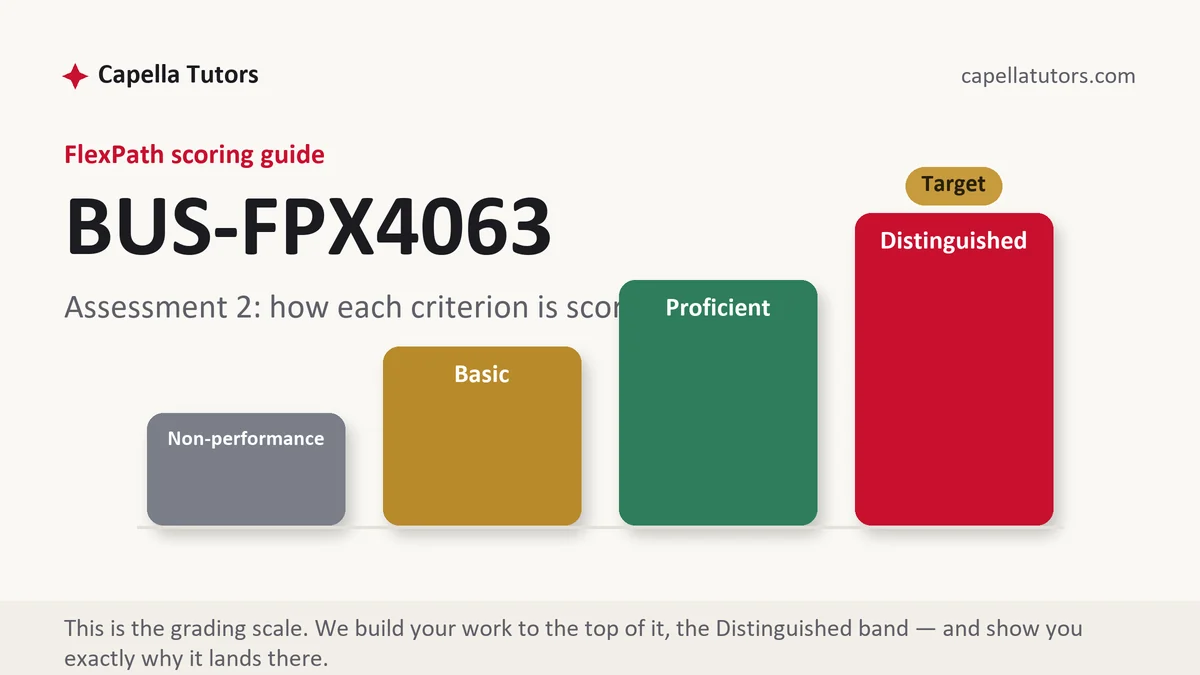
How BUS FPX 4063 Assessment 2 is scored
There are no letter grades in FlexPath. Every criterion lands on one of four levels, and the level descriptions tell you what to write:
| Level | What it means on a consolidation |
|---|---|
| Distinguished | The eliminations run in a stated order, each one carries a sentence saying what it removes and why, unrealised profit is calculated rather than estimated, the worksheet cross-foots, and the paper explains what the combined statements now show that the separate ones did not. |
| Proficient | The eliminations are complete and the consolidated statements balance. Sound work, one explanatory layer short of the top level. |
| Basic | The investment eliminated and the two columns added across, with intercompany trading removed partly or not at all. This is the usual landing place for a first attempt. |
| Non-performance | An elimination the case clearly required is missing, or the statements do not balance. Missing rather than imperfect is what puts a criterion on the floor. |
One principle drives every entry you will write. If a balance or a transaction exists only because the parent and the subsidiary are separate legal persons, it has no place in statements that describe a single economic unit. Say that principle once in your own words near the top of the deliverable, because the criterion asking you to explain the eliminations is asking for the reasoning behind them and not a list of debits.
The BUS FPX 4063 Assessment 2 method, step by step
-
Turn the criteria into headings, then set the worksheet up before anything else
Six columns: the parent's balances, the subsidiary's balances, a debit adjustment column, a credit adjustment column, and the consolidated total. Build the frame first and the entries have somewhere to land. Build it last and you will be reverse-engineering figures you have already written into prose.
-
Eliminate the investment against the subsidiary's equity
This is always the first entry and it is the one that stops the group from reporting its own shares as an asset. Bring the acquisition-date fair value adjustments in at the same time, along with the amortisation on them for the periods since, since the subsidiary's own books know nothing about either.
-
Cancel the intercompany balances
Receivables owed by one group member to another disappear against the matching payable, and so do intercompany loans and the interest accrued on them. Nothing is gained or lost here and no profit changes, which is why students skip it and lose an easy criterion. A group cannot owe itself money on the face of its own balance sheet.
-
Remove intercompany sales in full, both sides
Take the whole sale out of consolidated revenue and take the matching amount out of cost of sales. Consolidated profit is unchanged by that pair, which is the point, and removing only the revenue changes profit and gives the evaluator a clear error to mark. Adjacent group members trading with each other is activity, not sales.
-
Compute the unrealised profit that is still sitting in inventory
Find the portion of the transferred goods still unsold at year end, work out how much profit is buried in that portion, and take it out of cost of sales and out of ending inventory. Show the calculation. The same reasoning applies to a gain on equipment transferred between members, which is removed and then released across the asset's remaining life.
-
Allocate to the retained interest, prove it, then self-score
Compute the share of subsidiary income belonging to the interest outside the group, after the fair value amortisation and after the eliminations, and present it within equity. Confirm the adjustment columns are equal and the final column cross-foots. Then mark each criterion D, P, B or N yourself, fix anything below D, and submit early in the week.
A structure that maps to the criteria
These word targets are planning figures our tutors use for a consolidation deliverable of this size, not Capella requirements; grow whichever section your own guide weights most heavily.
| Section | What it must do | Guide word target |
|---|---|---|
| The group and the principle | Who controls whom, the ownership percentage, and why anything internal to the group comes out. | ~150 words |
| Investment and equity elimination | The first entry, plus the fair value adjustments and the amortisation carried since acquisition. | ~250 words |
| Intercompany balances and trading | Receivables against payables, loans and interest, and the full removal of internal sales with matching cost. | ~250 words |
| Unrealised profit | The unsold portion, the profit inside it, the calculation shown, and the same treatment for transferred assets. | ~300 words |
| Retained interest and worksheet proof | The income allocation, presentation inside equity, and evidence that the columns agree. | ~250 words |
| Reading the result, and references | What consolidation did to reported revenue, leverage and the asset base, plus current APA both ways. | ~200 words |
Annotated sample excerpt
An original model excerpt from our team, showing how an elimination reads when the working is on the page rather than in a spreadsheet nobody sees. Learn the moves, then run them on your own numbers.
Harbor Line Supply sold 640,000 dollars of marine hardware to its retail subsidiary, Tidewater Marine Outfitters, during the year at a markup of 25 percent on cost, and the full 640,000 is removed from consolidated revenue and from consolidated cost of sales, a pair of adjustments that changes group profit by nothing and stops the group from reporting a sale it made to itself.1 Tidewater still held 35 percent of those goods at 31 December, or 224,000 dollars at the transfer price, and the profit inside that figure is 224,000 multiplied by 25 over 125, which is 44,800 dollars.2 That 44,800 has not been earned from anybody outside the group, so it is removed from cost of sales and from ending inventory, and the reported inventory now reflects what the goods cost the group rather than what one member charged another.3
- 1Both sides of the trading elimination in one sentence, with the reason attached. Stating that profit is unchanged is what shows the evaluator you understand why the entry exists.
- 2The markup arithmetic written out. A markup on cost is converted with 25 over 125 rather than 25 over 100, and that single fraction is the most common numerical error in the whole deliverable.
- 3Both accounts named, then one clause on what the corrected inventory figure means. The criterion about explaining eliminations is answered by clauses like this one, not by a journal entry on its own.
The full premium sample for your exact assessment, written fresh to your scoring guide and issue, is free to request. Study it, revise it into your own voice, and submit work you understand.
The five mistakes that cost Distinguished
- Only the revenue side of an internal sale removed. Consolidated profit moves when the matching cost of sales stays behind, and an elimination that changes profit is doing the opposite of its job.
- The markup fraction inverted. A markup on cost of 25 percent means the profit is a quarter of the cost and a fifth of the selling price, and using the wrong denominator misstates the adjustment every time.
- Fair value amortisation forgotten after year one. The subsidiary never recorded the acquisition-date adjustments, so the catch-up has to be brought in on the worksheet each period.
- Intercompany receivables and payables left in place. A costless entry to make and an easy criterion to lose, and the balance sheet reads as though the group is its own debtor.
- No proof that the worksheet balances. Entries can look reasonable and still fail to produce statements that cross-foot, and without the columns nobody can tell which case yours is.
Pre-submission checklist
- The eliminations presented in a stated order, each with one line of explanation
- Internal sales removed from revenue and cost of sales in the same amount
- Unrealised profit computed with the markup arithmetic visible
- Fair value adjustments and their amortisation carried onto the worksheet
- The retained interest allocated after amortisation and presented inside equity
- Adjustment columns equal, consolidated column cross-footed, and the proof shown
Consolidation worksheet due?
Send both trial balances, the ownership percentage, the intercompany transactions and the criteria. We run the eliminations in order, calculate the unrealised profit, allocate to the retained interest and prove the worksheet cross-foots before it leaves us. The first premium sample costs nothing.