This manual is for BUS-FPX4063 Assessment 1, start to submission. Assessment 1 in BUS-FPX4063, Advanced Financial Accounting Topics and Trends, usually asks you to account for a business combination, which in practice means building the acquisition-date schedule that measures what the buyer transferred, assigns fair value to each identifiable asset acquired and liability assumed, and leaves goodwill standing as the residual. FlexPath scores it criterion by criterion off your own guide, four levels, no letters. Below is the method our tutors run on that deliverable, a structure the criteria can be checked against, and an annotated sample excerpt. Rather hand it over? Send the prompt and the acquisition details and a premium original sample comes back in 24 to 48 hours, revised free until the criteria are met. Your courseroom may print this as BUS FPX 4063 Assessment 1 or BUS4063 Assessment 1; it is the same deliverable, and BUS-FPX4063 Assessment 1 is what this manual walks through.
One honesty note before the manual: Capella revises courses and scoring guides over time, so always write to the exact scoring guide attached to your assessment in the courseroom. The course identity above is verified on capella.edu; the method and structure below are our tutors' approach to it, not Capella's official rubric text.
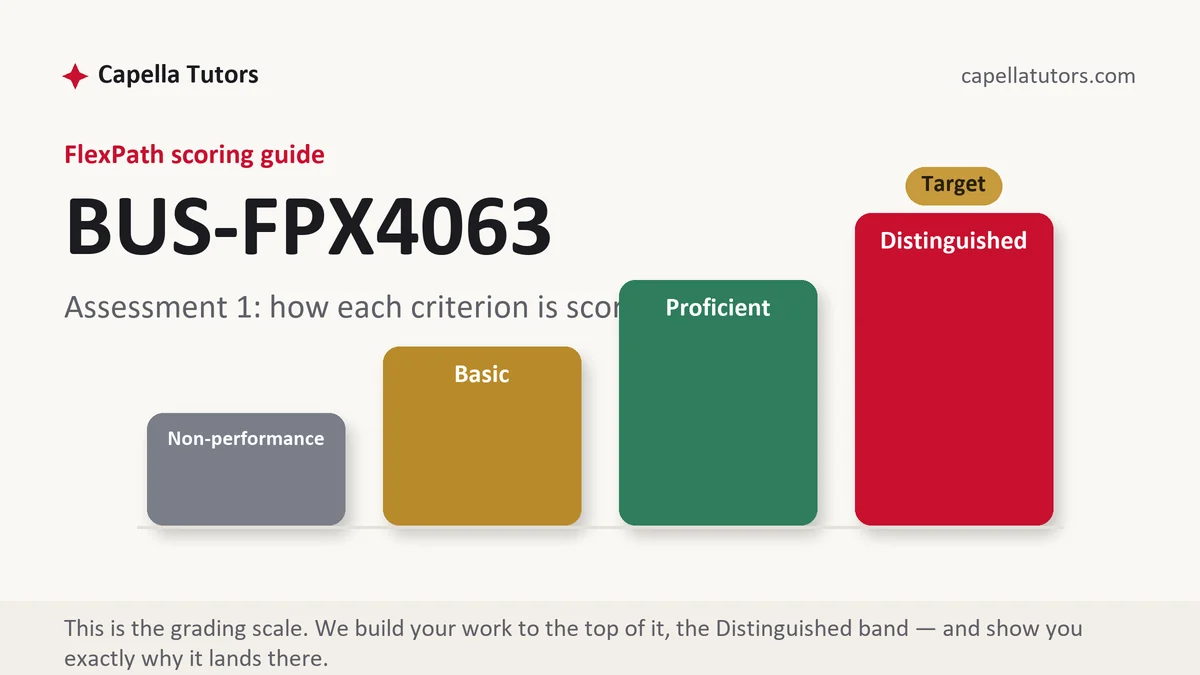
How BUS-FPX4063 Assessment 1 is scored
FlexPath returns no letter grade. Each criterion on your scoring guide comes back at one of four levels, and the wording of those levels is the brief you should be writing to:
| Level | What it means on an acquisition analysis |
|---|---|
| Distinguished | Every component of the consideration is measured, the fair value adjustments are identified one at a time with a basis stated for each, goodwill emerges as arithmetic rather than assertion, and the paper says what the buyer appears to have paid for. The extra move sits in the criterion wording; read it and make it. |
| Proficient | The schedule is complete and the numbers agree with each other. Correct, and one interpretive step below the top row. |
| Basic | Consideration less book value called goodwill, with the fair value step skipped or applied to one asset only. Most first attempts land here. |
| Non-performance | A required element is absent, most often the noncontrolling interest or the amortisation of what was recognised. Absence floors a criterion regardless of how tidy the rest looks. |
The whole deliverable rests on one sequence, and getting the order right protects the later criteria. Measure, then allocate, then let the residual appear. Students who compute goodwill first and distribute the remainder backwards produce a schedule that balances and reasoning that cannot be defended, and the criterion asking how goodwill arose is the one that catches it.
The BUS-FPX4063 Assessment 1 method, step by step
-
Rebuild the criteria as headings, then fix the acquisition date
Copy each criterion into your outline as a heading before writing a word of prose. Then find the date control passed, because every fair value in the schedule is measured at that date and not at the balance sheet date. A case that gives you two dates is testing whether you noticed.
-
Add up the consideration, all of it
Cash is the easy part. Shares issued are measured at their fair value on the acquisition date, any previously held interest is brought to fair value, and contingent consideration promised on future performance is included at its fair value now rather than ignored until it is paid. A schedule that lists only the cash understates the price and pushes the error into goodwill.
-
Fair value the identifiable assets and liabilities item by item
Work down the acquired balance sheet line by line and write the adjustment beside each one. Then look for what is not on it. Customer lists, service contracts, trade names and favourable leases are frequently the largest items in the schedule and almost never appear in the acquired company's own records, because internally generated intangibles do not get recognised until somebody buys them.
-
Measure the noncontrolling interest, then let goodwill fall out
Where less than all of the shares were bought, the interest that stayed behind is measured and shown inside consolidated equity. Add it to the consideration transferred, subtract the fair value of the identifiable net assets, and whatever is left is goodwill. Written that way it is a residual with a visible derivation, which is exactly what the criterion is asking to see.
-
Set the clock on everything you recognised
Each intangible you added needs a life and a stated reason for that life, whether it comes from a contract term, an observed customer retention rate or a comparable transaction. Goodwill is not amortised and is instead tested for impairment. Say which items amortise, over how long, and what the first full year of that charge does to consolidated income.
-
Prove the schedule, interpret it, then self-score
Check that the adjustments total to the difference between fair value and book value, that goodwill agrees between the schedule and the balance sheet, and that the noncontrolling interest agrees in both places. Then add the paragraph most drafts leave out, naming what the buyer bought. Mark each criterion D, P, B or N yourself and rewrite anything under D before submitting early in the week.
A structure that maps to the criteria
The word targets below are how our tutors plan an acquisition deliverable of this size, not a Capella rule; expand whichever section your own guide weights hardest.
| Section | What it must do | Guide word target |
|---|---|---|
| The transaction and the date | Who acquired whom, what percentage, on what date, and why that date is the measurement date. | ~150 words |
| Consideration transferred | Cash, shares at acquisition-date fair value, contingent amounts, and any interest already held, totalled. | ~200 words |
| Fair value allocation | Each asset and liability adjusted, plus the intangibles the acquired company never carried, with a basis for each. | ~350 words |
| Noncontrolling interest and goodwill | The retained interest measured, the residual computed, and goodwill shown as arithmetic. | ~250 words |
| Subsequent measurement | Amortisation lives assigned with reasons, the first-year charge quantified, and impairment testing named for goodwill. | ~200 words |
| Interpretation and references | What the buyer paid for beyond the tangible assets, the risk in that, and current APA reconciled both ways. | ~200 words |
Annotated sample excerpt
An original model excerpt from our team, showing what the allocation reads like when the arithmetic sits in the sentences. Take the moves and rebuild them from your own case figures.
Crestmoor Pest Solutions acquired 80 percent of Ridgeway Route Services on 1 April for 4,200,000 dollars in cash, and the interest that remained outside the group was measured at 1,020,000 dollars, putting the total measured at the acquisition date at 5,220,000 dollars.1 Ridgeway carried net assets of 2,650,000 dollars, and the fair value review added three items its own records had never shown: recurring service routes and the customer relationships attached to them at 610,000 dollars, the Ridgeway trade name at 180,000 dollars, and a 95,000 dollar step-up on the service fleet, giving identifiable net assets of 3,535,000 dollars at fair value.2 Goodwill is therefore 5,220,000 less 3,535,000, or 1,685,000 dollars, and it is the price Crestmoor paid for the density of a route book it could not have built in the same territory within three years.3
- 1Percentage, date and both measured amounts in one sentence, then totalled. The retained interest is measured rather than mentioned, which is where the noncontrolling interest criterion usually lives.
- 2The fair value step done as a list with a figure beside each item, including two intangibles the acquired company never recognised. Naming them is the single biggest separator between Basic and Proficient in this deliverable.
- 3Goodwill shown as subtraction, then explained in one clause. The arithmetic satisfies the computation criterion and the clause satisfies the interpretation criterion, and most drafts supply only the first.
The full premium sample for your exact assessment, written fresh to your scoring guide and issue, is free to request. Study it, revise it into your own voice, and submit work you understand.
The five mistakes that cost Distinguished
- Book value used where fair value is required. Skipping the revaluation step turns the entire excess into goodwill and leaves every identifiable intangible unrecognised.
- Part of the consideration left out. Shares issued and contingent payments belong in the total at their acquisition-date fair value, and omitting either understates the price.
- Goodwill treated as a starting figure. It is what remains after every identifiable item has been measured, so a schedule that assumes it first has no derivation to show.
- Recognised intangibles never amortised. Adding a customer list at acquisition and then ignoring it overstates consolidated income in every period afterwards.
- The retained interest placed outside equity. It sits within consolidated equity, and putting it between liabilities and equity is a presentation the standards moved away from.
Pre-submission checklist
- The acquisition date identified and used as the measurement date throughout
- Every component of the consideration listed and totalled, including non-cash items
- Fair value adjustments shown item by item with a stated basis for each
- Goodwill derived by subtraction, with the working visible on the page
- An amortisation life and reason attached to each recognised intangible
- One paragraph saying what the buyer paid for beyond the tangible assets
Acquisition schedule due?
Send the acquisition terms, the target's balances and the criteria. We measure the consideration, allocate fair value item by item, derive goodwill and set the amortisation lives, then check every figure against every other before delivery. First premium sample free, back in 24 to 48 hours.