This manual is for BUS FPX 4061 Assessment 3, start to submission. The final deliverable in Managerial Accounting Principles usually puts a real choice in front of you and asks for a recommendation. Relevant cost analysis is the whole of it: lay the alternatives side by side, keep only the amounts that differ and lie in the future, say plainly what you excluded and why, then answer the question. Our tutors' method is below, along with a structure that tracks the criteria and an annotated piece of a model answer. Want it built alongside you? A premium original sample for this exact assessment returns in 24 to 48 hours with the incremental analysis rebuilt and checked, revised free until the criteria are met. Capella's catalog lists the course as BUS-FPX4061, and some courserooms print BUS4061; both point to this same Assessment 3.
One honesty note before the manual: Capella revises courses and scoring guides over time, so always write to the exact scoring guide attached to your assessment in the courseroom. The course identity above is verified on capella.edu; the method and structure below are our tutors' approach to it, not Capella's official rubric text.
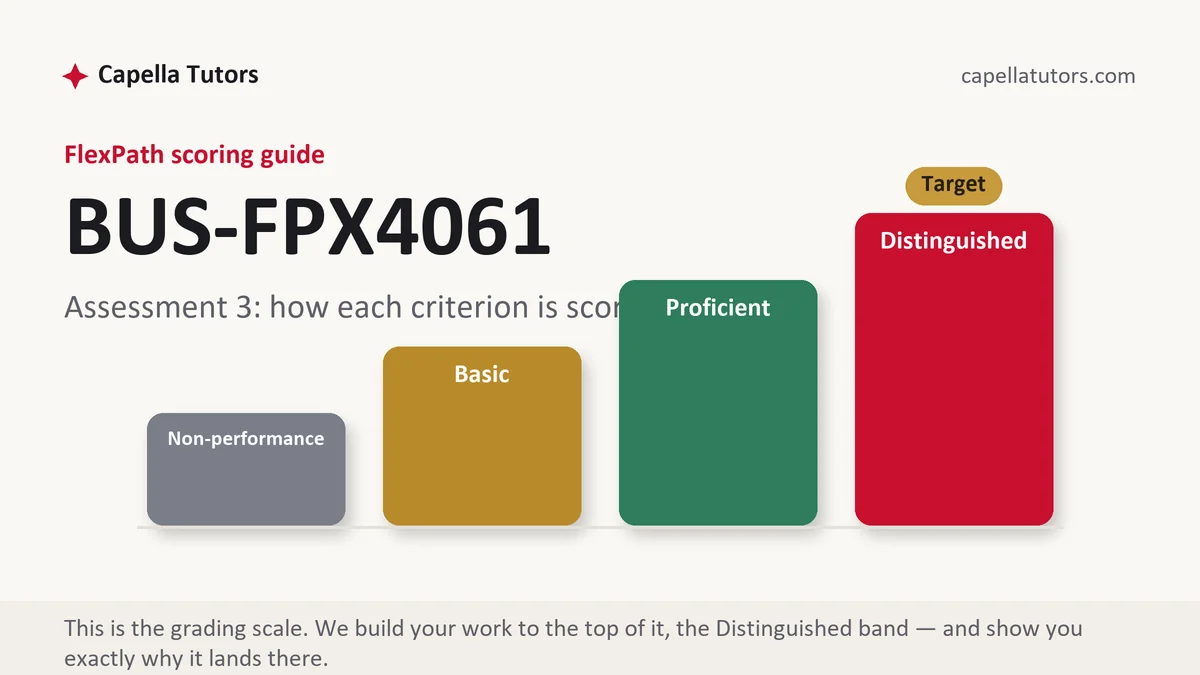
How BUS FPX 4061 Assessment 3 is scored
Each criterion on the guide is marked at one of four levels. Treat the wording of those levels as the outline for what you write:
| Level | What it means on a decision analysis deliverable |
|---|---|
| Distinguished | The alternatives are compared in differential terms, the exclusions are named with reasons, opportunity cost is priced, and the recommendation is followed by the assumption most likely to break it. The top column names the extra move. |
| Proficient | The incremental comparison is correct and the recommendation follows from it. Right answer, quiet about what was left out. |
| Basic | A full cost comparison presented as a decision, with sunk costs and unavoidable allocations still inside the arithmetic. |
| Non-performance | One alternative is not costed, or no recommendation is reached. Declining to conclude is the single response that certainly loses the criterion. |
Two errors account for most of the wrong answers in this deliverable: leaving money already spent inside the comparison, and treating an allocation that will continue as though dropping the product removes it. Say out loud which costs you excluded and the criterion largely looks after itself.
The BUS FPX 4061 Assessment 3 method, step by step
-
Write the decision as a question, then build the criteria into headings
One sentence, with the alternatives named and the volume attached: should the shop keep making 18,000 drawer boxes a year or buy them at the quoted price. A question that specific produces an answerable analysis, while a heading that reads analysis of options produces a description.
-
Separate avoidable from unavoidable, line by line
A drawer box made in-house costs 16.30 dollars, made up of 6.75 of material, 4.60 of labour, 1.85 of variable overhead and 3.10 of allocated fixed overhead. The quote is 14.95, so the naive comparison appears to save 1.35. Only 13.20 of that unit cost actually disappears if production stops, which makes buying 1.75 dearer per unit, or 31,500 a year across 18,000 units.
-
Ask which fixed costs are genuinely avoidable, because some are
Allocation is not automatically unavoidable. If 40 percent of the 3.10 is a lease on a dedicated dowel machine that can be surrendered, 1.24 per unit leaves with the decision, avoidable cost rises to 14.44 and the gap narrows to 0.51 a unit, or 9,180 a year. Say which portion you tested and how you decided, because this is the step most submissions skip entirely.
-
Price the freed capacity
Capacity released by buying is worth whatever the next best use earns. If the vacated machine hours could produce 2,600 chair frames contributing 9.40 each, that is 24,440 of contribution against 9,180 of extra purchase cost, and the decision reverses with a 15,260 advantage to buying. Opportunity cost is a real cost that never arrives as an invoice, and the top of the guide is usually paying for it.
-
Name the factors the arithmetic cannot hold
Numbers rarely settle a make or buy question by themselves. Whether the supplier can hold its delivery dates, what happens to inspection once the work leaves the building, how long the reorder cycle becomes, the position the shop is in when the price is renegotiated, and whether the operation could ever be brought back in house all belong in the recommendation. Treat each one as something that could change the answer, not as a paragraph of hedging bolted on at the end.
-
Recommend, test the weakest assumption, then self-score
State the decision in one sentence. Then move the assumption most likely to be wrong, whether that is the supplier price after year one or the contribution the freed capacity really earns, and show what it takes to flip the answer. Mark each criterion yourself and submit early, since two business days of evaluation time still has to fit inside your billing session.
A structure that maps to the criteria
The targets are our tutors' planning figures for a decision memo of this size; the scoring guide decides whether you deliver schedules, a memo to management, or both together.
| Section | What it must do | Guide |
|---|---|---|
| The decision, stated as a question | The alternatives, the volume, the time horizon and who decides. | ~130 words |
| Relevant cost analysis | The two alternatives side by side in differential terms, carrying only the amounts that differ. | ~280 words |
| Exclusions and why | Costs already incurred and allocations that will not stop, each named and taken out on the page rather than dropped quietly. | ~180 words |
| Avoidable fixed costs and opportunity cost | Which fixed costs leave with the decision, and what the freed capacity is worth. | ~220 words |
| Qualitative factors | What the arithmetic cannot capture, and how much weight each factor carries. | ~180 words |
| Recommendation, sensitivity and references | The answer, the assumption tested, the flip point, and current APA both ways. | ~200 words |
Annotated sample excerpt
A model excerpt from our team showing what a differential comparison looks like when the exclusions are argued instead of assumed.
Ridgeport Furniture Works records a unit cost of 16.30 dollars for a drawer box it makes in-house, against a supplier quote of 14.95, which appears to favour buying by 1.35.1 The comparison is wrong because 3.10 of that unit cost is allocated fixed overhead, and the plant lighting, building insurance and supervisory salaries behind it continue whether or not the shop presses another drawer box, leaving only 13.20 genuinely avoidable and making the purchase 1.75 dearer per unit, or 31,500 across the 18,000 units.2 One part of the allocation does leave, however: the dedicated dowel machine sits on a lease Ridgeport can surrender, worth 1.24 a unit, which narrows the gap to 0.51 and puts the answer inside the range that freed capacity can decide.3
- 1Presents the obvious answer first and labels it an appearance. The paper is now going to earn its conclusion rather than assert one.
- 2Names the excluded amount, says what the cost actually is, and converts the per-unit gap into an annual figure a manager can weigh.
- 3Tests the allocation instead of dismissing it wholesale. That is the distinction between applying the rule and understanding it.
The full premium sample for your exact assessment, written fresh to your scoring guide and issue, is free to request. Study it, revise it into your own voice, and submit work you understand.
The five mistakes that cost Distinguished
- Sunk costs left in the comparison. A cost already incurred is the same figure under either option, so carrying it in can only distort a result it should have no influence over.
- Every allocated fixed cost written off as unavoidable. The rule is that unavoidable costs are irrelevant, not that allocated costs are, and a lease you can release belongs in the analysis.
- Freed capacity valued at zero. Capacity released by buying earns whatever the next best use earns, and ignoring it understates one side of the comparison.
- A recommendation with no decision in it. Presenting both options fairly and stopping is not analysis, and the criterion is written around reaching a defensible answer.
- Qualitative factors used as filler. Supplier reliability matters because it could change the decision, so say how it would, and at what point.
Pre-submission checklist
- The decision written as one question with alternatives, volume and horizon attached
- Alternatives compared in differential terms rather than on full cost
- Every excluded amount named with the reason for excluding it
- Avoidable and unavoidable portions of the fixed overhead tested separately
- Opportunity cost of the freed capacity priced and brought into the comparison
- A stated recommendation, one assumption moved, and the point at which the answer flips
Make or buy call to write up?
Send the cost breakdown, the quote and the criteria. We build the incremental comparison in two columns, argue the exclusions, price the freed capacity and test the assumption most likely to break. Every figure is recomputed by a second reader, and the first premium sample is free.