This manual is for BUS FPX 4061 Assessment 2, start to submission. The middle deliverable in Managerial Accounting Principles usually asks you to build or evaluate a costing system: choose the treatment, set the overhead rate, defend the allocation base, and say what the choice does to the reported cost of a product or a service line. There is no standard to appeal to, so the defense of the base is the assessment. What comes next is the method our tutors follow, a section plan tied to the criteria, and one annotated excerpt from a model. Rather have it built alongside you? A premium original sample for this exact assessment comes back in 24 to 48 hours with every rate and allocation recomputed, revised free until the guide is satisfied. Capella's catalog lists the course as BUS-FPX4061, and some courserooms print BUS4061; both point to this same Assessment 2.
One honesty note before the manual: Capella revises courses and scoring guides over time, so always write to the exact scoring guide attached to your assessment in the courseroom. The course identity above is verified on capella.edu; the method and structure below are our tutors' approach to it, not Capella's official rubric text.
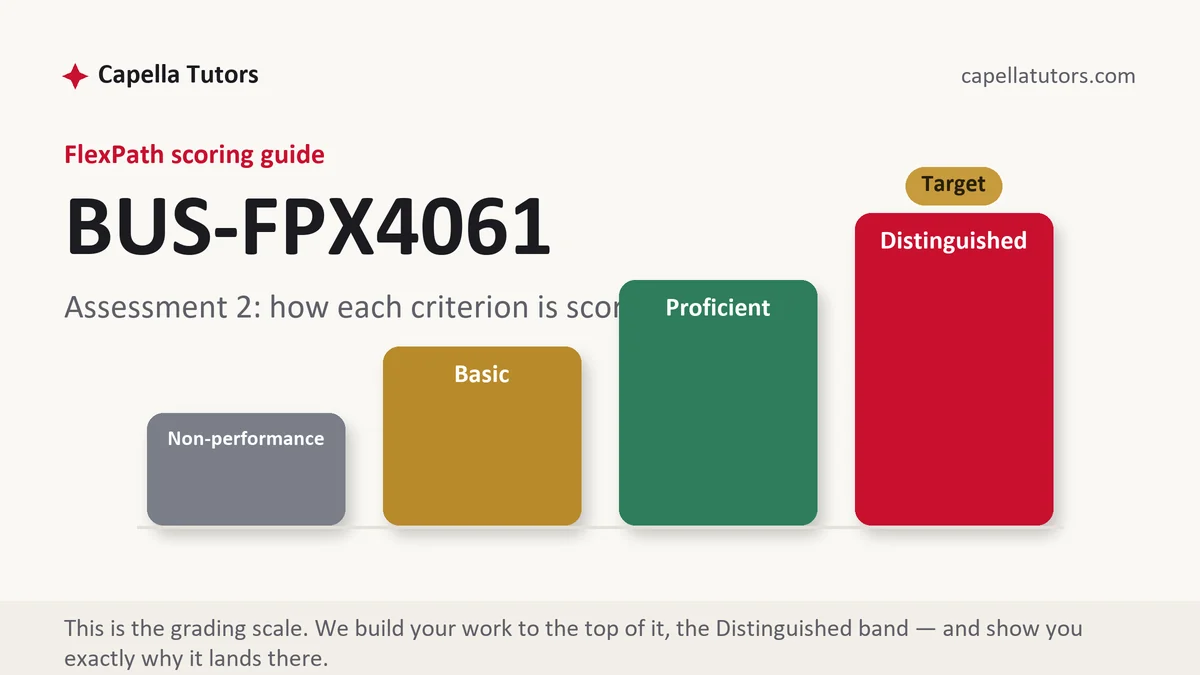
How BUS FPX 4061 Assessment 2 is scored
Four levels, one per criterion, and nothing that resembles a percentage. The level wording is the specification:
| Level | What it means on a costing system deliverable |
|---|---|
| Distinguished | The treatment is chosen from the facts, the allocation base is defended by what actually drives the cost, and the effect of the choice is quantified rather than described. Read the top column for the move it names. |
| Proficient | The rate is correct, the allocation is applied consistently, and the system works. Sound, and silent on why that base was the right one. |
| Basic | A rate computed from whichever total was largest, or an activity model built over a case that never asked for one. |
| Non-performance | The overhead rate or the allocation is missing, or an over and under applied balance is left sitting in the account. Omissions cost more than errors. |
The judgment being tested is narrower than it looks. Every allocation base is a claim about cause, and a paper that treats the base as arithmetic has skipped the only part of the exercise a manager would argue about.
The BUS FPX 4061 Assessment 2 method, step by step
-
Read the criteria for what the case is steering you toward
Give every criterion a heading, then read the fact pattern for signals. Several products of differing complexity, a remark that low-volume work looks unprofitable, or data about setups, inspections and orders processed all point toward tracing overhead to activities. One line of work and one overhead pool point toward a single rate, and an elaborate model over that case reads as display rather than analysis.
-
Decide job or process treatment from how the work actually flows
Costs follow individual jobs when the output differs order to order, and average across units when production is continuous and the units are alike. Say which you have and why in one sentence. A laundry running hotel linen in continuous batches while handling surgical textiles under a separate protocol has both patterns inside one building, and that fact is usually what the criterion is built on.
-
Set the predetermined rate and name the base
An overhead pool of 268,800 dollars a year against 2,240,000 pounds processed gives a plant-wide rate of 0.12 per pound. Compute it before the period begins, as the method requires, then say why pounds is or is not the thing causing the cost. That second sentence is where the criterion sits.
-
Test the base by costing one line both ways
Split the pool: 89,600 of it is sorting and inspection driven by inspection passes, and 179,200 genuinely varies with weight, giving 44.80 per pass and 0.08 per pound. Surgical textiles take 1,600 of the 2,000 passes on 380,000 pounds, so they absorb 71,680 plus 30,400, which is 102,080 against the 45,600 the plant-wide rate assigned them. The same work now costs 0.27 a pound rather than 0.12.
-
Deal with the over or under applied balance
A predetermined rate guarantees a difference between overhead applied and overhead actually incurred, and the criteria expect you to close it. Say how large it is, whether it is over or under applied, and where it goes, whether that is cost of sales or an allocation across the accounts carrying the overhead. A balance left in the account is a visible omission.
-
Say what the choice changed, then self-score
Close by naming the consequence: which line looked profitable under the old rate and does not now, and what a manager would do differently on Monday. Then mark each criterion yourself and rewrite anything below the top. Evaluators have two business days per attempt, so leave room for one resubmission inside the billing session.
A structure that maps to the criteria
The targets below are how our tutors plan a costing deliverable of this kind; your scoring guide decides whether it arrives as schedules, a memo to management or a workbook with commentary.
| Section | What it must do | Guide |
|---|---|---|
| Setting and cost object | What is being costed, why the question arose, and who will use the answer. | ~130 words |
| System selection | Job or process treatment chosen from how the work flows, with the reason stated. | ~160 words |
| Overhead pool and rate | The pool, the base, the predetermined rate, and the argument for that base. | ~200 words |
| Comparative allocation | One line costed under a single rate and under an activity view, with the difference shown. | ~280 words |
| Over or under applied overhead | The variance, its direction, and its disposition. | ~150 words |
| Consequence and references | What the reported costs now say, what a manager should do, and current APA in both directions. | ~200 words |
Annotated sample excerpt
A model excerpt from our team showing how an allocation argument reads when the base is defended instead of assumed.
Tidewater Linen Service has always spread its 268,800 dollars of annual overhead across 2,240,000 pounds processed, a rate of 0.12 per pound that treats weight as the thing causing the cost.1 Weight explains the washing, drying and water charges, but it explains almost nothing about sorting and inspection, and surgical textiles consume 1,600 of the plant total of 2,000 inspection passes while contributing only 380,000 of its pounds.2 Splitting the pool at 89,600 for inspection and 179,200 for weight-driven processing moves 56,480 of cost onto the surgical line, raising its overhead from 45,600 to 102,080, which is 0.27 a pound rather than 0.12.3
- 1States the existing method and, in the same sentence, the claim about cause it silently makes. Naming that claim is what opens the analysis.
- 2Separates what the base explains from what it does not, using the plant own activity counts as evidence rather than assertion.
- 3Quantifies the consequence. A criterion about method choice is asking for this number, and most submissions describe the difference instead of computing it.
The full premium sample for your exact assessment, written fresh to your scoring guide and issue, is free to request. Study it, revise it into your own voice, and submit work you understand.
The five mistakes that cost Distinguished
- An allocation base with no causal argument. Direct labour hours are a habit rather than a reason, and a base chosen by convention is the easiest thing in the paper to challenge.
- An activity model built for a case that did not need one. One product line and one overhead pool call for a single rate, and complexity that earns nothing reads as padding.
- Over or under applied overhead left in the account. A predetermined rate always produces a difference, and the criteria expect you to name it, size it and dispose of it.
- Allocated cost used to kill a service line. A line showing a loss after full allocation may be covering fixed costs that will not leave with it, and that error is expensive in both directions.
- A rate computed after the fact. A predetermined rate is set before the period starts, and deriving it from actual results defeats the purpose the method exists for.
Pre-submission checklist
- Job or process treatment chosen from the facts, with the reason on the page
- The overhead pool, the base and the predetermined rate all shown and computed
- The allocation base defended by what drives the cost, not by convention
- At least one line costed under two methods, with the difference quantified
- Over or under applied overhead identified, sized and disposed of
- A closing paragraph naming what the reported costs change for a manager
Costing system deliverable on the clock?
Send the overhead data, the activity counts and the criteria. We select the treatment from the facts, set the rate, defend the base, cost a line under two methods and close the applied overhead balance. Every figure is recomputed independently, and the first premium sample is free.