This manual is for BUS FPX 4061 Assessment 1, start to submission. The opening deliverable in Managerial Accounting Principles usually gives you a cost structure and asks what happens when something in it moves. Classify the costs, separate anything mixed, compute contribution margin, find break-even, and say what the answer means to whoever has to act on it. No reporting standard governs any of this, which is why every classification you make has to be defended in a line. The pages below give our tutors' working method, a structure that answers the criteria one at a time, and an annotated model excerpt. Prefer backup? A premium original sample for this exact assessment lands in 24 to 48 hours with all arithmetic independently recomputed and revisions included until the criteria are satisfied. Capella's catalog lists the course as BUS-FPX4061, and some courserooms print BUS4061; both point to this same Assessment 1.
One honesty note before the manual: Capella revises courses and scoring guides over time, so always write to the exact scoring guide attached to your assessment in the courseroom. The course identity above is verified on capella.edu; the method and structure below are our tutors' approach to it, not Capella's official rubric text.
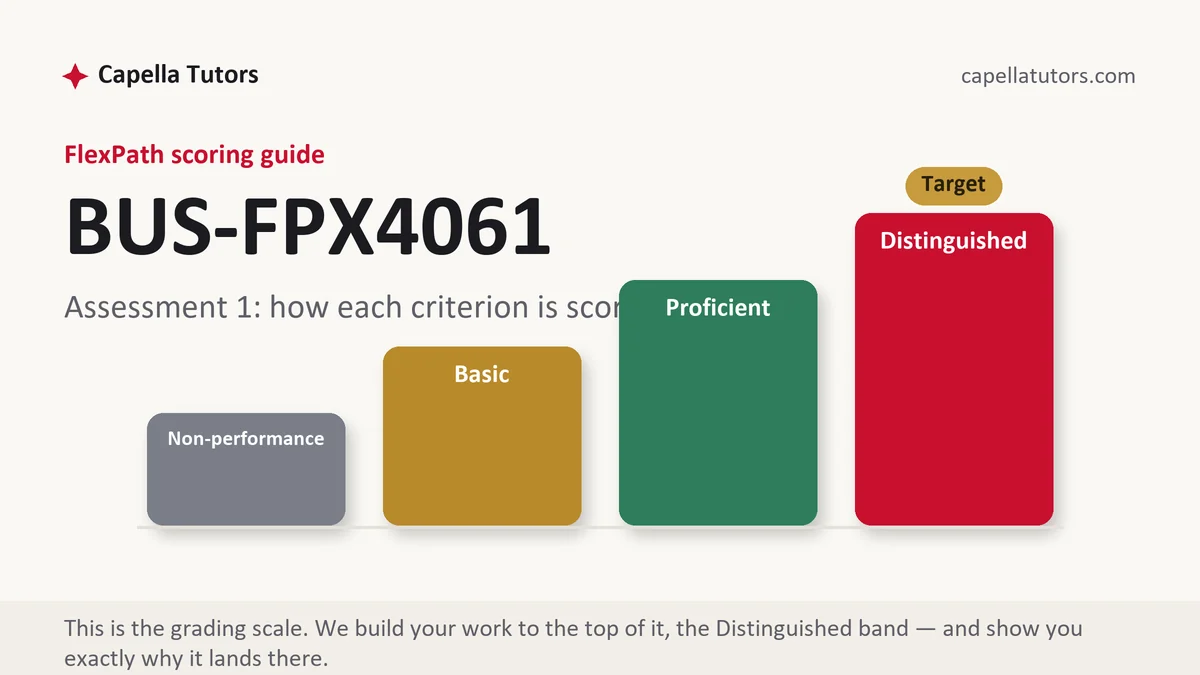
How BUS FPX 4061 Assessment 1 is scored
FlexPath scores criterion by criterion on four levels, with no letter grade at the end. Read the level text as instructions:
| Level | What it means on a cost behavior and contribution analysis |
|---|---|
| Distinguished | Every cost is classified with a one-line defense, the relevant range is stated, the contribution figures are computed and then interpreted, and one assumption is tested. The extra move is printed in the top column of the guide. |
| Proficient | The classifications and the break-even arithmetic are correct and complete. Accurate work that leaves the manager to draw the conclusion. |
| Basic | Costs sorted into fixed and variable with no justification offered, or a break-even figure produced and never explained. |
| Non-performance | A required computation is missing, or a mixed cost was used without being separated. An absent element scores below a flawed one. |
The habit this deliverable builds is worth more than the arithmetic in it. Contribution margin is the idea the rest of the course runs on, and a student who can say what one more unit contributes can answer most of what a later decision or budget assessment asks.
The BUS FPX 4061 Assessment 1 method, step by step
-
Make the criteria the outline, then classify before you calculate
Give each criterion its own heading. Then build a short table of every cost in the case with its behaviour and one line of justification. A classification you cannot defend in a sentence will undermine every figure that depends on it, and in this course almost every figure depends on it.
-
Separate the mixed costs and say what the method costs you
Route fuel and maintenance came to 21,600 dollars in the busiest month at 34,000 miles and 15,120 in the quietest at 22,000. The spread of 6,480 across 12,000 extra miles puts the variable element at 0.54 a mile, so stripping 18,360 of mileage cost out of the busy month leaves 3,240 that the trucks incurred whether they rolled or not. Two observations carry the whole estimate, so look at both months for anything unrepresentative and write down what you found.
-
State the relevant range out loud
A fixed cost is only fixed inside a range of activity, and a projection that lifts volume while holding every fixed cost constant is wrong in a way an evaluator will notice. Warehouse space is fixed until a second bay is needed and a route supervisor is fixed until the route count changes. Name the range your figures hold inside.
-
Compute contribution margin and everything that follows from it
A delivered case earning 6.40 dollars against 3.85 of variable cost contributes 2.55, about 39.8 percent of the fee. Against monthly fixed route costs of 71,400 the break-even point is 28,000 cases, or 179,200 dollars of revenue. A target profit of 18,000 needs 89,400 divided by 2.55, which is 35,059 cases. At the current 41,000 cases the margin of safety is 13,000 cases, close to a third of present volume, and that last figure is the one a manager actually wants.
-
Test a change, because that is what the criterion is for
Move one variable and show the consequence. Cutting the fee by 0.60 dollars drops contribution to 1.95 and lifts break-even to 36,616 cases, which means the reduction has to raise volume by more than 30 percent before the business is back where it started. That sentence is the analysis; the break-even figure on its own is only an input to it.
-
Interpret for the manager, then self-score
Close with what a person deciding something should do differently, and name the assumption most likely to be wrong. Then mark yourself against each criterion at the top level and rewrite anything below it. Faculty take up to two business days per attempt, so submit early enough that a resubmission still fits your billing session.
A structure that maps to the criteria
These are our tutors' planning targets for a cost behavior deliverable, not Capella rules; your scoring guide decides whether the output is a set of schedules, a memo or a workbook with commentary.
| Section | What it must do | Guide |
|---|---|---|
| Purpose and decision at stake | What is being decided, by whom, and what the analysis has to answer for them. | ~120 words |
| Cost classification table | Every cost as fixed, variable or mixed, with a line of justification and the relevant range stated. | ~250 words |
| Mixed cost separation | The method used, the observations behind it, the variable rate and the fixed element. | ~150 words |
| Contribution and break-even | Unit contribution in dollars and as a ratio, break-even in units and revenue, target volume, margin of safety. | ~280 words |
| Sensitivity test | One variable moved, the new break-even, and the volume change required to stand still. | ~180 words |
| Recommendation and references | The answer, the qualitative factors, and current APA in both directions. | ~200 words |
Annotated sample excerpt
A model passage from our team showing how the contribution figures read when they are interpreted rather than merely reported.
Each case Sandhill Beverage Distribution delivers earns 6.40 dollars and consumes 3.85 in handling, fuel and driver time, contributing 2.55 toward the 71,400 of fixed route cost the company carries every month.1 Break-even is therefore 28,000 cases, and at a current volume of 41,000 the company sits 13,000 cases clear, a cushion of just under a third of what it now moves.2 That is the figure worth taking into the route negotiation, because a wholesaler asking for a 0.60 reduction in the delivered rate is asking Sandhill to move its break-even to 36,616 cases and surrender nearly two thirds of the cushion it now holds.3
- 1Builds the contribution figure from its parts inside one sentence, so the 2.55 is derived on the page rather than announced.
- 2Reports break-even and immediately converts it into the margin of safety, which is the form a manager can act on.
- 3Answers the question the case actually asked. The arithmetic serves a decision, which is what the top of the guide describes.
The full premium sample for your exact assessment, written fresh to your scoring guide and issue, is free to request. Study it, revise it into your own voice, and submit work you understand.
The five mistakes that cost Distinguished
- Mixed costs used without separation. A cost containing both behaviours cannot enter a contribution calculation until it is split, and using the total quietly corrupts every figure downstream.
- Fixed costs projected outside the relevant range. If a forecast lifts volume sharply while every fixed cost stays exactly where it was, the paper has quietly assumed something about capacity that it never argues for.
- Break-even computed and never interpreted. A break-even figure earns its keep through the margin of safety it implies, so a number sitting on the page with nothing said beside it leaves the criterion half answered.
- Classifications with no justification. Nothing here is set by a standard, which makes the defense of each choice the work rather than a formality.
- A single projected number with no sensitivity test. A forecast offered as one certain figure leaves an evaluator with one obvious question, so put the answer in the paper before it gets asked.
Pre-submission checklist
- Every criterion from the guide has a heading and every heading has figures under it
- Each cost classified with one line of justification and a stated relevant range
- Mixed costs separated, with the method named and its weakness acknowledged
- Contribution margin given in dollars and as a ratio, break-even in both units and revenue
- Margin of safety computed and expressed in terms a manager can use
- One variable moved, the new break-even shown, and the required volume change stated
Cost structure to analyze this week?
Send the cost data and the criteria. We classify every line with a defense, split the mixed costs, run the contribution and break-even arithmetic, and test the assumption most likely to break. A second reader recomputes each figure before delivery, and the first premium sample is free.