This manual is for BUS FPX 4060 Assessment 2, start to submission. The middle deliverable in Financial Accounting Principles usually hands you an unadjusted trial balance and a short list of period-end facts, then asks which accounts are misstated at the reporting date, by how much, and why that period is the right one. Accrual reporting lives entirely in these entries, and the scoring guide is built to find out whether you understand them or copied them. The method our tutors work to is set out below, together with a structure keyed to the criteria and one annotated excerpt. Handing it off is an option: a premium original sample for this exact assessment returns in 24 to 48 hours with every computation independently rechecked, and revisions cost nothing until the criteria are met. Capella's catalog lists the course as BUS-FPX4060, and some courserooms print BUS4060; both point to this same Assessment 2.
One honesty note before the manual: Capella revises courses and scoring guides over time, so always write to the exact scoring guide attached to your assessment in the courseroom. The course identity above is verified on capella.edu; the method and structure below are our tutors' approach to it, not Capella's official rubric text.
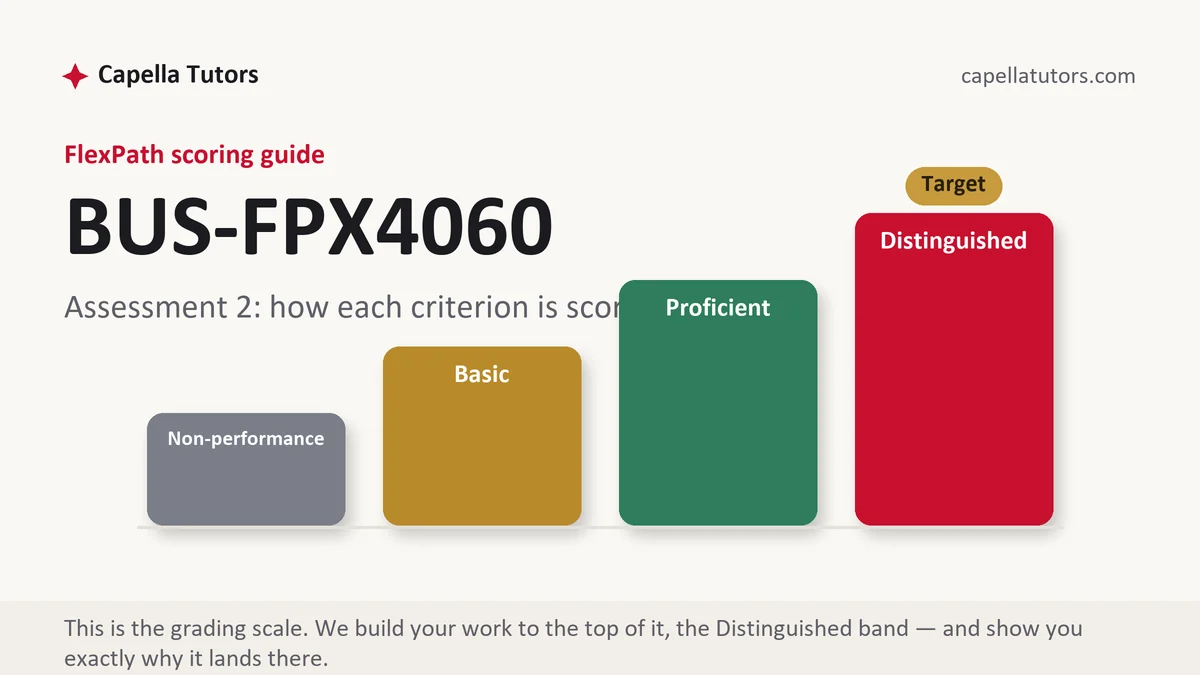
How BUS FPX 4060 Assessment 2 is scored
There are four levels on a FlexPath criterion and no letter grade anywhere. The level descriptions are the specification for what you write:
| Level | What it means on an adjustment deliverable |
|---|---|
| Distinguished | Each adjustment carries a computation and a stated reason for the period selected, the contra accounts are used as designed, and the adjusted trial balance agrees without help. The top column always asks for one further move; find it and make it. |
| Proficient | The adjustments are complete and correctly computed. Accurate, and still short of the top, usually because the reason for the period is missing. |
| Basic | Adjustments made mechanically, amounts right and reasoning invisible, or one or two entries quietly skipped. |
| Non-performance | A required adjustment is absent, or the adjusted trial balance never appears. An omission drops a criterion further than an error does. |
Omissions are expensive here because a single adjustment moves two statements at once. A missed accrual understates expense on the income statement and understates the liability on the balance sheet in the same stroke, and the error travels into the next period rather than staying where it was made.
The BUS FPX 4060 Assessment 2 method, step by step
-
Build the criteria into headings, then walk the trial balance line by line
Read the guide first and give each criterion a heading. Then take the unadjusted trial balance one account at a time and ask a single question of each: has anything happened to this account since the entry was made that the books do not yet know about. That pass is what finds adjustments. Reading the fact list alone finds only the ones the prompt made obvious.
-
Sort every adjustment into its family
There are five, and naming the family first prevents most errors. Cash paid before the benefit is consumed, cash received before the work is done, expense incurred and not yet invoiced, revenue earned and not yet billed, and the periodic allocation of a long-lived asset cost. Once the family is settled the direction of the entry is settled with it, and only the amount is left to compute.
-
Compute each amount in the document
Insurance of 10,800 dollars bought on the first of February for twelve months costs 900 a month, so five months consumed by the end of June moves 4,500 to expense and leaves 6,300 prepaid. Five staff earning 152 dollars a day for three days worked after the last payroll is 2,280 of accrued wages. Rent of 14,400 collected on the first of March for a twelve month block releases 1,200 a month, so four months earned moves 4,800 out of the liability. Write the division and the multiplication down where a reader can see them.
-
Use the contra accounts the way they were designed
Depreciation is credited to accumulated depreciation, never to the asset. Fencing and gates costing 46,000 dollars with a salvage value of 6,000 over ten years take 4,000 a year, so a six month period takes 2,000. Crediting the asset directly hides original cost from the reader, which is exactly the information the contra account exists to preserve, and the criteria treat that as an error rather than a preference.
-
Prove the adjusted trial balance and carry the effects forward
Post into a worksheet laid out in columns, showing the balances before adjustment, the adjustments themselves, and the balances after, so every step of the arithmetic can be inspected. Confirm the adjustment column balances on its own before you check the final totals. Then say, for each adjustment, what it did to income and what it did to the balance sheet, because that sentence is frequently the criterion itself.
-
Self-score the reasoning, not only the numbers
Mark each criterion yourself. The usual gap in this deliverable is not arithmetic; it is an entry with a correct amount and no stated reason for the period. Fix those, then submit with room to spare, since faculty have two business days per attempt and a resubmission still has to fit inside your billing session.
A structure that maps to the criteria
These targets are our tutors' planning figures for an adjustment deliverable, not Capella requirements; the schedules expand with the number of facts your prompt supplies.
| Section | What it must do | Guide |
|---|---|---|
| Scope and reporting date | The business, the period being closed, and the date every adjustment is measured against. | ~110 words |
| Adjustment schedule | Each item, its family, the computation, and the accounts it touches. | ~280 words |
| Adjusting journal entries | The entries in proper form, dated at the reporting date, each with its reason. | as needed |
| Worksheet and adjusted trial balance | Balances before adjustment, the adjustment column proved equal, and the post-adjustment balances agreeing. | one schedule |
| Effect on the statements | What each adjustment did to income and to the balance sheet, named account by account. | ~220 words |
| Assumptions and references | Any estimate you made, the basis for it, and current APA in both directions. | ~150 words |
Annotated sample excerpt
A model excerpt written by our team to show what a defensible adjustment looks like on the page. Take the moves, not the figures.
Cedar Row Storage bought twelve months of property insurance for 10,800 dollars on 1 February, and five of those months had been consumed by the 30 June reporting date, so 4,500 belongs to this period and 6,300 remains an asset.1 The entry debits insurance expense 4,500 and credits prepaid insurance 4,500, and the reason is that coverage is used up with the passage of time rather than at the moment the premium leaves the account.2 Without it, expense for the period is understated by 4,500 and total assets are overstated by the same amount, so both statements are wrong from one omission.3
- 1Puts the whole computation in one sentence: annual cost, months elapsed, amount consumed, amount remaining. A reader can reproduce it without asking a question.
- 2Gives the reason for the period rather than describing the entry. This is the sentence that separates the top of the guide from a merely correct answer.
- 3Names the effect on both statements. Adjustments move two places at once, and saying so demonstrates that you know why the entry exists.
The full premium sample for your exact assessment, written fresh to your scoring guide and issue, is free to request. Study it, revise it into your own voice, and submit work you understand.
The five mistakes that cost Distinguished
- Depreciation credited straight to the asset. Keeping the accumulated amount in its own account is what lets a reader see what the asset cost and how much of it has been used up, and merging the two throws that away.
- An adjustment in the fact list but not in the accounts. Prompts routinely bury one item that only a line-by-line pass over the trial balance will surface, and that item is usually the point of the question.
- Amounts right, period unexplained. Every criterion in this deliverable is written around matching a cost to a period, so an entry with no stated reason answers half of it.
- Accruals dated by the invoice. An expense incurred before the reporting date belongs to this period even though the paperwork arrives next month, and dating it by the invoice defeats the accrual.
- Unsupported estimates. Useful life and salvage value are judgments. Name the basis you worked from, because an assumption you declare helps your case while one you bury waits to be found.
Pre-submission checklist
- Each criterion from the scoring guide appears as its own heading
- Every account on the unadjusted trial balance tested against the reporting date
- Each adjustment shows its family, its computation and its reason for the period
- Depreciation credited to accumulated depreciation rather than to the asset account
- The adjustments column balances and the adjusted trial balance agrees without a plug
- The effect of each adjustment on income and on the balance sheet stated in words
Unadjusted trial balance sitting in front of you?
Send it with the period-end facts and the criteria. We identify the adjustments, show every computation, build a worksheet that balances and write the reasoning for each period chosen. A separate reconciliation pass checks the figures before delivery, and the first premium sample costs nothing.