This manual is for BUS FPX 4060 Assessment 1, start to submission. The opening deliverable in Financial Accounting Principles usually hands you a list of business events and asks you to decide what each one did to the accounts, record it in proper journal form, post it, and prove that the debits equal the credits. It is marked the way every FlexPath deliverable is marked, one criterion at a time against the guide attached to it, and the arithmetic is read as closely as the prose. What follows is the method our tutors use on it, a structure built from the criteria, and an annotated excerpt from a model answer. Prefer to hand it off? A premium original sample for this exact assessment comes back in 24 to 48 hours, with a second reader re-deriving every entry, and revisions cost nothing until the guide is satisfied. Capella's catalog lists the course as BUS-FPX4060, and some courserooms print BUS4060; both point to this same Assessment 1.
One honesty note before the manual: Capella revises courses and scoring guides over time, so always write to the exact scoring guide attached to your assessment in the courseroom. The course identity above is verified on capella.edu; the method and structure below are our tutors' approach to it, not Capella's official rubric text.
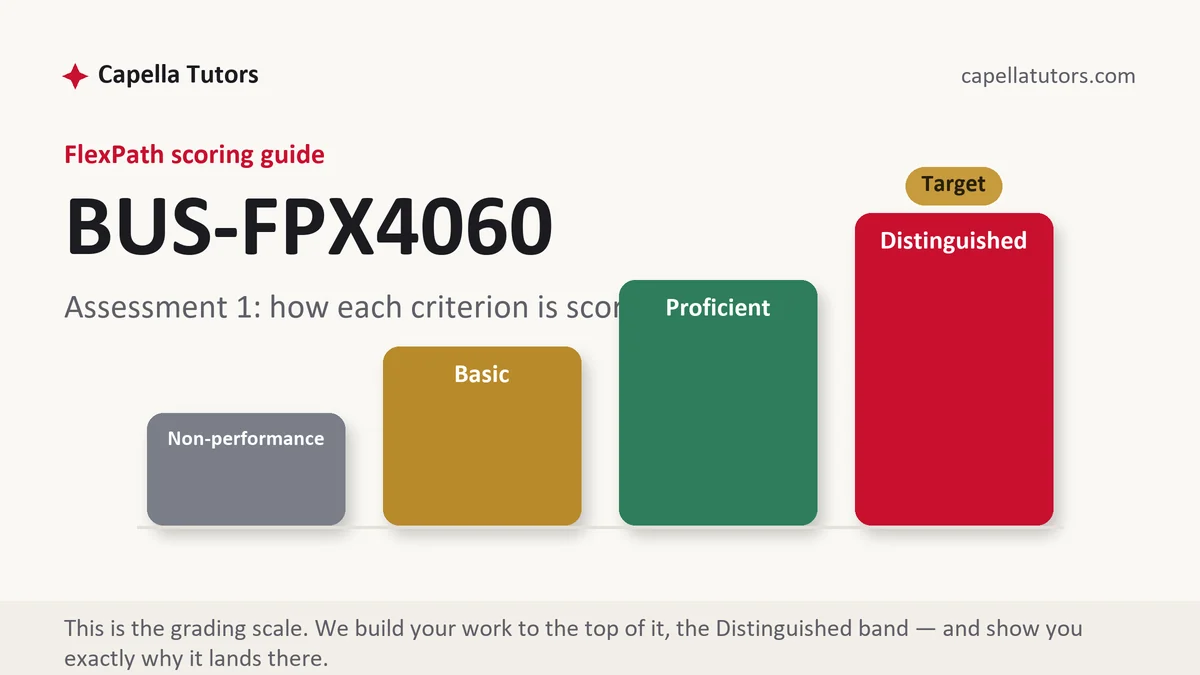
How BUS FPX 4060 Assessment 1 is scored
FlexPath does not award letter grades. The guide marks each criterion at one of four levels, and that level wording is the brief you are writing to:
| Level | What it means on a recording deliverable |
|---|---|
| Distinguished | Every event is analyzed before it becomes an entry, the entry is in proper form, and a short reason sits beside it saying what came in and what went out in exchange. The trial balance proves itself. The extra move is written into the criterion, so read the top column and make it. |
| Proficient | The entries are correct and complete. Solid work, and one move short of the top, usually because the reasoning stayed in your head instead of on the page. |
| Basic | Entries copied out with no visible analysis, or a column of totals that does not add. Correct-looking work a reader cannot verify lands here more often than wrong work does. |
| Non-performance | Something the guide requires is simply not in the document, most often the trial balance or the explanations. What is absent costs you more than what is merely thin. |
Nothing later in the course escapes this deliverable. The adjustments and the statements you will be graded on afterwards read from the accounts you build here, so an amount posted on the wrong side now comes back as a wrong statement later.
The BUS FPX 4060 Assessment 1 method, step by step
-
Turn the criteria into headings before you read the data
The prompt tells you what the deliverable looks like; the scoring guide decides what it is worth. Copy each criterion into your document as a heading and park its top-level description underneath. Anything you write outside those headings is unpaid work, and anything a heading needs and does not have is a criterion sitting at the floor.
-
Ask two questions of every event
What came into the business, and what left it or was promised in exchange. A shop buying a computer-controlled router priced at 31,500 dollars, paying 7,500 down and signing a note for the rest, took in an asset worth 31,500, parted with 7,500 of cash and owes 24,000. That reads straight across into a debit to equipment of 31,500, a credit to cash of 7,500 and a credit to notes payable of 24,000. Reason your way through the unfamiliar events rather than matching them against a memorised list.
-
Write the entry in proper form, then write the reason
Date, debits first, credits indented beneath, and one line underneath saying why. The reason is not decoration. Several criteria in this course award the explanation as much weight as the mechanics, and a reader who can see why you chose those accounts will extend some trust to the ones they cannot check.
-
Show the arithmetic that sits inside an entry
Some events carry a small calculation, and the criterion is usually about that calculation. Material bought for 8,400 dollars on terms of 2 percent within ten days and paid inside the window costs 168 dollars less, so cash falls by 8,232 and the 168 reduces the recorded cost of the material rather than becoming income. Put the multiplication in the document. An amount with no visible working cannot be marked correct.
-
Post to the accounts and prove the total
Carry each entry into its account, foot the columns, and build the unadjusted trial balance. If it does not agree, the size of the gap will usually tell you where to look. Halve it and hunt for that amount in your work, since a figure entered on the wrong side shows up as a shortfall of exactly twice itself. If the gap divides evenly by nine, suspect two swapped digits inside a single amount. If it is a round number, an entry probably never made it out of the journal. Never plug it.
-
Self-score, then submit early in the week
Go through the draft criterion by criterion and put your own mark against each one, Distinguished, Proficient, Basic or Non-performance, without being generous about it. Anything below the top gets another pass. Faculty have two business days per attempt, so work handed in late in the week may not be looked at until the next one, while an early submission leaves room to resubmit.
A structure that maps to the criteria
Our tutors use the figures below as planning targets for a recording deliverable of this size, not as Capella rules; the schedules grow or shrink with the transaction list you were handed.
| Section | What it must do | Guide |
|---|---|---|
| Purpose and scope | Name the business, the period covered and what the deliverable contains, in a few sentences a reader can use as a map. | ~120 words |
| Transaction analysis | Each event listed with the accounts affected, the direction of each effect and the amount. | ~250 words |
| Journal entries | Every entry in proper form with a date and a one-line reason beneath it. | as needed |
| Ledger postings | Entries carried into the accounts, with each account footed to a balance. | as needed |
| Unadjusted trial balance | All accounts with their balances, debits equal to credits, no plug figure. | one schedule |
| Notes, assumptions and references | Any judgment you exercised, what you assumed and why, and current APA in both directions. | ~200 words |
Annotated sample excerpt
One paragraph from a model our team wrote for this deliverable. Read it for the moves rather than the figures, then rebuild them around your own transaction list.
Harbor Line Signworks paid 7,500 dollars in cash and signed a 24,000 dollar note for a computer-controlled router priced at 31,500, so the shop acquired one asset and created one obligation in a single event.1 Equipment is debited for the full 31,500 because the recorded cost is what the shop agreed to pay rather than what it handed over on the day, cash is credited 7,500 and notes payable is credited 24,000.2 Two weeks later the shop settled an 8,400 dollar aluminum invoice inside its ten-day discount window, taking 168 dollars off the amount owed, which reduces the recorded cost of the material rather than creating income.3
- 1States what happened in the language of the business before naming a single account. The analysis is visible, which is what the criterion is looking for.
- 2Gives the reason for the recorded amount, not just the amount. One clause about cost versus cash paid answers a question the evaluator was about to ask.
- 3Carries the 168 dollar calculation into the sentence and says where it lands. A discount treated as income is a common error, and naming the correct treatment forecloses it.
The full premium sample for your exact assessment, written fresh to your scoring guide and issue, is free to request. Study it, revise it into your own voice, and submit work you understand.
The five mistakes that cost Distinguished
- A trial balance forced to agree. Anybody who re-adds the columns will find the number you invented, and every schedule resting on that total goes down with it.
- Entries with no reason attached. A note repeating the debit and the credit in words tells a reader nothing they could not already see; the criterion wants to know why those accounts and those amounts were chosen.
- Purchase discounts recorded as income. Taking 168 dollars off an invoice reduces the cost of what you bought, and the treatment is graded rather than assumed.
- Amounts asserted without the working. A figure that appears from nowhere cannot be checked, and a criterion about accuracy depends on being able to check it.
- Consumer-grade sourcing. Homework answer sites and accounting blogs are not authorities. The codification, the Securities and Exchange Commission and the professional bodies are.
Pre-submission checklist
- Each criterion from the guide carries its own labeled section in the document
- Each event analyzed in the language of the business before it becomes an entry
- Debits and credits in proper form, dated, with a one-line reason under each
- Every internal calculation shown, including discounts, part payments and allocations
- Unadjusted trial balance in balance, with no plug and no unexplained difference
- Self-scored at the top of the guide on every criterion, submitted early in the week
Transaction list and criteria in hand?
Send the events, the account names you were given and the scoring guide. We analyze each transaction, post the entries, foot the accounts and prove the trial balance, with a second reader recomputing every figure before it reaches you. The first premium sample is free.