This manual is for BUS FPX 4048 Assessment 3, start to submission. In current courserooms, Assessment 3 of this course is a case study of a global company's talent management strategy, for example a video game company known for its distinctive culture: its approach to attracting, developing and retaining talent, the cultural influences on its HR practices, your view of what works and what does not, and how HR leaders and non-HR leaders share responsibility for talent. The grade turns on analysis of the case. Retelling the company's story scores lower than evaluating its strategy against evidence and its own results. Below is the method our tutors use, a structure that maps to the criteria, and an annotated sample excerpt. Prefer to hand it off? A premium original sample for this exact assessment comes back in 24 to 48 hours, revised free until it meets the guide. Capella's catalog lists the course as BUS-FPX4048, and some courserooms print BUS4048; both point to this same Assessment 3. In current courserooms this assessment typically appears as "Talent Management Strategy Case Study".
One honesty note before the manual: Capella revises courses and scoring guides over time, so always write to the exact scoring guide attached to your assessment in the courseroom. The course identity above is verified on capella.edu; the method and structure below are our tutors' approach to it, not Capella's official rubric text.
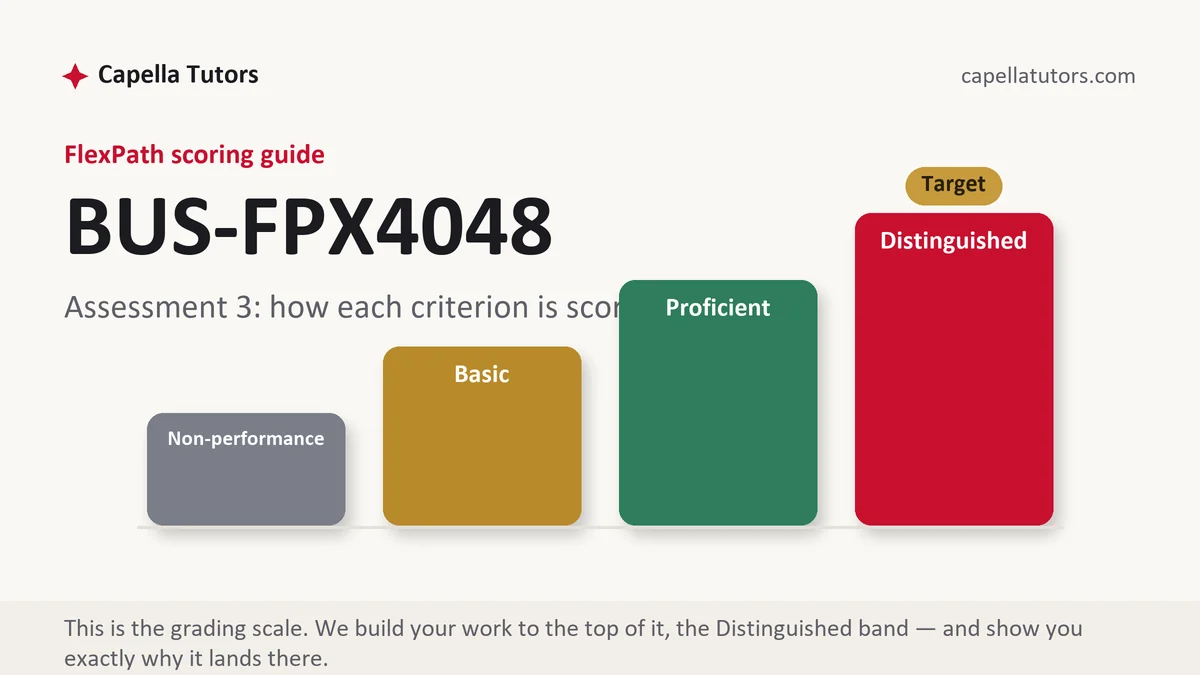
How BUS FPX 4048 Assessment 3 is scored
FlexPath does not use letter grades. Each criterion in the scoring guide lands on one of four levels, and the level descriptions are the real writing brief:
| Level | What it means on a talent management case study |
|---|---|
| Distinguished | The talent management case study is specific to the organization or case, applies course concepts accurately with credible sources, and ends in justified conclusions or recommendations. |
| Proficient | The talent management case study is accurate, but the application or recommendations are general. |
| Basic | The talent management case study describes concepts with little application. |
| Non-performance | A required part of the talent management case study is missing. |
Use the company your courseroom names and cite reporting on it.
The BUS FPX 4048 Assessment 3 method, step by step
-
Summarize the company
History, size and culture.
-
Analyze talent management
Hiring, development, retention and performance.
-
Cultural influences
How national and organizational culture shape HR.
-
Evaluate the strategy
Strengths and problems, with evidence.
-
Compare HR and non-HR leaders
Who owns which talent decisions.
-
Recommend
Changes to strengthen the strategy.
A structure that maps to the criteria
Word counts are planning targets our tutors use, not Capella rules; follow the length and format your scoring guide states.
| Section | What it must do | Guide |
|---|---|---|
| Introduction | The company. | ~75 words |
| Talent management | The strategy. | ~150 words |
| Cultural influences on HR practices | Analysis. | ~125 words |
| Personal view, HR versus non-HR leaders and references | Evaluation, then references. | ~150 words |
Annotated sample excerpt
An original model excerpt from our team, written to show the register that reaches the top of the guide. Learn the moves, then write your own version.
The company built its talent strategy on hiring passionate players of its own games, which produced deep commitment but also a narrow culture that later faced public allegations of gender discrimination and a legal settlement.1 The lesson is that a strong culture can become a hiring filter that excludes people who would add needed perspectives.2 In my view, the company's later move to tie leaders' evaluations to inclusion goals was the right correction, because talent decisions are made by managers across the business, not only by HR.3
- 1Identifies a strength and its downside with evidence.
- 2Draws a general lesson.
- 3Takes a reasoned position linked to HR versus line leaders.
The full premium sample for your exact assessment, written fresh to your scoring guide and topic, is free to request. Study it, revise it into your own voice, and submit work you understand.
The five mistakes that cost Distinguished
- Definitions without application. Apply each concept to the organization or case.
- No sources. Cite credible business sources.
- Vague recommendations. Make them specific and justified.
- Retelling the story. Evaluate the strategy.
Pre-submission checklist
- Company summarized
- Talent strategy analyzed
- Cultural influences
- Evaluation with evidence
- HR and non-HR roles
- References
Want the talent management case study written?
Send the scoring guide and any materials from your courseroom. Our team returns a premium original talent management case study in 24 to 48 hours, revised free until it meets the guide.