How to write BUS-FPX4048 Assessment 1

The short answer

This manual is for BUS-FPX4048 Assessment 1, start to submission. An opening assessment in an international human resource course usually asks you to design or evaluate an overseas staffing arrangement and defend it. The assessment usually wants the host country's statutory constraints named with sources and the package costed and totalled, because a policy no local operation could lawfully implement fails the criterion however well it reads. Your scoring guide decides whether that arrives as a policy, a package proposal or a recommendation to leadership. Or hand it over: a premium original sample with the package itemised, totalled and set against the assignment arrives inside 24 to 48 hours, revised free until it scores. Your courseroom may print this as BUS FPX 4048 Assessment 1 or BUS4048 Assessment 1; it is the same deliverable, and BUS-FPX4048 Assessment 1 is what this manual walks through.

One honesty note before the manual: Capella revises courses and scoring guides over time, so always write to the exact scoring guide attached to your assessment in the courseroom. The course identity above is verified on capella.edu; the method and structure below are our tutors' approach to it, not Capella's official rubric text.
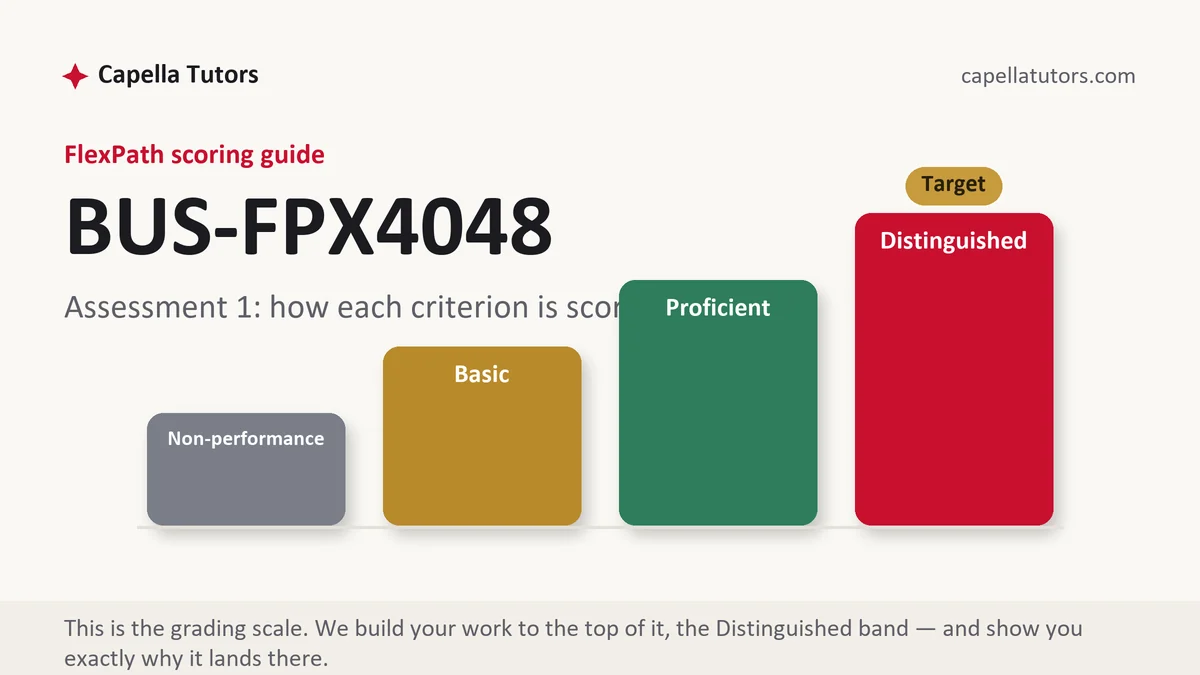
BUS-FPX4048 Assessment 1 grading scale at Capella FlexPath, the criterion levels this assessment is scored on, from Capella Tutors
How Capella FlexPath grades BUS-FPX4048 Assessment 1, visualized by Capella Tutors.

How BUS-FPX4048 Assessment 1 is scored

FlexPath grades each criterion separately at one of four levels, and the level wording is the brief:

LevelWhat it means on an international assignment deliverable
DistinguishedSpecific statutory requirements named with sources, a costed package built on a stated methodology, and the total set against the value of the assignment.
ProficientA defensible staffing choice with a complete package and the legal context covered.
BasicA general account of cultural difference with allowances listed and never totalled. Where most first attempts at an assignment policy land.
Non-performanceA required element absent, most often the compliance section or the total cost.

Hiring methods, training design and appraisal conversations generally survive the move with some adjustment. Employment protection, working time, dismissal procedure, employee representation and data handling do not transfer at all, because they are set by the law of the country where the person works rather than by the policy of the country where the company is headquartered.

The BUS-FPX4048 Assessment 1 method, step by step

  1. Fix the two countries and the assignment type before researching anything

    A short project assignment, a three-year posting with family and a permanent local transfer raise almost entirely different questions, and a paper that has not decided which one it describes will drift. Write the type into the first heading and hold it.

  2. Research the host country's employment rules as constraints

    Find the statutory notice period, the minimum leave entitlement, the standard working week, the rules on fixed-term contracts, whether statutory employee representation exists, and what dismissal actually requires. Write these in as facts with sources, because a criterion about legal context is asking for exactly this and most submissions offer generalities.

  3. Choose a staffing philosophy and defend it against the alternatives

    Filling the post from the parent country buys control and costs a great deal while limiting local advancement. Filling it locally is cheaper and better connected and can leave the subsidiary loosely coupled. Recruiting regardless of nationality is the ideal that immigration rules and cost interrupt. Pick one for a stated reason.

  4. Select on more than technical performance

    Success abroad tracks with adaptability, tolerance for ambiguity and the willingness of the accompanying family to be there, and the family is the reason a large share of assignments end early. Treat those as selection factors rather than as welfare afterthoughts, and put language and cultural preparation before departure rather than after arrival.

  5. Itemise, cost and total the package

    Base carried at home level, a goods and services differential with the index named, housing at the local market rate, education if children accompany, a mobility premium, relocation and shipping as one-off costs, home leave as an annual entitlement, and tax treatment stated as equalisation or protection. Then total it and express it as a multiple of base.

  6. Write repatriation and data handling, then self-score

    Return planning starts before departure and consists of commitments with owners and dates. On data, say where employee records sit, what crosses borders and what legal basis permits it. Both sections are short and both separate a complete policy from a first draft. Then score every row and submit with time in hand.

A structure that maps to the criteria

Word counts are our tutors' planning targets for a deliverable of this kind, not Capella rules; wherever your scoring guide asks for more, expand it.

SectionWhat it must doGuide
The business case and the assignment typeThe reason an outside appointment is needed, how long it runs, and what a successful posting would produce.~170 words
Staffing approachThe approach adopted for this particular post, and what it does to oversight, spend and local advancement.~230 words
Selection and preparationSelection factors past technical ability, how candidates are assessed, the accompanying family, and preparation before departure.~250 words
Compensation packageBase, differentials, housing, education, premium, one-off costs, tax treatment and the total.~300 words
Host-country complianceEmployment law, working time, termination, representation, immigration and social security, sourced.~270 words
Return planning, data handling and referencesReturn commitments with owners and dates, cross-border data handling, and APA both ways.as needed

Annotated sample excerpt

A model excerpt from our team, showing an assignment package costed and then used to reopen a decision. Read it for the costing, then rebuild it around the countries and the role your prompt names.

Sample excerpt: the package, totalled Original model · Capella Tutors

Base salary stays at the home level of $102,000, and the balance sheet additions are itemised: $28,800 of housing differential at $2,400 a month, a $7,300 goods and services differential, a mobility premium of 10 percent at $10,200, $34,000 of schooling for two children, $21,000 of relocation and shipping as a one-off, $6,800 of home leave, and $19,500 of tax equalisation.1 That is $127,600 of additions against $102,000 of base, so the first year costs $229,600, which is 2.25 times base, and years two and three cost $208,600 each once the one-off relocation drops out, giving a three-year commitment of $646,800.2 With that figure on the page the staffing question becomes real rather than rhetorical, because a local quality manager at the host market rate would cost a fraction of it, and the defensible reason for spending the difference is not control in general but two specific things the posting is meant to deliver: the transfer of a measurement method that exists only at the home plant, and a named successor trained locally by the end of year three.3

  • 1Every component on its own line with a figure and a basis, so a reader can check the logic without needing audited numbers.
  • 2Totals the additions, expresses the result as a multiple of base, and carries the one-off out of the later years. The multiple is the figure a cost criterion is looking for.
  • 3Uses the total to reopen the staffing decision and then defends the spend with two deliverables rather than with a preference for control. Justifying the premium against a named outcome is the top-column move.

The full premium sample for your exact assessment, written fresh to your scoring guide and issue, is free to request. Study it, revise it into your own voice, and submit work you understand.

Get the full sample free

The five mistakes that cost Distinguished

  • A parent-country policy exported without change. Notice periods, termination process and consultation duties belong to the country where the person works, and a policy silent on them cannot be carried out.
  • An assignment package that is never totalled. Allowances listed without a figure hide the fact that the posting may cost twice base or more.
  • Selection resting on technical performance alone. The best technician on the site is not necessarily the person who can work inside unfamiliar rules with a family relocating alongside.
  • Cultural distance offered as the entire explanation of what changes. Cultural scores are the easy half, and the constraints that actually bind come out of statute.
  • A country score read onto a person. National averages from particular samples say nothing reliable about the individual you are about to send.

Pre-submission checklist

  • The assignment type is fixed in the first section and held throughout
  • At least four host-country statutory requirements are named with sources and years
  • The staffing philosophy is chosen and defended against the alternatives
  • The package is itemised, costed, totalled and expressed as a multiple of base
  • Repatriation commitments carry owners and dates
  • Cross-border data handling is addressed, APA matched both ways

Global assignment policy due this week?

Send the prompt, the criteria and the pair of countries involved. We research the statutory constraints, cost the package on a stated methodology, total it against the value of the assignment and write the return plan most drafts leave out. Returned inside 24 to 48 hours, with rework at no charge until each row is satisfied.

Keep going

Online now