This manual is for BUS FPX 4045 Assessment 2, start to submission. Internet Recruiting asks you to evaluate how employers recruit online, often as a presentation: compare the career pages of two employers in the same industry for ease of use, review major job search sites and social media recruiting, weigh each from the applicant's and the employer's point of view, and recommend practices. The grade turns on hands-on evaluation. Comparing real sites with specific observations scores above general claims about online recruiting. Below is the method our tutors use, a structure that maps to the criteria, and an annotated sample excerpt. Prefer to hand it off? A premium original sample for this exact assessment comes back in 24 to 48 hours, revised free until it meets the guide. Capella's catalog lists the course as BUS-FPX4045, and some courserooms print BUS4045; both point to this same Assessment 2. In current courserooms this assessment typically appears as "Internet Recruiting".
One honesty note before the manual: Capella revises courses and scoring guides over time, so always write to the exact scoring guide attached to your assessment in the courseroom. The course identity above is verified on capella.edu; the method and structure below are our tutors' approach to it, not Capella's official rubric text.
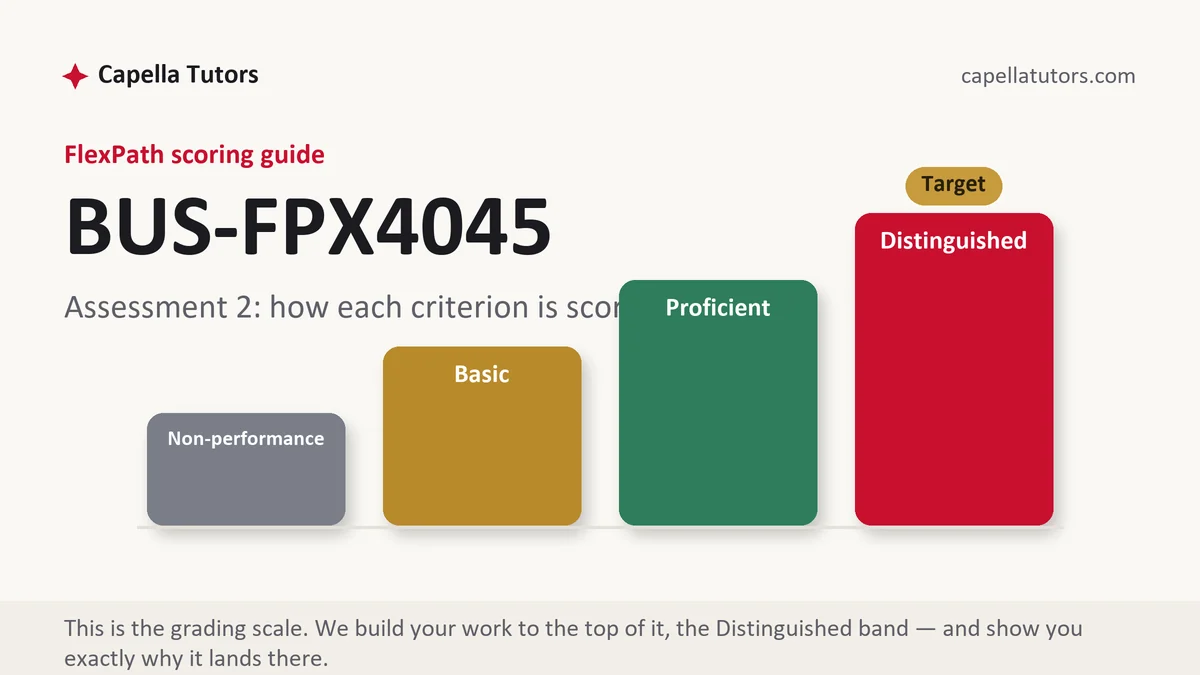
How BUS FPX 4045 Assessment 2 is scored
FlexPath does not use letter grades. Each criterion in the scoring guide lands on one of four levels, and the level descriptions are the real writing brief:
| Level | What it means on a internet recruiting evaluation |
|---|---|
| Distinguished | The internet recruiting evaluation is specific to the organization or case, applies course concepts accurately with credible sources, and ends in justified conclusions or recommendations. |
| Proficient | The internet recruiting evaluation is accurate, but the application or recommendations are general. |
| Basic | The internet recruiting evaluation describes concepts with little application. |
| Non-performance | A required part of the internet recruiting evaluation is missing. |
Visit the sites yourself and note specifics such as the number of steps to apply.
The BUS FPX 4045 Assessment 2 method, step by step
-
Choose two employers
Competitors in one industry.
-
Evaluate career pages
Navigation, application steps, mobile use.
-
Review job search sites
Features, cost and reach.
-
Review social media recruiting
LinkedIn and others, with pros and cons.
-
Compare viewpoints
Applicant experience versus employer goals.
-
Recommend
What employers should improve.
A structure that maps to the criteria
Slide counts vary by version; the note lengths are planning targets our tutors use.
| Section | What the slide and notes must do | Guide |
|---|---|---|
| Agenda | What will be covered. | 1 slide |
| Employer career pages compared | Observations. | 2 slides, ~200 words of notes |
| Job search site review | Sites evaluated. | 1 to 2 slides, ~150 words |
| Social media recruiting | Pros and cons. | 1 slide, ~100 words |
| Recommendations and references | Then references. | 1 to 2 slides, ~100 words |
Annotated sample excerpt
An original model excerpt from our team, written to show the register that reaches the top of the guide. Learn the moves, then write your own version.
Applying for a store associate job took seven screens on the first retailer's site and four on the second, and only the second let applicants upload a resume from a phone without creating an account first.1 From the applicant's view, every extra step is a chance to give up, and recruiting research consistently finds that long applications reduce completion rates.2 From the employer's view, the longer form screens for availability up front, so the recommendation is a short first step with availability questions moved to a second stage for those who pass.3
- 1Gives specific observations from the sites.
- 2Explains the applicant effect with evidence.
- 3Balances the employer's view in a recommendation.
The full premium sample for your exact assessment, written fresh to your scoring guide and topic, is free to request. Study it, revise it into your own voice, and submit work you understand.
The five mistakes that cost Distinguished
- Definitions without application. Apply each concept to the organization or case.
- No sources. Cite credible business sources.
- Vague recommendations. Make them specific and justified.
- General claims. Evaluate real sites.
Pre-submission checklist
- Two employers compared
- Job search sites reviewed
- Social media reviewed
- Both viewpoints
- Recommendations
- References
Want the internet recruiting evaluation written?
Send the scoring guide and any materials from your courseroom. Our team returns a premium original internet recruiting evaluation in 24 to 48 hours, revised free until it meets the guide.