How to write BUS-FPX4044 Assessment 3

The short answer

This manual is for BUS-FPX4044 Assessment 3, start to submission. Assessment 3 in BUS-FPX4044, Legal Issues in Human Resource Management, usually asks for synthesis: you take what the earlier analysis found and turn it into something the organisation can adopt, a revised practice or policy with the legal reasoning behind it, the rollout attached and the record-keeping specified. Your scoring guide decides the exact form. FlexPath scores it criterion by criterion. Below is the method, a structure built from the criteria, and an annotated excerpt. Prefer to hand it over? One premium original sample, 24 to 48 hours, revised free until the guide is satisfied. Your courseroom may print this as BUS FPX 4044 Assessment 3 or BUS4044 Assessment 3; it is the same deliverable, and BUS-FPX4044 Assessment 3 is what this manual walks through.

One honesty note before the manual: Capella revises courses and scoring guides over time, so always write to the exact scoring guide attached to your assessment in the courseroom. The course identity above is verified on capella.edu; the method and structure below are our tutors' approach to it, not Capella's official rubric text.
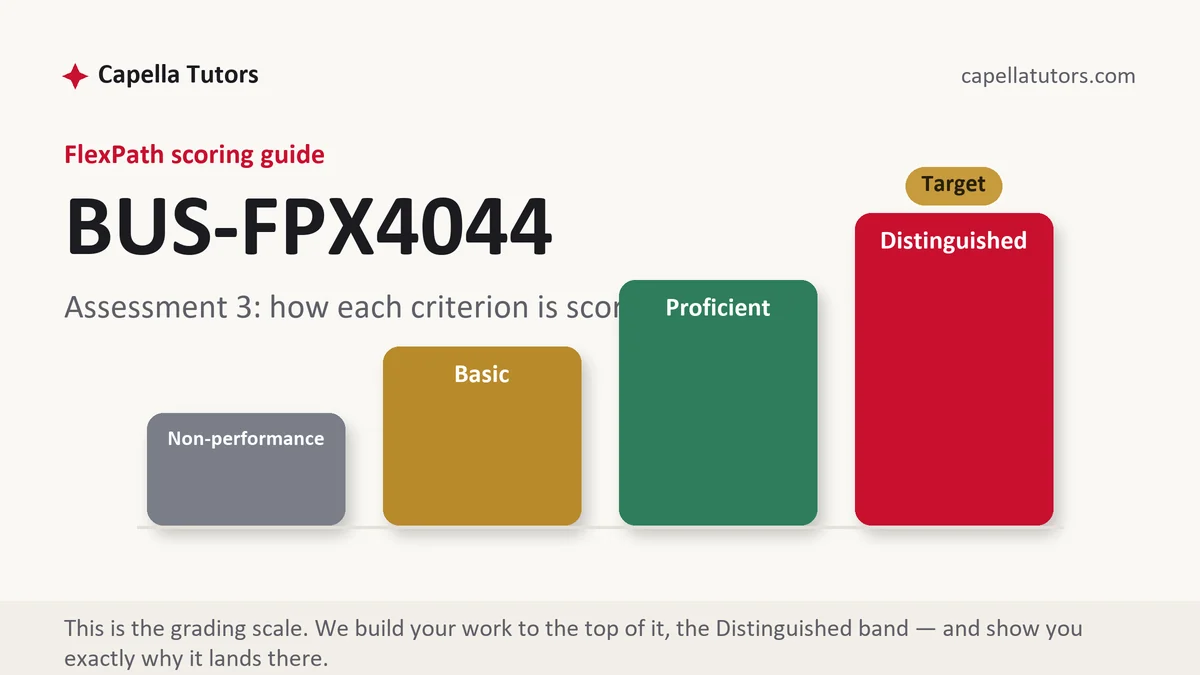
BUS-FPX4044 Assessment 3 grading scale at Capella FlexPath, the criterion levels this assessment is scored on, from Capella Tutors
How Capella FlexPath grades BUS-FPX4044 Assessment 3, visualized by Capella Tutors.

How BUS-FPX4044 Assessment 3 is scored

Nothing in FlexPath arrives as a letter grade. Every criterion lands on one of four levels, and reading those levels as instructions is the whole technique:

LevelWhat it means on a compliance and policy deliverable
DistinguishedThe policy language is drafted rather than described, each provision traces to the legal requirement behind it, the rollout names owners and dates, and the paper says what evidence will exist afterwards to prove compliance. The criterion tells you which of these it weights most.
ProficientA sound policy recommendation, legally accurate and clearly organised. Adoptable, and still short of the row that shows its own working.
BasicGood practice summarised in the abstract, with the policy talked about rather than written and no line drawn back to any statute.
Non-performanceA required component is missing outright, commonly the implementation plan or the recordkeeping section. An absent component takes the criterion to the floor on its own.

Synthesis deliverables reward costing. If you are recommending that a screen be replaced, price the replacement and price the exposure it removes, because a recommendation with two numbers beside it is a business case and one without them is an opinion. The arithmetic does not need to be complicated to do that job.

The BUS-FPX4044 Assessment 3 method, step by step

  1. Start from the failure, not from best practice

    Name the specific gap the policy exists to close, in one sentence, with the fact that revealed it. A policy written against a general aspiration will read as generic; one written against a screen that produced an uneven pass rate last quarter reads as professional work.

  2. Trace every provision to its source

    Each clause you draft should answer to something: a statutory requirement, a regulation, an agency guidance document or a documented operational need. Put the source beside the clause while drafting, then move it into the citation. Provisions with no source behind them are the ones that get cut in review.

  3. Draft the language, do not describe it

    Write the sentences the handbook would carry, in the register a handbook uses. Two paragraphs of real policy text prove more about your understanding than two pages explaining what the policy would cover, and the criterion asking for a recommendation usually means a usable one.

  4. Cost the change and cost the exposure

    Put the implementation figure on one side, including the staff time nobody remembers to count, and the avoided cost on the other. Say where each figure comes from and label the estimates as estimates. This is the paragraph that turns a compliance paper into something a manager would take to a budget holder.

  5. Build the rollout with names and dates

    Who approves it, who communicates it, who is trained and by when, what the supervisor briefing contains, and how an employee acknowledges receipt. Compliance failures are usually implementation failures, and the criteria in this course tend to reward the paper that knows it.

  6. Specify the evidence, then self-score

    State what documents will exist after this policy is running: the acknowledgement, the training log, the decision record, the review date. Then read your draft against the guide criterion by criterion, score yourself honestly, and fix anything below the top level before you submit.

A structure that maps to the criteria

The targets below are how our tutors plan a policy deliverable of this scope; your own guide governs, and any section it weights heavily should grow.

SectionWhat it must doGuide
The gap and its evidenceWhat went wrong or what is exposed, with the fact, figure or incident that establishes it.~200 words
Legal basisThe statutes and guidance that govern the practice, the coverage position, and any state requirement reaching further.~250 words
Drafted policy or practiceThe actual language, provision by provision, each traceable to the requirement or need behind it.~400 words
Cost and benefitWhat the change costs to implement, what exposure it removes, and where both figures come from.~200 words
Implementation and trainingApproval, communication, training content and audience, supervisor briefing, and the dates.~250 words
Recordkeeping, review and referencesThe documents the practice will generate, who holds them, the review cycle, and APA both ways.~200 words

Annotated sample excerpt

An original model paragraph from our team, showing what it looks like when a policy recommendation carries its own arithmetic. Read for the structure, then write yours from your own facts.

Sample excerpt: replacing a physical screen Original model · Capella Tutors

Ashgrove Catering Co. staffed up for a corporate dining contract using two informal screens for event crew, a 60-pound single-person lift and unrestricted weekend availability, neither of which appears in any job description.1 Across the hiring round, 41 of 52 male applicants cleared the lift screen and 19 of 44 female applicants did, rates of 78.8 and 43.2 percent and a ratio of 0.55, while the availability rule removed every applicant with a fixed religious observance without any conversation about swaps.2 Recommendation: replace the flat lift standard with the task as the contract actually requires it, a two-person carry for anything above 40 pounds, at a one-time cost of 620 dollars for four additional service trolleys, and add a documented availability exception process before the next hiring round opens.3

  • 1The practice is described with the detail that matters, which is that neither screen was written down anywhere. Undocumented requirements are the exposure, and naming that early frames everything after it.
  • 2Both screens are handled in one sentence each, with the arithmetic shown for the measurable one. The ratio is calculated rather than asserted, so the reader can check the division.
  • 3The recommendation is drafted as a rule, priced, and given a deadline tied to a real business event. A recommendation you could hand to an operations manager is what the top of the guide is describing.

The full premium sample for your exact assessment, written fresh to your scoring guide and issue, is free to request. Study it, revise it into your own voice, and submit work you understand.

Get the full sample free

The five mistakes that cost Distinguished

  • Policy described instead of drafted. Two pages about what the policy should address leaves the evaluator with nothing to assess against a criterion that asks for a recommendation.
  • Provisions with no legal anchor. A clause that cannot be traced to a statute, a regulation or a documented operational need is preference dressed as compliance.
  • The rollout left to management. Saying that leadership support is required names no owner, no date and no training content, and it is the easiest criterion in this deliverable to underfill.
  • Nothing costed. A change with no price and no avoided exposure beside it cannot be argued for in front of anybody holding a budget.
  • Recordkeeping treated as an afterthought. Employers lose defensible positions on the record more often than on the law, so the documents the practice will produce are substance, not administration.

Pre-submission checklist

  • The gap stated in one sentence with the fact that evidences it
  • Every drafted provision traceable to a statute, regulation or operational need
  • Actual policy language on the page, in handbook register
  • Implementation cost and avoided exposure both quantified, with sources named
  • Rollout with owners, training audience and dates
  • The documents this practice will generate, and who retains them

Policy and compliance deliverable to finish?

Send us the criteria and whatever the earlier stages of the course produced. We draft the language, trace each provision to its source, cost the change and build the rollout, with a reviewer whose only job is matching the file to your guide. First premium sample free.

Keep going

Online now