This manual is for BUS FPX 4016 Assessment 2, start to submission. Ethical Business Management asks you to examine ethics in international business: how an organization's ethical standing or reputation affects its business abroad, whether philosophical approaches to ethics, such as utilitarianism or rights-based ethics, can work across cultures, and how a particular approach would reflect on the organization and its stakeholders. The grade turns on applying ethics to international decisions. Describing theories scores lower than testing them against a cross-cultural business situation. Below is the method our tutors use, a structure that maps to the criteria, and an annotated sample excerpt. Prefer to hand it off? A premium original sample for this exact assessment comes back in 24 to 48 hours, revised free until it meets the guide. Capella's catalog lists the course as BUS-FPX4016, and some courserooms print BUS4016; both point to this same Assessment 2. In current courserooms this assessment typically appears as "Ethical Business Management".
One honesty note before the manual: Capella revises courses and scoring guides over time, so always write to the exact scoring guide attached to your assessment in the courseroom. The course identity above is verified on capella.edu; the method and structure below are our tutors' approach to it, not Capella's official rubric text.
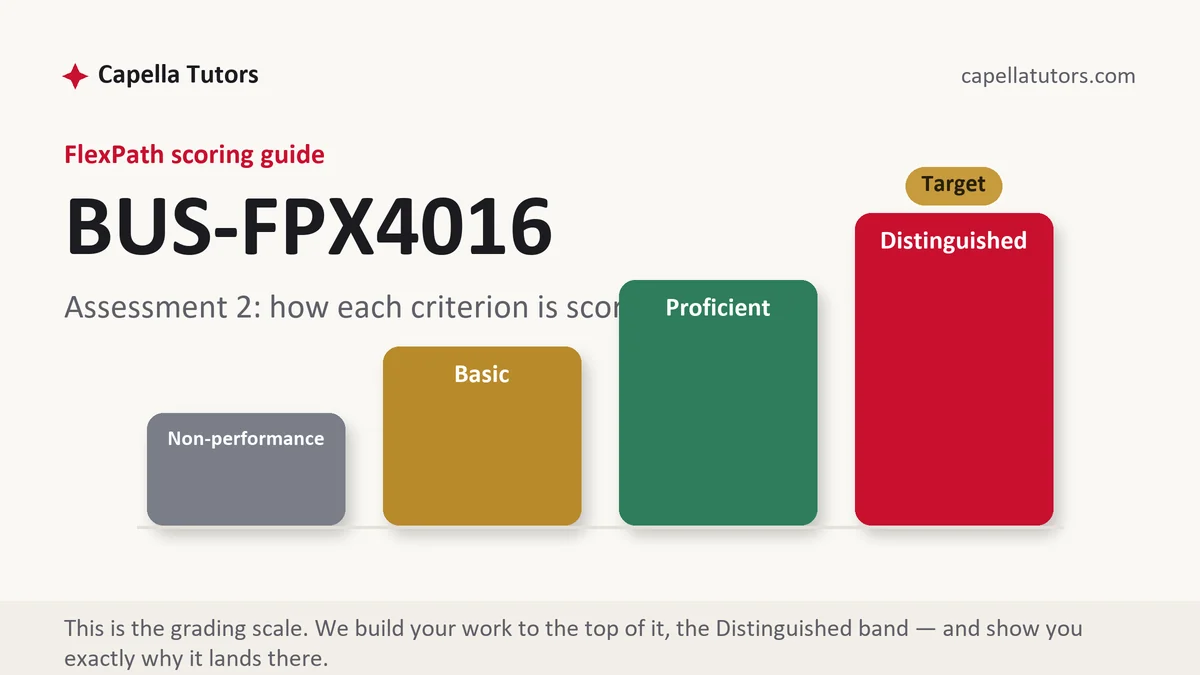
How BUS FPX 4016 Assessment 2 is scored
FlexPath does not use letter grades. Each criterion in the scoring guide lands on one of four levels, and the level descriptions are the real writing brief:
| Level | What it means on a international ethics paper |
|---|---|
| Distinguished | The international ethics paper is specific to the organization or case, applies course concepts accurately with credible sources, and ends in justified conclusions or recommendations. |
| Proficient | The international ethics paper is accurate, but the application or recommendations are general. |
| Basic | The international ethics paper describes concepts with little application. |
| Non-performance | A required part of the international ethics paper is missing. |
Use an organization or scenario with a real cross-border ethical issue.
The BUS FPX 4016 Assessment 2 method, step by step
-
Choose the organization
One operating internationally.
-
Reputation abroad
How ethical standing affects customers, partners and governments.
-
Philosophical approaches
Utilitarian, rights-based, virtue or relativist.
-
Test across cultures
Where an approach fits and where it clashes with local norms.
-
Reflect on stakeholders
How the approach looks to employees, customers and communities.
-
Conclude
The approach that best guides the organization.
A structure that maps to the criteria
Word counts are planning targets our tutors use, not Capella rules; follow the length and format your scoring guide states.
| Section | What it must do | Guide |
|---|---|---|
| Introduction | The organization. | ~50 words |
| Effect of ethical standing abroad | Reputation and business. | ~125 words |
| Philosophical approaches across cultures | Analysis. | ~150 words |
| Reflection on stakeholders and references | Then references. | ~100 words |
Annotated sample excerpt
An original model excerpt from our team, written to show the register that reaches the top of the guide. Learn the moves, then write your own version.
Ethical relativism, the view that right and wrong depend on local norms, seems respectful but fails when a local norm allows practices such as unsafe working conditions that the company would never accept at home.1 A rights-based approach gives firmer guidance, since basic rights such as safety apply everywhere, while still leaving room to adapt practices that are matters of custom rather than harm.2 For a company whose brand depends on trust, applying the same core rights in every country protects its reputation more reliably than following whichever standard is lowest locally.3
- 1Tests one approach and shows where it fails.
- 2Presents a stronger alternative with its limits.
- 3Connects the choice to reputation.
The full premium sample for your exact assessment, written fresh to your scoring guide and topic, is free to request. Study it, revise it into your own voice, and submit work you understand.
The five mistakes that cost Distinguished
- Definitions without application. Apply each concept to the organization or case.
- No sources. Cite credible business sources.
- Vague recommendations. Make them specific and justified.
- Theories without application. Test them on a real case.
Pre-submission checklist
- Organization chosen
- Reputation effects
- Approaches explained
- Tested across cultures
- Stakeholder reflection
- References
Want the international ethics paper written?
Send the scoring guide and any materials from your courseroom. Our team returns a premium original international ethics paper in 24 to 48 hours, revised free until it meets the guide.