This manual is for BUS FPX 4013 Assessment 3, start to submission. Learning Organizations asks you to examine the idea of the learning organization: you summarize selected articles and explain why you chose them, define what a learning organization is and how organizations learn, and weigh the advantages and disadvantages of being one, ideally with an example. The grade turns on clear explanation and balanced evaluation. Praising learning organizations scores lower than weighing their costs and limits. Below is the method our tutors use, a structure that maps to the criteria, and an annotated sample excerpt. Prefer to hand it off? A premium original sample for this exact assessment comes back in 24 to 48 hours, revised free until it meets the guide. Capella's catalog lists the course as BUS-FPX4013, and some courserooms print BUS4013; both point to this same Assessment 3. In current courserooms this assessment typically appears as "Learning Organizations".
One honesty note before the manual: Capella revises courses and scoring guides over time, so always write to the exact scoring guide attached to your assessment in the courseroom. The course identity above is verified on capella.edu; the method and structure below are our tutors' approach to it, not Capella's official rubric text.
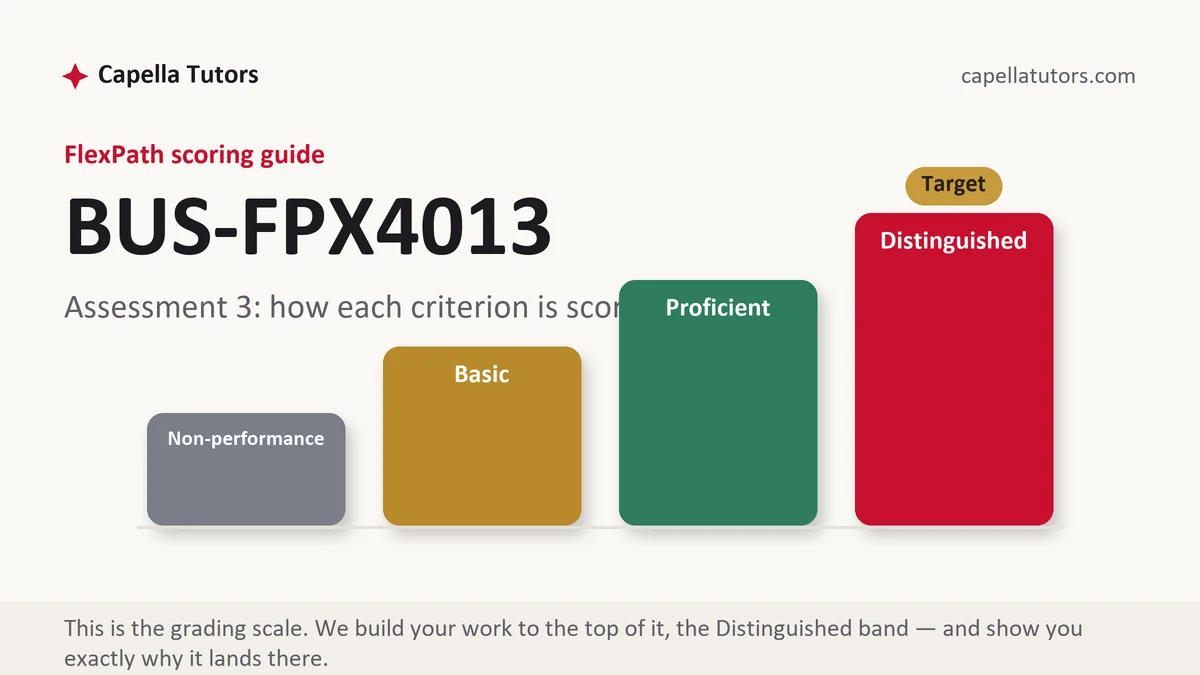
How BUS FPX 4013 Assessment 3 is scored
FlexPath does not use letter grades. Each criterion in the scoring guide lands on one of four levels, and the level descriptions are the real writing brief:
| Level | What it means on a learning organization paper |
|---|---|
| Distinguished | The learning organization paper is specific to the organization or case, applies course concepts accurately with credible sources, and ends in justified conclusions or recommendations. |
| Proficient | The learning organization paper is accurate, but the application or recommendations are general. |
| Basic | The learning organization paper describes concepts with little application. |
| Non-performance | A required part of the learning organization paper is missing. |
Use scholarly sources such as Senge's work and recent research.
The BUS FPX 4013 Assessment 3 method, step by step
-
Select articles
Scholarly sources on organizational learning.
-
Summarize them
Main points and why chosen.
-
Define the concept
Senge's five disciplines or similar.
-
Explain how organizations learn
Feedback, experimentation, knowledge sharing.
-
Weigh advantages
Adaptability, innovation, engagement.
-
Weigh disadvantages
Cost, time, difficulty of measurement.
A structure that maps to the criteria
Word counts are planning targets our tutors use, not Capella rules; follow the length and format your scoring guide states.
| Section | What it must do | Guide |
|---|---|---|
| Introduction | Purpose. | ~50 words |
| Article summaries | Each article. | ~150 words |
| What a learning organization is | Definition and how learning happens. | ~125 words |
| Advantages and disadvantages | Balanced evaluation. | ~150 words |
| Conclusion and references | Then references. | ~50 words |
Annotated sample excerpt
An original model excerpt from our team, written to show the register that reaches the top of the guide. Learn the moves, then write your own version.
The main advantage of a learning organization is that it notices problems and opportunities earlier, because people at every level are expected to question how work is done and share what they find.1 The disadvantage is cost: protected time for reflection, training and experiments competes with output, and the benefits are hard to measure in a quarter.2 For that reason, learning practices tend to survive where leaders treat them as part of the work, such as after-action reviews built into every project, rather than as a separate program.3
- 1States a main advantage with its mechanism.
- 2States a real disadvantage.
- 3Draws a practical conclusion.
The full premium sample for your exact assessment, written fresh to your scoring guide and topic, is free to request. Study it, revise it into your own voice, and submit work you understand.
The five mistakes that cost Distinguished
- Definitions without application. Apply each concept to the organization or case.
- No sources. Cite credible business sources.
- Vague recommendations. Make them specific and justified.
- Only advantages. Weigh disadvantages too.
Pre-submission checklist
- Articles summarized
- Concept defined
- How organizations learn
- Advantages
- Disadvantages
- References
Want the learning organization paper written?
Send the scoring guide and any materials from your courseroom. Our team returns a premium original learning organization paper in 24 to 48 hours, revised free until it meets the guide.