This manual is for BUS FPX 4013 Assessment 1, start to submission. Assessment 1 of BUS FPX 4013, Organizational Structure, Learning, and Performance, is the structural deliverable: you set out how an organization is arranged, judge that arrangement against what the business is trying to win on, and recommend a change with its price attached. Structure is only right or wrong relative to a strategy, so the paper that never states the strategy cannot pass judgment on anything. Below is how our tutors approach it, a structure that answers each criterion in turn, and an annotated excerpt. Need it handled? A premium original sample written against your criteria comes back inside 24 to 48 hours, with revision included until it scores. Capella's catalog lists the course as BUS-FPX4013, and some courserooms print BUS4013; both point to this same Assessment 1.
One honesty note before the manual: Capella revises courses and scoring guides over time, so always write to the exact scoring guide attached to your assessment in the courseroom. The course identity above is verified on capella.edu; the method and structure below are our tutors' approach to it, not Capella's official rubric text.
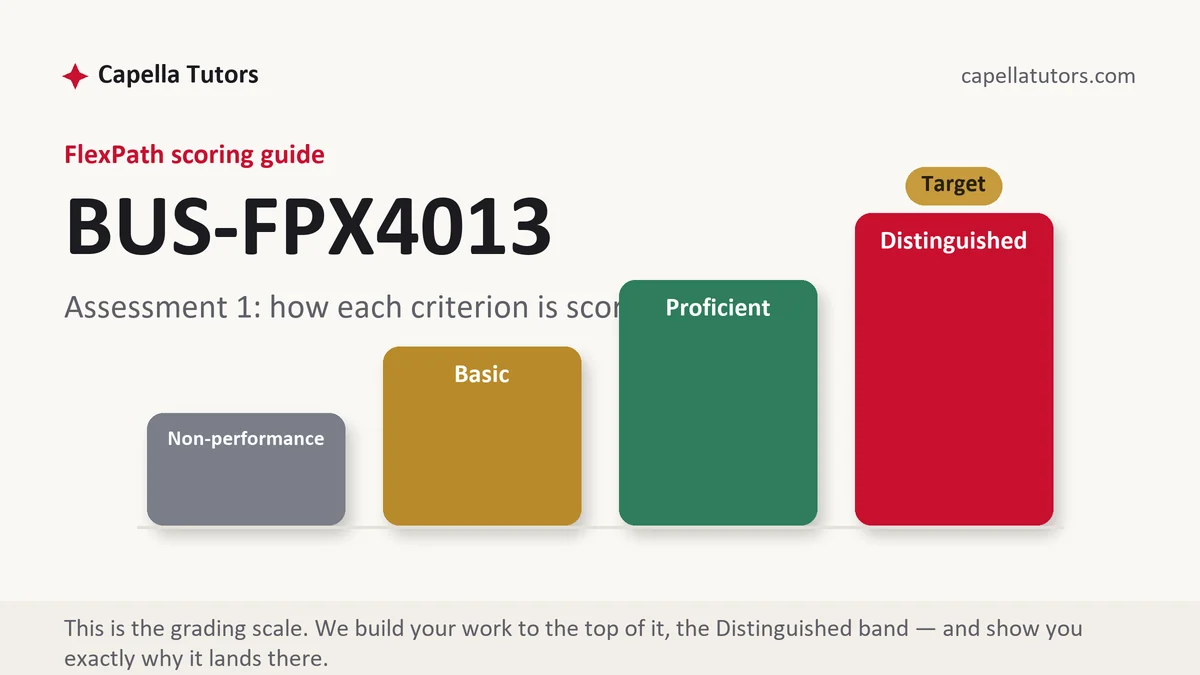
How BUS FPX 4013 Assessment 1 is scored
FlexPath has no letter grades. Every criterion on the scoring guide lands at one of four levels, and the level language is your writing brief:
| Level | What it means on a structural analysis |
|---|---|
| Distinguished | Layers and spans are counted, the strategy is stated before the structure is judged, and the recommendation names what it costs and who absorbs it. The extra move is always written into the criterion; find it and make it. |
| Proficient | The structure is described accurately and its problems are identified with support. Competent, and still one step below the top level. |
| Basic | A description of the organization chart with adjectives instead of counts and no strategy to measure it against. The usual first attempt in 4013. |
| Non-performance | A required element is absent, most often the recommendation or its consequences. An empty criterion cannot be scored up. |
Two habits separate this deliverable from a description. The first is counting: layers between the person doing the work and the person who can approve an exception, direct reports per manager, days for a decision to cross the desks it has to cross. The second is admitting cost, because every structural change loses something and a proposal that concedes nothing reads as unexamined.
The BUS FPX 4013 Assessment 1 method, step by step
-
Convert the criteria into headings before you draw anything
Paste each criterion in, put the Distinguished wording under it, and fill only those spaces. Structural work tempts students into description, and description is the difference between a paper that reads well and a paper that scores.
-
State what the organization competes on, in one paragraph
A business winning on low cost needs standardisation, central purchasing and few exceptions, and a functional arrangement serves it. A business winning on responsiveness to different customers needs decisions made close to those customers, and the same functional arrangement will strangle it. Write the strategy first and every later judgment has a standard behind it. Skip it and you are arguing that a structure is bad without saying bad for what.
-
Count the layers and the spans
Take an organization of 141 people with one owner, three managers and 137 everybody else: the service manager carries 52 direct reports, install 46, fabrication 21, and 18 office staff report straight to the owner. Two layers, spans wide enough that nobody is being supervised, and every one of those figures is checkable. A manager with three reports is expensive supervision; a manager with 52 is a mailbox.
-
Time one decision from request to answer
Pick a routine exception, a change order, a credit approval, an overtime request, and trace it. If it needs sign-off from three functions and each takes two days, the business runs a six-day approval cycle it has never named out loud. A timed decision is the most persuasive single piece of evidence available in a structural paper, and you usually get it by asking two people.
-
Separate the published chart from the working one
Informal routes exist in every organization, and in many the person who actually gets a decision made holds no relevant authority. Say where the diagram and the practice diverge, because an analysis that describes only the formal boxes is describing a document. Note it as an observation with an example rather than as a complaint.
-
Recommend one change, price it, then self-score
Name the change, state what it costs once and what it costs to run, say who absorbs the loss, and sequence the transition including who is told what and in which order. Flattening a layer speeds decisions and removes the coaching that layer did. Attach a measure and a review date. Then score your draft against each criterion and rewrite anything below the top level before submitting early in the week.
A structure that maps to the criteria
Word counts here are planning targets our tutors use for a typical 4013 structural deliverable, not Capella rules; expand wherever your guide asks for more.
| Section | What it must do | Guide |
|---|---|---|
| Introduction and organization | What the business does, who it serves, and the structural question this paper answers. | ~150 words |
| Strategy stated | What the organization competes on, specifically enough that a structure can be judged against it. | ~200 words |
| The current structure counted | Departments, reporting lines, layers, spans, and where authority to decide actually sits. | ~300 words |
| Diagnosis | Where the arrangement helps and where it obstructs, evidenced by approval times, duplication or unresolved conflict. | ~300 words |
| Recommendation and its price | The change proposed, its one-off and running cost, who absorbs it, and the transition sequence. | ~280 words |
| Measures and references | What will show whether the change worked, who reviews it and when, plus APA both ways. | ~170 words |
Annotated sample excerpt
An original model excerpt from our team, written to demonstrate the register the top column rewards in a structural paper. Study the moves and produce your own.
Ridgeway Mechanical employs 141 people and has added 107 of them in six years without changing a reporting structure built for a firm of thirty-four.1 There are two layers between a technician and the owner: the service manager holds 52 direct reports, the install manager 46, the fabrication manager 21, and the remaining 18 office staff report to the owner himself, which means no manager in the company has a span small enough to review anybody's work.2 A change order above 2,000 dollars needs the estimator, the relevant manager and the owner to sign, each of whom handles them in a single daily pass, so an approval that is never contested still takes three working days and in practice averages six.3
- 1Two figures do the work of a page of prose: the headcount and how much of it is new. Growth without structural change is the finding, stated before any judgment.
- 2Spans counted rather than characterised, with the consequence drawn in the same sentence. A reader can add 52, 46, 21 and 18 and check the claim.
- 3The approval cycle timed, with the difference between the theoretical and the observed figure kept in. That gap is often where the strongest recommendation comes from.
The full premium sample for your exact assessment, written fresh to your scoring guide and issue, is free to request. Study it, revise it into your own voice, and submit work you understand.
The five mistakes that cost Distinguished
- Structure judged with no strategy on the page. Calling an arrangement inefficient is meaningless until the reader knows what it was supposed to deliver.
- Spans and layers described, not counted. Too many direct reports is an opinion; 52 direct reports is a finding the criterion can reward.
- The chart mistaken for the organization. Where decisions actually get made is often two boxes from where the diagram puts them, and only the paper can say so.
- A recommendation with no cost. Every structural change loses something, and a proposal that admits nothing reads as unexamined however sensible it is.
- Consultancy models cited as evidence. Maturity frameworks and vendor diagrams are marketing documents, and the contingency literature has authors a faculty reader expects to see.
Pre-submission checklist
- Every scoring-guide criterion has its own labeled section
- What the organization competes on is stated before any structure is judged
- Layers counted and every span given as a number
- At least one decision timed from request to answer
- The recommendation carries a cost, a bearer of that cost, and a sequence
- A measure, a review point, and current APA in both directions
Structural analysis due this week?
Send the criteria and whatever you know about the reporting lines, even if it is only a description. We will count the layers and spans, time the approval cycle, price the recommendation, and return a premium original sample written to the Distinguished descriptors in 24 to 48 hours, revised free until the criteria are met.