This manual is for BUS FPX 3121 Assessment 3, start to submission. The Ethical Case Study asks you to analyze a health care case, usually supplied in the courseroom, in which an ethical problem arises, such as a patient's wishes being overridden: recognize the problem, analyze the ethical factors and which principles were breached, and recommend corrections, both internal to the organization and external, often with supporting tables. The grade turns on precise analysis and practical corrections. Naming principles scores lower than showing exactly how each was breached and what would prevent it next time. Below is the method our tutors use, a structure that maps to the criteria, and an annotated sample excerpt. Prefer to hand it off? A premium original sample for this exact assessment comes back in 24 to 48 hours, revised free until it meets the guide. Capella's catalog lists the course as BUS-FPX3121, and some courserooms print BUS3121; both point to this same Assessment 3. In current courserooms this assessment typically appears as "Ethical Case Study".
One honesty note before the manual: Capella revises courses and scoring guides over time, so always write to the exact scoring guide attached to your assessment in the courseroom. The course identity above is verified on capella.edu; the method and structure below are our tutors' approach to it, not Capella's official rubric text.
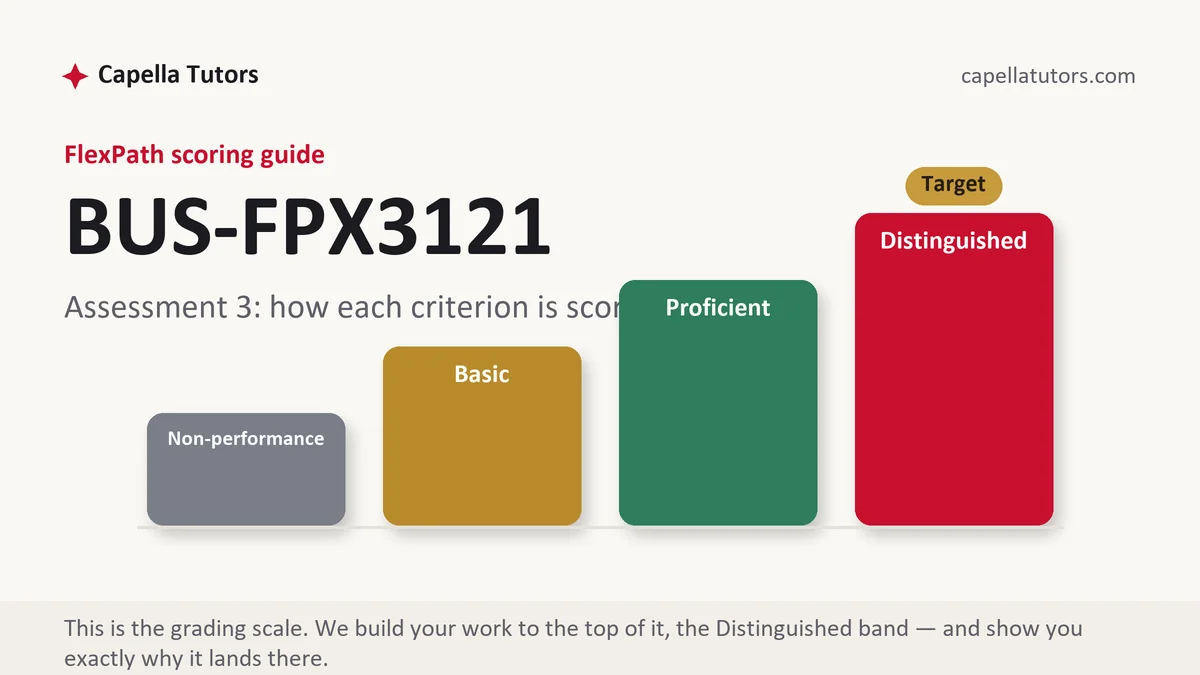
How BUS FPX 3121 Assessment 3 is scored
FlexPath does not use letter grades. Each criterion in the scoring guide lands on one of four levels, and the level descriptions are the real writing brief:
| Level | What it means on an ethical case study |
|---|---|
| Distinguished | The problem is recognized precisely, each principle is applied to specific facts, corrections are concrete and divided into internal and external measures, and tables are complete. |
| Proficient | All parts are accurate, but corrections are general. |
| Basic | The paper names principles with little analysis of the facts. |
| Non-performance | The analysis, the corrections or the tables are missing. |
Base every claim on the case facts and complete any tables the courseroom provides.
The BUS FPX 3121 Assessment 3 method, step by step
-
Recognize the problem
What went wrong ethically, in one or two sentences.
-
Analyze autonomy
How the patient's choices were respected or overridden.
-
Analyze nonmaleficence and beneficence
Harm caused and good neglected.
-
Consider justice and law
Fairness and legal duties, where relevant.
-
Recommend internal corrections
Policies, training and review processes.
-
Recommend external measures
Reporting, regulatory or legal steps.
A structure that maps to the criteria
Word counts are planning targets our tutors use, not Capella rules; follow the length and format your scoring guide states.
| Section | What it must do | Guide |
|---|---|---|
| Introduction and recognition of the problem | The case and the problem. | ~125 words |
| Analysis of ethical factors | Principles applied to facts. | ~250 words |
| Likely corrections | Internal and external measures. | ~175 words |
| Conclusion and references | Close, then references. | ~75 words |
Annotated sample excerpt
An original model excerpt from our team, written to show the register that reaches the top of the guide. Learn the moves, then write your own version.
The patient told staff at admission that he did not want his father involved in his care decisions, but when he became unable to speak for himself, the team relied on his father as the decision maker without checking the record.1 That is a breach of autonomy, because his stated wishes were documented and should have guided who was consulted, and it may also breach privacy rules on disclosure to family.2 The internal correction is a required check of documented preferences and surrogate designations before any family member is treated as decision maker.3
- 1States the facts that create the problem.
- 2Applies the principle and a related legal duty precisely.
- 3Proposes a specific internal correction.
The full premium sample for your exact assessment, written fresh to your scoring guide and topic, is free to request. Study it, revise it into your own voice, and submit work you understand.
The five mistakes that cost Distinguished
- Naming principles only. Apply them to facts.
- Adding facts. Use only the case.
- Vague corrections. Make them specific.
- Missing external measures. Include them.
- Incomplete tables. Complete every table.
Pre-submission checklist
- Problem recognized
- Principles applied to facts
- Internal corrections
- External measures
- Tables complete
- References
Want the ethical case study written?
Send the scoring guide and any materials from your courseroom. Our team returns a premium original ethical case study in 24 to 48 hours, revised free until it meets the guide.