This manual is for BUS FPX 3121 Assessment 2, start to submission. Technology, Data Security and Ethics in Care asks you to analyze an ethical dilemma created by health information technology, often a scenario in the courseroom: the tension between patient privacy and timely care, informed consent, including in emergencies, an ethical decision-making process, the legal and ethical obligations involved, such as HIPAA, and the long-term consequences of the decision. The grade turns on reasoning through the dilemma. A summary of HIPAA scores lower than a decision process that weighs the competing duties in this case. Below is the method our tutors use, a structure that maps to the criteria, and an annotated sample excerpt. Prefer to hand it off? A premium original sample for this exact assessment comes back in 24 to 48 hours, revised free until it meets the guide. Capella's catalog lists the course as BUS-FPX3121, and some courserooms print BUS3121; both point to this same Assessment 2. In current courserooms this assessment typically appears as "Technology, Data Security and Ethics in Care".
One honesty note before the manual: Capella revises courses and scoring guides over time, so always write to the exact scoring guide attached to your assessment in the courseroom. The course identity above is verified on capella.edu; the method and structure below are our tutors' approach to it, not Capella's official rubric text.
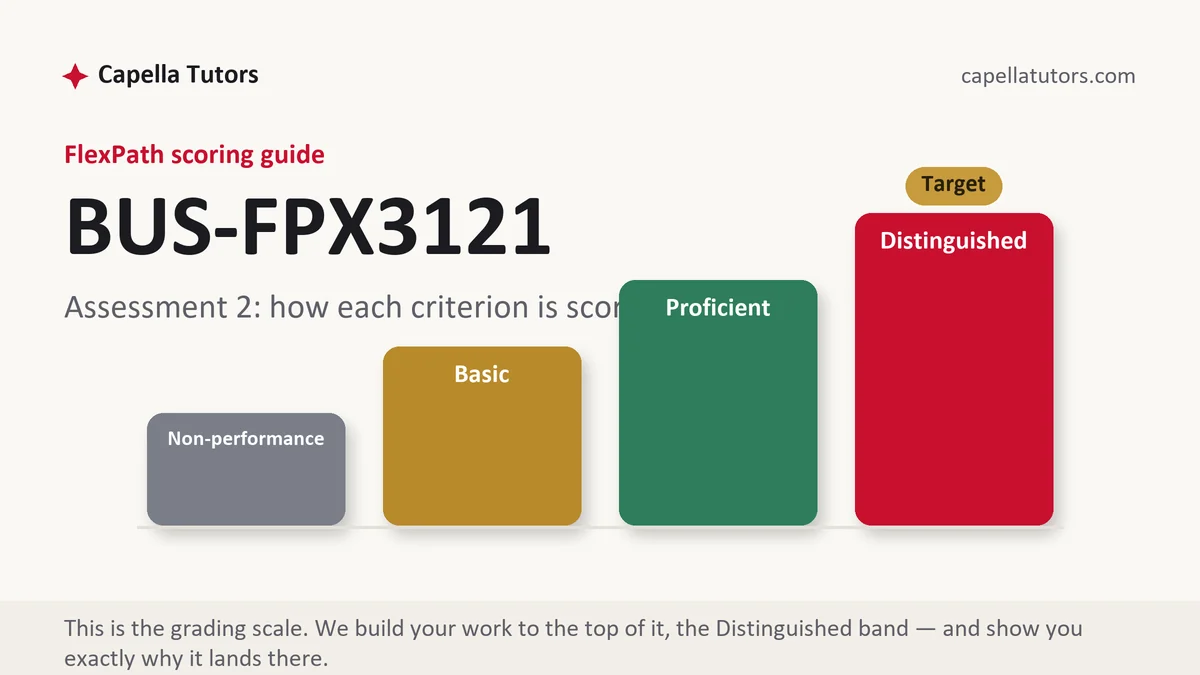
How BUS FPX 3121 Assessment 2 is scored
FlexPath does not use letter grades. Each criterion in the scoring guide lands on one of four levels, and the level descriptions are the real writing brief:
| Level | What it means on a technology and ethics dilemma |
|---|---|
| Distinguished | The dilemma is defined, privacy and care are weighed, informed consent is analyzed including emergencies, a decision-making model is applied, legal obligations are accurate, and long-term consequences are considered. |
| Proficient | All parts are accurate, but the decision process is brief. |
| Basic | The paper describes privacy law with little analysis of the dilemma. |
| Non-performance | The decision process, the legal obligations or the consequences are missing. |
Use the scenario your courseroom provides and cite HIPAA accurately.
The BUS FPX 3121 Assessment 2 method, step by step
-
Define the dilemma
The decision and the values in conflict.
-
Weigh privacy against care
Who needs the information and why.
-
Analyze informed consent
Including the emergency exception.
-
Apply a decision-making model
Step by step to a recommendation.
-
State legal and ethical obligations
HIPAA Privacy and Security Rules and professional codes.
-
Consider long-term consequences
Trust, liability and policy.
A structure that maps to the criteria
Word counts are planning targets our tutors use, not Capella rules; follow the length and format your scoring guide states.
| Section | What it must do | Guide |
|---|---|---|
| Introduction | The scenario and dilemma. | ~100 words |
| Privacy versus care | The tension. | ~150 words |
| Informed consent | Including emergencies. | ~150 words |
| Ethical decision-making process | The model applied. | ~150 words |
| Legal obligations, consequences and references | Then references. | ~150 words |
Annotated sample excerpt
An original model excerpt from our team, written to show the register that reaches the top of the guide. Learn the moves, then write your own version.
Informed consent normally requires that a patient understand and agree to how their information will be used, but an unconscious patient arriving in the emergency department cannot do either.1 HIPAA permits providers to share information needed for treatment without authorization, so the immediate question is not legal permission but how much to share and with whom.2 The ethical answer is the minimum necessary for care, with the patient informed and given a chance to object as soon as they are able, which respects autonomy without delaying treatment.3
- 1States the normal requirement and why it fails here.
- 2Applies the law accurately.
- 3Reaches an ethical answer that balances the duties.
The full premium sample for your exact assessment, written fresh to your scoring guide and topic, is free to request. Study it, revise it into your own voice, and submit work you understand.
The five mistakes that cost Distinguished
- Summarizing HIPAA. Analyze the dilemma.
- Ignoring emergencies. Address the exception.
- No decision model. Apply one step by step.
- Legal errors. Check the rules you cite.
- No long-term view. Consider consequences.
Pre-submission checklist
- Dilemma defined
- Privacy and care weighed
- Informed consent analyzed
- Decision model applied
- Legal obligations accurate
- Consequences and references
Want the technology ethics analysis written?
Send the scoring guide and any materials from your courseroom. Our team returns a premium original technology ethics analysis in 24 to 48 hours, revised free until it meets the guide.