This manual is for BUS FPX 3121 Assessment 1, start to submission. Ethical Theories and Principles in Healthcare Leadership asks you to prepare a presentation for health care managers, often framed as a lunch-and-learn session: the role of personal integrity and ethical leadership, the core ethical principles in health care, such as autonomy, beneficence, nonmaleficence and justice, a discussion of how they apply, and their impact on leadership practice. The grade turns on application. Defining the principles scores lower than showing how a manager would use them in real decisions. Below is the method our tutors use, a structure that maps to the criteria, and an annotated sample excerpt. Prefer to hand it off? A premium original sample for this exact assessment comes back in 24 to 48 hours, revised free until it meets the guide. Capella's catalog lists the course as BUS-FPX3121, and some courserooms print BUS3121; both point to this same Assessment 1. In current courserooms this assessment typically appears as "Ethical Theories and Principles in Healthcare Leadership".
One honesty note before the manual: Capella revises courses and scoring guides over time, so always write to the exact scoring guide attached to your assessment in the courseroom. The course identity above is verified on capella.edu; the method and structure below are our tutors' approach to it, not Capella's official rubric text.
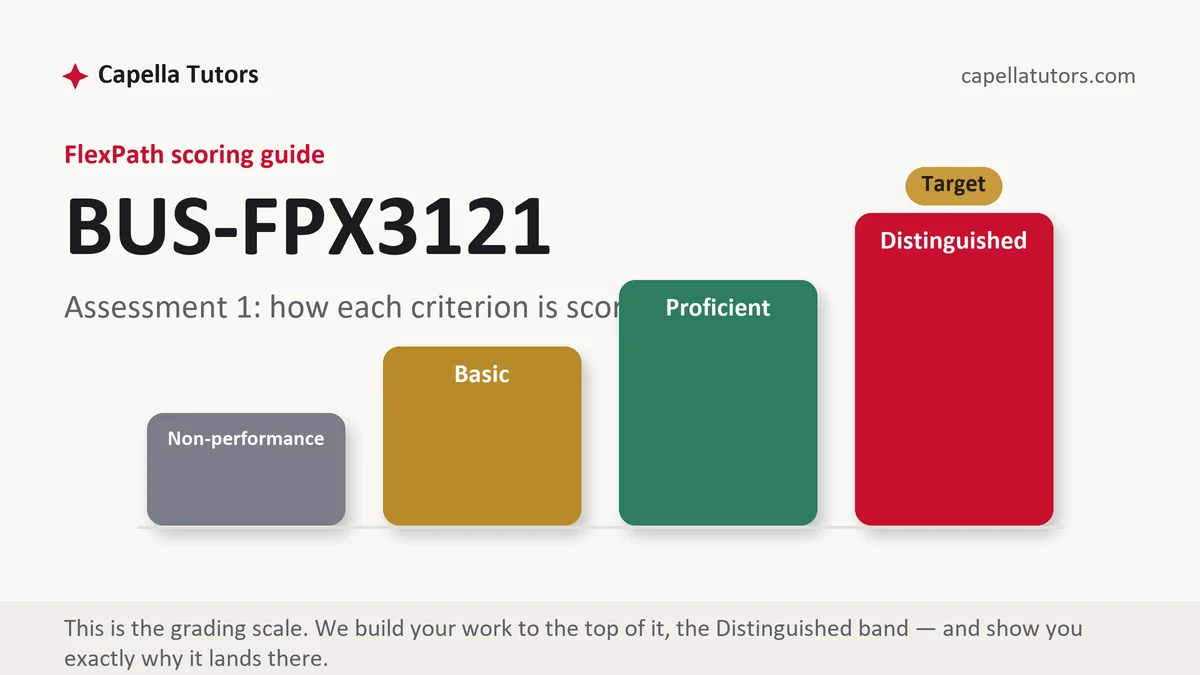
How BUS FPX 3121 Assessment 1 is scored
FlexPath does not use letter grades. Each criterion in the scoring guide lands on one of four levels, and the level descriptions are the real writing brief:
| Level | What it means on a health care ethics presentation |
|---|---|
| Distinguished | Integrity and ethical leadership are explained, principles are defined accurately and applied to management examples, the discussion is engaging, impact on practice is specific, and notes carry the evidence. |
| Proficient | All parts are accurate, but examples are general. |
| Basic | The presentation defines principles with little application. |
| Non-performance | A principle, the leadership discussion or the notes are missing. |
Check the format: slides with speaker notes or a recorded presentation.
The BUS FPX 3121 Assessment 1 method, step by step
-
Introduce the session
Purpose and audience.
-
Explain personal integrity
Why it is the base of ethical leadership.
-
Define the principles
Autonomy, beneficence, nonmaleficence and justice.
-
Apply to management
A staffing, budgeting or patient-access decision for each.
-
Prompt discussion
A question or scenario for the group.
-
Explain the impact
How ethical leadership changes culture and outcomes.
A structure that maps to the criteria
Slide counts vary by version; the note lengths are planning targets our tutors use.
| Section | What the slide and notes must do | Guide |
|---|---|---|
| Introduction | Purpose and audience. | 1 slide |
| Personal integrity and ethical leadership | Explained. | 1 to 2 slides, ~150 words of notes |
| Ethical principles in health care | Defined and applied. | 2 to 3 slides, ~250 words |
| Group discussion | A scenario. | 1 slide, ~100 words |
| Impact on leadership practice and references | Then references. | 2 slides, ~150 words |
Annotated sample excerpt
An original model excerpt from our team, written to show the register that reaches the top of the guide. Learn the moves, then write your own version.
Justice asks us to distribute resources fairly, and as managers we apply it every time we schedule staff or approve a budget.1 When a unit is short-staffed, a just decision considers patient need across units rather than simply protecting the department with the loudest voice.2 Studies of organizational justice show that staff who see decisions as fair are more engaged and less likely to leave, so fairness is an ethical duty and a practical one.3
- 1Defines the principle in management terms.
- 2Applies it to a concrete decision.
- 3Connects it to outcomes with evidence.
The full premium sample for your exact assessment, written fresh to your scoring guide and topic, is free to request. Study it, revise it into your own voice, and submit work you understand.
The five mistakes that cost Distinguished
- Definitions only. Apply each principle.
- No discussion element. Include a scenario or question.
- Thin notes. Notes carry the evidence.
- Clinical examples only. Use management decisions.
- No sources. Cite evidence.
Pre-submission checklist
- Purpose set
- Integrity and ethical leadership
- Principles defined and applied
- Discussion element
- Impact on practice
- Notes with references
Want the ethics presentation written?
Send the scoring guide and any materials from your courseroom. Our team returns a premium original ethics presentation in 24 to 48 hours, revised free until it meets the guide.