This manual is for BUS FPX 3040 Assessment 2, start to submission. Performance Management and Training asks you to analyze performance management in an organization, often a well-known company case: how its system works and whether it is effective, the difference between formal and informal feedback, best practices to improve employee performance, and why training and documentation matter, including protection from litigation. The grade turns on evaluation. Describing a performance system scores lower than judging whether it works and recommending practices supported by evidence. Below is the method our tutors use, a structure that maps to the criteria, and an annotated sample excerpt. Prefer to hand it off? A premium original sample for this exact assessment comes back in 24 to 48 hours, revised free until it meets the guide. Capella's catalog lists the course as BUS-FPX3040, and some courserooms print BUS3040; both point to this same Assessment 2. In current courserooms this assessment typically appears as "Performance Management and Training".
One honesty note before the manual: Capella revises courses and scoring guides over time, so always write to the exact scoring guide attached to your assessment in the courseroom. The course identity above is verified on capella.edu; the method and structure below are our tutors' approach to it, not Capella's official rubric text.
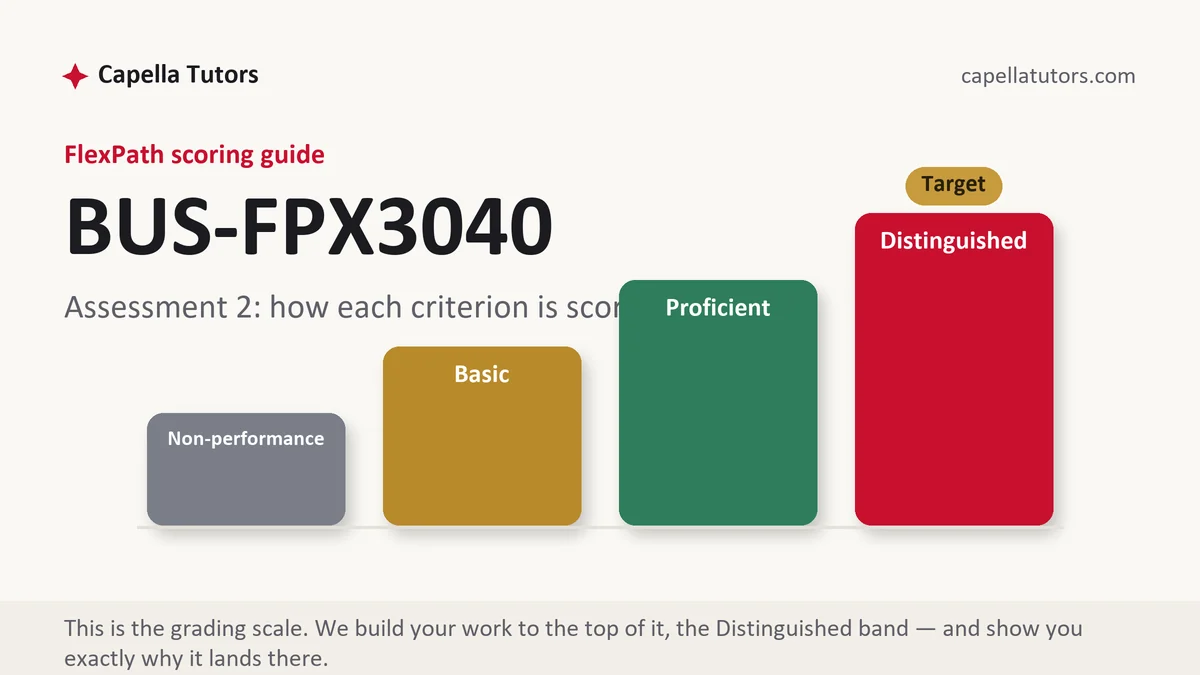
How BUS FPX 3040 Assessment 2 is scored
FlexPath does not use letter grades. Each criterion in the scoring guide lands on one of four levels, and the level descriptions are the real writing brief:
| Level | What it means on a performance management paper |
|---|---|
| Distinguished | The organization's system is described and evaluated, formal and informal feedback are compared, best practices are evidence-based, and the role of training and documentation in reducing legal risk is explained accurately. |
| Proficient | All parts are accurate, but the evaluation is brief. |
| Basic | The paper describes performance management in general. |
| Non-performance | The evaluation, the best practices or the legal discussion is missing. |
Use the company case your courseroom names, or a real organization with published information.
The BUS FPX 3040 Assessment 2 method, step by step
-
Describe the system
How performance is set, reviewed and rewarded.
-
Evaluate it
Evidence that it works or does not.
-
Compare feedback types
Annual reviews versus ongoing conversations.
-
Recommend best practices
Clear goals, frequent check-ins, development plans.
-
Explain training's role
Manager training in fair evaluation.
-
Address litigation risk
Consistent documentation and fair processes.
A structure that maps to the criteria
Word counts are planning targets our tutors use, not Capella rules; follow the length and format your scoring guide states.
| Section | What it must do | Guide |
|---|---|---|
| Introduction and the organization | Context. | ~75 words |
| The performance management system and its effectiveness | Description and evaluation. | ~150 words |
| Formal versus informal feedback | Comparison. | ~100 words |
| Best practices | Evidence-based recommendations. | ~100 words |
| Training, litigation protection and references | Then references. | ~100 words |
Annotated sample excerpt
An original model excerpt from our team, written to show the register that reaches the top of the guide. Learn the moves, then write your own version.
The company replaced its forced ranking system, which sorted employees into fixed percentages of top and bottom performers, with frequent conversations between managers and employees supported by an app.1 Reports since the change suggest employees value the more regular feedback, but some managers struggle to give honest criticism without the structure of a formal rating.2 That mixed result supports a blended approach: keep frequent informal feedback, but pair it with a documented annual review so expectations and decisions have a written record.3
- 1Describes the change in the system.
- 2Evaluates the evidence on both sides.
- 3Turns the evaluation into a recommendation.
The full premium sample for your exact assessment, written fresh to your scoring guide and topic, is free to request. Study it, revise it into your own voice, and submit work you understand.
The five mistakes that cost Distinguished
- Description without evaluation. Judge whether it works.
- No feedback comparison. Contrast formal and informal.
- Practices without evidence. Support recommendations.
- Ignoring legal risk. Explain documentation's role.
- No sources. Cite the case and research.
Pre-submission checklist
- System described
- Effectiveness evaluated
- Feedback types compared
- Evidence-based best practices
- Training and litigation protection
- References
Want the performance management paper written?
Send the scoring guide and any materials from your courseroom. Our team returns a premium original performance management paper in 24 to 48 hours, revised free until it meets the guide.