This manual is for BUS FPX 3040 Assessment 1, start to submission. The opening deliverable in Fundamentals of Human Resource Management usually starts at the front of the staffing chain: analyze a job, write down what it requires, and design a way of choosing between people that would survive review. Two readers have to be satisfied at once, an employment lawyer and a finance director, and most undergraduate drafts satisfy one of them. Below is the order our tutors work in, a structure taken from the criteria, and an annotated excerpt. Or hand it across, and a premium original sample written to your own scoring guide comes back within 24 to 48 hours, revised free until the criteria are met. Capella's catalog lists the course as BUS-FPX3040, and some courserooms print BUS3040; both point to this same Assessment 1.
One honesty note before the manual: Capella revises courses and scoring guides over time, so always write to the exact scoring guide attached to your assessment in the courseroom. The course identity above is verified on capella.edu; the method and structure below are our tutors' approach to it, not Capella's official rubric text.
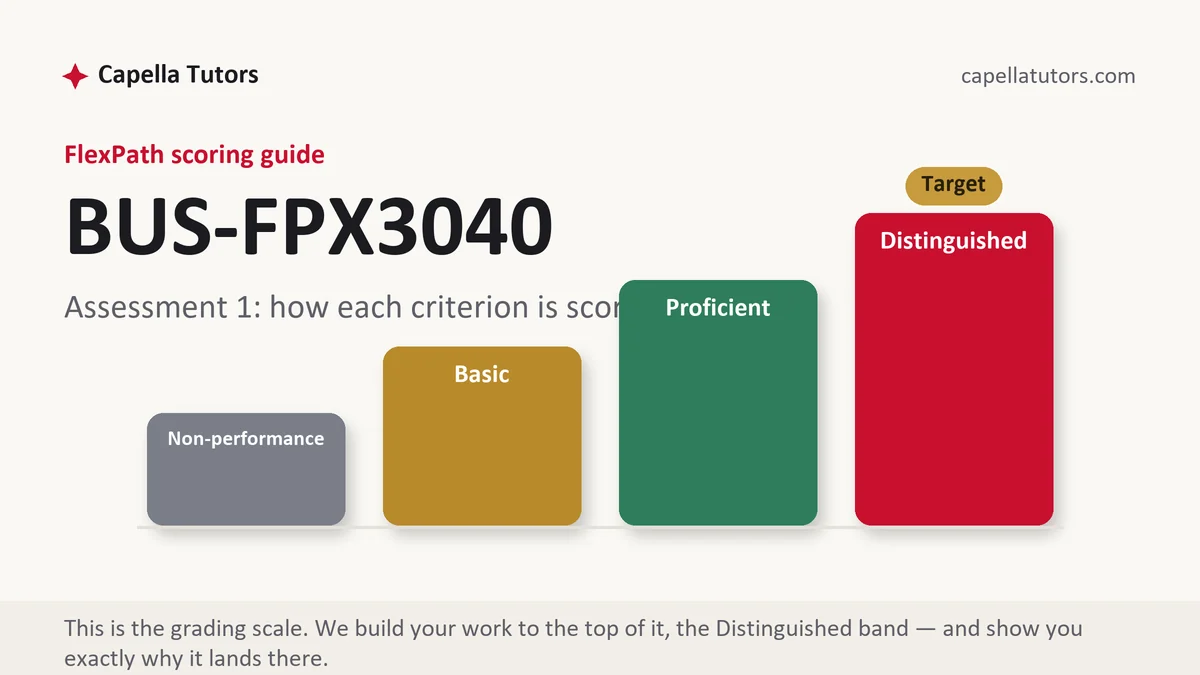
How BUS FPX 3040 Assessment 1 is scored
FlexPath scores criterion by criterion on four levels and issues no letter grade. The level wording is what you are writing to:
| Level | What it means on a job analysis and selection deliverable |
|---|---|
| Distinguished | The job analysis method is named, the selection tools trace back to the duties it produced, and the funnel is measured rather than described. That traceability is what the top column is asking for. |
| Proficient | A sound description and a defensible selection process, with the link between them assumed rather than shown. |
| Basic | A job description reproduced from a posting, or interview questions with no visible origin in any analysis. |
| Non-performance | No analysis method appears, or a required element of the process the criterion names is missing entirely. |
Everything in this deliverable defends itself from one document. The defense of every interview question, every rating that came out low, and every dollar in the range runs back through the job analysis, so treat that document as evidence rather than as paperwork and the rest of the paper becomes easy to argue.
The BUS FPX 3040 Assessment 1 method, step by step
-
Turn the guide into the outline
Each criterion becomes a heading with its top-column sentence parked underneath, and any paragraph refusing to sit beneath one of them is deleted rather than kept, since length spent off the guide is length taken from the rows that pay. State the role you are writing from in the first paragraph.
-
Name the job analysis method you used
Interviews with incumbents, direct observation, a structured questionnaire, or a review of existing documentation, each with what it covered and how many people it involved. A named method is a method a grader can evaluate; duties that simply appear are duties nobody can defend.
-
Write duties as observable behavior with a frequency
Answers roughly forty patient calls a shift is a duty; provides excellent service is an adjective. Observable and countable duties convert directly into interview questions, into performance standards, and into the market comparison that prices the role.
-
Design selection tools that point back at duties
Every screening question, work sample, and rating scale should trace to a specific duty. Structure the interview, write the scoring anchors before anybody is interviewed, and keep the same questions in the same order for every candidate so the comparison runs between people rather than between conversations.
-
Measure the funnel you already have
Applications, screens, interviews, offers, and acceptances give you a selection ratio and an acceptance rate, and time to fill multiplied by the daily cost of covering the gap gives the vacancy its price. Those figures tell you which stage is the problem, which is the finding the analysis criterion wants.
-
Check the legal footing, then self-score
Name the guidance or statute the process has to satisfy, cite the instrument itself rather than a summary of it, and stop short of predicting how a claim would be decided. Then mark your draft against each criterion and revise anything below the top level before submitting.
A structure that maps to the criteria
The targets below are our tutors' planning figures for a staffing deliverable, not Capella limits. Weight each section to match your own criteria.
| Section | What it must do | Guide |
|---|---|---|
| Situation and role | The organization, the vacancy, who it touches, and the authority you are writing with. | ~150 words |
| Job analysis | The method, what it covered, and the duties it produced, written as observable behavior. | ~300 words |
| Selection design | Screening, structured questions, work samples, and scoring anchors, each traced to a duty. | ~300 words |
| The funnel measured | Applications through acceptances, with ratios, time to fill, and the cost of the vacancy. | ~200 words |
| Legal footing | The guidance or statute the process must satisfy, cited to the primary instrument. | ~150 words |
| Recommendation and references | The change, its owner, its cost, its measure, and current APA both directions. | ~150 words |
Annotated sample excerpt
An original excerpt from our team, written for a multi-clinic dental practice, showing a hiring funnel measured rather than complained about.
Halstead Dental Group filled two of four coordinator vacancies last quarter, and the ratios say the shortage is not at the top of the funnel.1 One hundred eighty six applications produced 31 phone screens, 12 interviews, 3 offers, and 2 acceptances, a selection ratio of 1.1 percent and an offer acceptance rate of 67 percent, so the narrowing is sharpest between screen and interview rather than at intake.2 Time to fill averaged 68 days, and at $310 a day for temporary front-desk coverage each open seat cost about $21,000 before a single recruiting invoice was counted, which is the figure the proposal below is written against.3
- 1The claim arrives before the evidence, and it contradicts the assumption the practice walked in with, which is what makes the paragraph worth reading.
- 2Five counts, two ratios, and a located problem, all rebuildable, all inside one sentence with its denominators visible.
- 3The vacancy is priced, which converts a staffing complaint into a budget argument a finance director can weigh.
The full premium sample for your exact assessment, written fresh to your scoring guide and issue, is free to request. Study it, revise it into your own voice, and submit work you understand.
The five mistakes that cost Distinguished
- A job description copied from a posting. Nothing later in the paper can be defended from a document you did not build.
- Duties written as adjectives. Excellent communication skills cannot be interviewed for, observed, or rated on a scale.
- An unstructured interview left unstructured. Different questions for different candidates compares conversations, not people.
- A funnel described instead of counted. Ratios and time to fill locate the problem; adjectives about a tight market do not.
- Employment law taken from a secondary summary. Cite the guidance or the statute itself, because the wording is the entire point.
Pre-submission checklist
- The seat you are writing from stated in the opening paragraph
- A named job analysis method with its coverage described
- Every duty observable, with a frequency or a volume attached
- Each selection tool traced back to a specific duty
- Funnel ratios, time to fill, and the daily cost of the vacancy computed
- The governing guidance cited to the primary instrument, APA both ways
Staffing deliverable due?
Give us the vacancy, the guide, and whatever applicant counts you can lay hands on. We build the analysis, structure the selection tools, run the ratios, and cite the instrument behind every claim. Nothing is owed on your first premium sample.