This manual is for BHA FPX 4104 Assessment 3, start to submission. The Organizational Communication Plan asks you to analyze a communication problem in a health care organization, often patient dissatisfaction shown in survey data from a courseroom scenario, and plan how to fix it: what the data show, communication best practices that apply, the stakeholders involved, and the strategies you recommend. The grade turns on the data. A plan built on what the surveys actually show, with strategies aimed at the specific causes, scores above general advice on communication. Below is the method our tutors use, a structure that maps to the criteria, and an annotated sample excerpt. Prefer to hand it off? A premium original sample for this exact assessment comes back in 24 to 48 hours, revised free until it meets the guide. Capella's catalog lists the course as BHA-FPX4104, and some courserooms print BHA4104; both point to this same Assessment 3. In current courserooms this assessment typically appears as "Organizational Communication Plan".
One honesty note before the manual: Capella revises courses and scoring guides over time, so always write to the exact scoring guide attached to your assessment in the courseroom. The course identity above is verified on capella.edu; the method and structure below are our tutors' approach to it, not Capella's official rubric text.
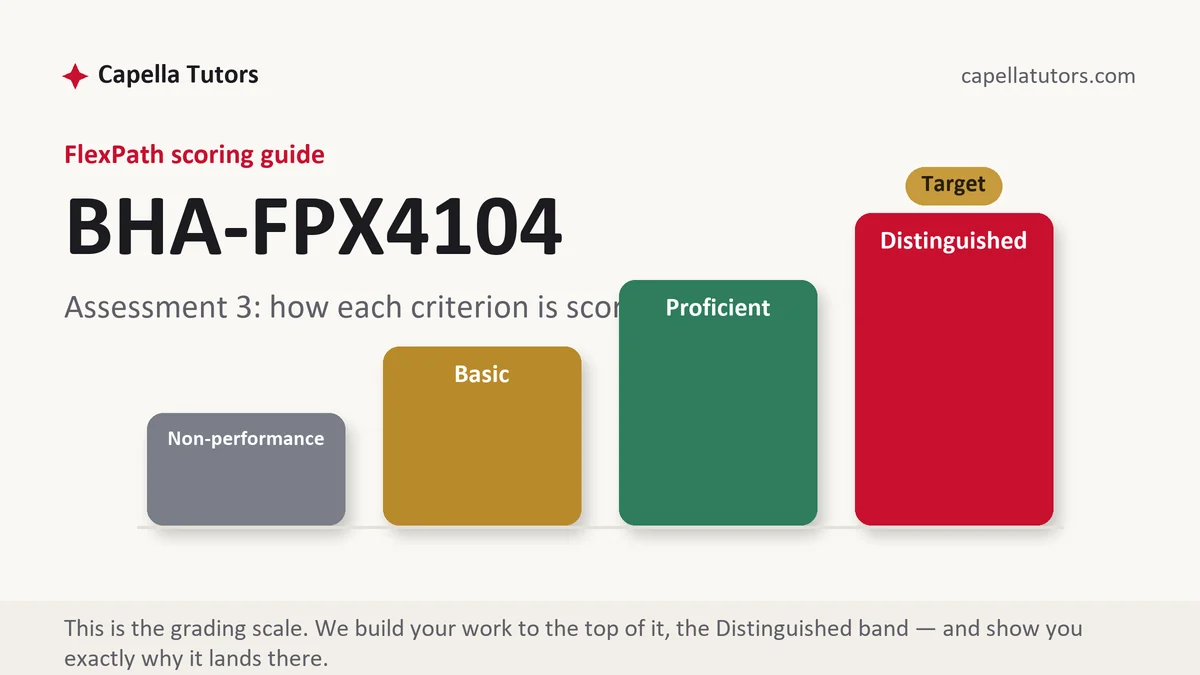
How BHA FPX 4104 Assessment 3 is scored
FlexPath does not use letter grades. Each criterion in the scoring guide lands on one of four levels, and the level descriptions are the real writing brief:
| Level | What it means on a communication plan |
|---|---|
| Distinguished | The problem is analyzed from the scenario data, best practices are evidence-based, stakeholders are specific with their roles, strategies answer the causes found, and success measures are stated. |
| Proficient | All parts are present and accurate, but strategies are general. |
| Basic | The plan offers general communication advice with little analysis. |
| Non-performance | The data analysis, the stakeholders or the strategies are missing. |
Work from the data in your scenario. Quote the figures that show the problem.
The BHA FPX 4104 Assessment 3 method, step by step
-
Analyze the data
What patients complained about, how often, and where.
-
Identify causes
Communication failures behind the dissatisfaction, such as unclear discharge instructions or slow responses.
-
Apply best practices
Approaches such as AIDET, teach-back and service recovery, with evidence.
-
Identify stakeholders
Patients, nurses, physicians, managers and patient experience staff.
-
Recommend strategies
Specific actions aimed at each cause.
-
Set measures
Survey scores and complaint counts to track improvement.
A structure that maps to the criteria
Word counts are planning targets our tutors use, not Capella rules; follow the length and format your scoring guide states.
| Section | What it must do | Guide |
|---|---|---|
| Introduction | The organization and the communication problem. | ~75 words |
| Analysis of the data | What the surveys show. | ~150 words |
| Communication best practices | Evidence-based approaches. | ~125 words |
| Stakeholders | Who is involved and their roles. | ~100 words |
| Strategies for improvement and measures | Actions and how success is tracked. | ~150 words |
| Conclusion and references | Close, then current APA. | ~75 words |
Annotated sample excerpt
An original model excerpt from our team, written to show the register that reaches the top of the guide. Learn the moves, then write your own version.
The inpatient surveys show the problem is concentrated rather than general: scores for courtesy are close to the system average, but only 58 percent of patients said staff explained their medicines, and that item is lowest on the two surgical units.1 Comments on those units mention being given discharge papers without anyone going through them, which points to a process gap at discharge rather than a staff attitude problem.2 That distinction matters for the plan, because training on courtesy would not move the item patients are actually unhappy about, while a structured teach-back at discharge would.3
- 1Locates the problem precisely in the data.
- 2Uses comments to identify the cause.
- 3Shows how the analysis directs the strategy.
The full premium sample for your exact assessment, written fresh to your scoring guide and topic, is free to request. Study it, revise it into your own voice, and submit work you understand.
The five mistakes that cost Distinguished
- General advice. Base the plan on the data.
- Causes not identified. Explain what drives dissatisfaction.
- Best practices without evidence. Cite support.
- Strategies not tied to causes. Aim each at a specific failure.
- No measures. Say how improvement will be tracked.
Pre-submission checklist
- Data analyzed
- Causes identified
- Evidence-based best practices
- Stakeholders and roles
- Strategies and measures
- Current APA references
Want the communication plan written?
Send the scoring guide and the scenario data. Our team returns a premium original plan in 24 to 48 hours, revised free until it meets the guide.