This manual is for BHA FPX 4104 Assessment 1, start to submission. Strategic Planning and Leadership asks you to explain strategic planning in a health care organization, often as a briefing for new leaders: what strategic planning is and why it matters, its phases and components, theories and best practices of strategic leadership, how strategic leadership differs from leadership in general, the key stakeholders, and how strategy is aligned across the organization. The grade turns on application. Definitions are required, but the top column rewards showing how each idea works in a real health care organization. Below is the method our tutors use, a structure that maps to the criteria, and an annotated sample excerpt. Prefer to hand it off? A premium original sample for this exact assessment comes back in 24 to 48 hours, revised free until it meets the guide. Capella's catalog lists the course as BHA-FPX4104, and some courserooms print BHA4104; both point to this same Assessment 1. In current courserooms this assessment typically appears as "Strategic Planning and Leadership".
One honesty note before the manual: Capella revises courses and scoring guides over time, so always write to the exact scoring guide attached to your assessment in the courseroom. The course identity above is verified on capella.edu; the method and structure below are our tutors' approach to it, not Capella's official rubric text.
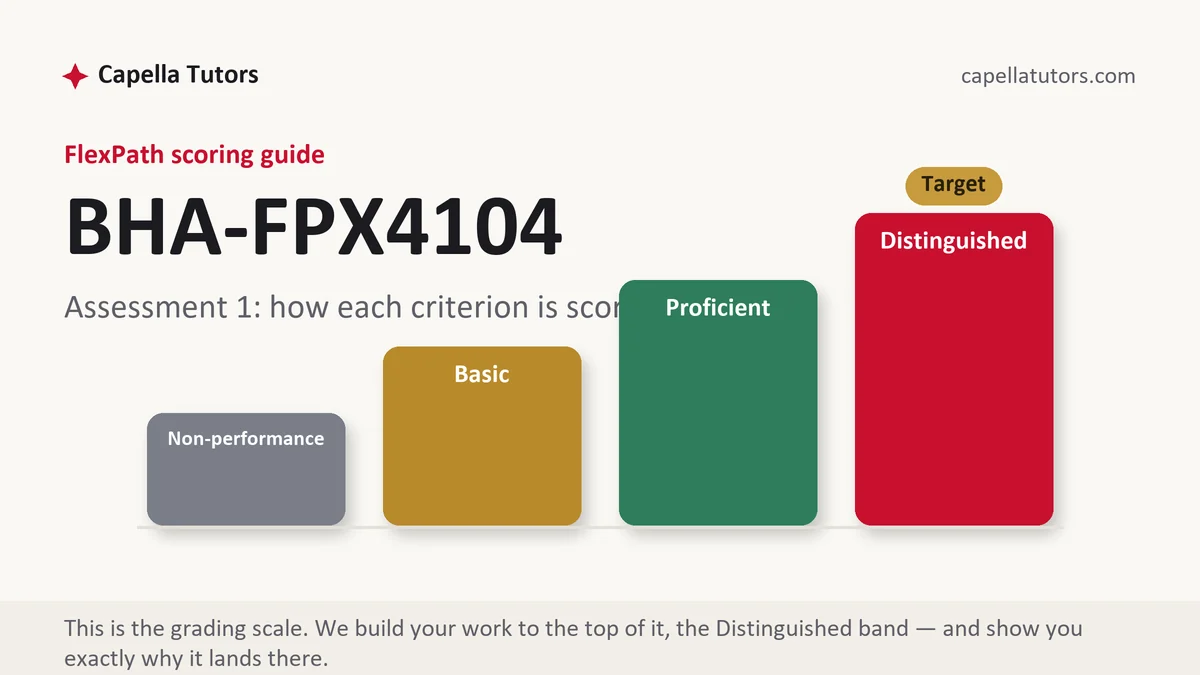
How BHA FPX 4104 Assessment 1 is scored
FlexPath does not use letter grades. Each criterion in the scoring guide lands on one of four levels, and the level descriptions are the real writing brief:
| Level | What it means on a strategic planning and leadership paper |
|---|---|
| Distinguished | Strategic planning and its phases are explained accurately with sources, leadership theories are compared and applied, the distinction between leadership and strategic leadership is clear, stakeholders are specific, and alignment is illustrated with an example. |
| Proficient | All parts are accurate, but examples are general. |
| Basic | The paper defines terms with little application. |
| Non-performance | A required part, such as the phases, the theories or the stakeholders, is missing. |
Use one health care organization, real or from your courseroom, as the example throughout.
The BHA FPX 4104 Assessment 1 method, step by step
-
Define strategic planning
In your own words with a source, and why health care organizations need it.
-
Describe the phases and components
Environmental assessment, mission and vision, goals, strategies, implementation and evaluation.
-
Explain strategic leadership theories
For example transformational leadership or the resource-based view, with sources.
-
Distinguish leadership from strategic leadership
Day-to-day direction versus long-term positioning, with an example of each.
-
Identify key stakeholders
Board, executives, physicians, staff, patients, payers and community.
-
Show alignment
How a strategic goal cascades into department objectives.
A structure that maps to the criteria
Word counts are planning targets our tutors use, not Capella rules; follow the length and format your scoring guide states.
| Section | What it must do | Guide |
|---|---|---|
| Introduction | Purpose and organization used as the example. | ~75 words |
| Strategic planning defined and its phases | Definition, phases and components. | ~200 words |
| Strategic leadership theories and best practices | Theories compared and applied. | ~175 words |
| Leadership versus strategic leadership | The distinction with examples. | ~125 words |
| Stakeholders and alignment | Who is involved and how strategy cascades. | ~150 words |
| Conclusion and references | Close, then current APA. | ~75 words |
Annotated sample excerpt
An original model excerpt from our team, written to show the register that reaches the top of the guide. Learn the moves, then write your own version.
When the health system set a strategic goal of reducing avoidable emergency visits by ten percent over three years, alignment meant translating that goal into something each department could act on.1 Primary care took on same-day appointment slots, case management took responsibility for calling high-risk patients after discharge, and finance tracked the effect on emergency department volume each quarter.2 Strategic leadership showed in that cascade: the executive team did not run the clinics, but it made sure every department's objectives pointed at the same measurable result.3
- 1Starts from a specific strategic goal with a number.
- 2Shows how it becomes departmental objectives.
- 3Uses the example to define strategic leadership.
The full premium sample for your exact assessment, written fresh to your scoring guide and topic, is free to request. Study it, revise it into your own voice, and submit work you understand.
The five mistakes that cost Distinguished
- Definitions only. Apply each idea to an organization.
- Theories listed. Compare and apply them.
- Blurring leadership types. Make the distinction clear with examples.
- Generic stakeholders. Name them for the organization.
- No alignment example. Show a goal cascading.
Pre-submission checklist
- Strategic planning defined with sources
- Phases and components
- Strategic leadership theories applied
- Leadership versus strategic leadership
- Stakeholders and alignment example
- Current APA references
Want the strategic planning paper written?
Send the scoring guide. Our team returns a premium original paper in 24 to 48 hours, revised free until it meets the guide.