This manual is for BHA FPX 3108 Assessment 3, start to submission. The assessment usually asks for a strategy and the plan that will tell you whether it worked: the population split into tiers, a different intensity of effort matched to each tier, the partners and staff time each one needs, then measures specified the way a measure steward would specify them, with a baseline, a target, a date and a stratified read. Undergraduate submissions usually stop one step short of that last piece. What follows is the method, the structure behind it, and an annotated sample excerpt. Want this one handled? A premium original sample written to your population and target returns in 24 to 48 hours, with revision free until the guide is met. Capella's catalog lists the course as BHA-FPX3108, and some courserooms print BHA3108; both point to this same Assessment 3.
One honesty note before the manual: Capella revises courses and scoring guides over time, so always write to the exact scoring guide attached to your assessment in the courseroom. The course identity above is verified on capella.edu; the method and structure below are our tutors' approach to it, not Capella's official rubric text.
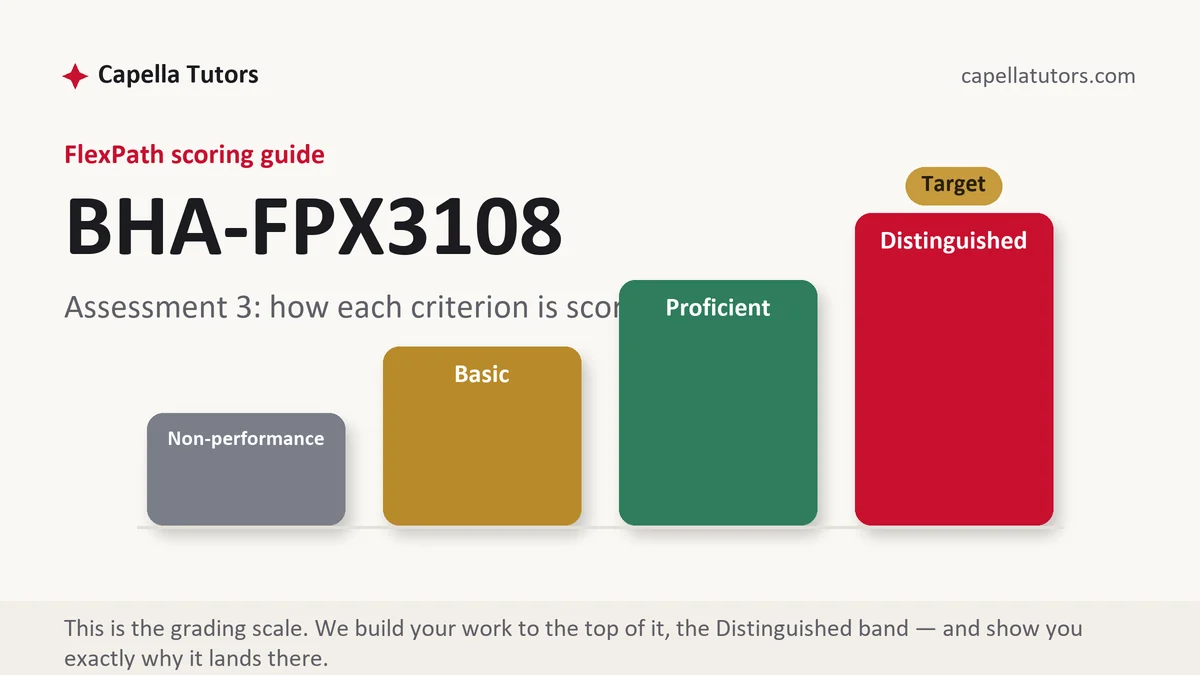
How BHA FPX 3108 Assessment 3 is scored
Nothing here is graded as a paper. Each criterion lands on one of four levels, and the level language doubles as the brief:
| Level | What it means on a strategy and evaluation plan |
|---|---|
| Distinguished | Effort is matched to tier size with the staff time named, partners carry a defined role and a referral route, measures are fully specified with a measured baseline, and results are read by subgroup so an aggregate gain cannot hide a widening gap. One more move is written into the criterion; find it and make it. |
| Proficient | The strategy is coherent and the evaluation is present. Sound work that reports only in aggregate. |
| Basic | One intervention aimed at an undivided population, a list of community partners, and a promise to monitor progress. |
| Non-performance | A required element is absent, most often the baseline or the measure specification. Absence floors the criterion regardless of the writing. |
The stratified read matters more than it sounds. An overall rate can rise while the distance between the best served and worst served subgroups widens, and a program reporting only the aggregate will never find out.
The BHA FPX 3108 Assessment 3 method, step by step
-
Criteria to headings, then stratify before you design
A single intervention aimed at an undivided population is the most common structural fault in these papers. Split the group by clinical risk, by the barrier that is actually blocking care, or by both, and only then decide what each tier receives.
-
Match intensity to tier size and say what it costs in time
The small high risk tier can afford individual outreach because there are few enough people for that to be possible. The middle tier usually needs a system fix such as standing orders or automated recall. The large low risk tier needs prevention at scale. Give each one an hours estimate.
-
Give every partner a role and a route
A list of organizations is not a partnership section. Say what each partner does, who refers to whom, how the referral travels, and what comes back, because a referral with no return path is a referral into nothing.
-
Specify measures the way a steward would
Numerator, denominator, exclusions, lookback period and data source, for each measure. Then add one measure of whether the effort was delivered at all, since a strategy can fail because nobody received it rather than because it does not work.
-
Measure the baseline instead of assuming it
Pull the current value before anything starts and report it with its collection window. Then give the target a number and a date, and name the comparison that would show the change was yours: a comparable site, the same months a year earlier, or the wider county figure.
-
Plan the stratified read, then self-score
Commit in advance to reporting results by the subgroups you identified at the start. Then mark each criterion D, P, B or N, rewrite anything below D, and submit early in the week to leave room for a revision inside the same session.
A structure that maps to the criteria
Use these as planning targets our tutors apply to a strategy and evaluation deliverable rather than as Capella requirements, and expand where your guide places the weight.
| Section | What it must do | Guide word target |
|---|---|---|
| Population and gap | The defined group, the current value of the outcome, and the gap expressed in people. | ~200 words |
| Stratification | How the group is split, the size of each tier, and the basis for the split. | ~250 words |
| Strategy by tier | What each tier receives, who delivers it, the staff time it needs and the barrier it removes. | ~350 words |
| Partners and resources | Each partner's role, the referral route, what returns, and what the plan depends on. | ~200 words |
| Evaluation plan | Measures fully specified, the measured baseline, the target with a date, and the comparison. | ~300 words |
| References | Measure specifications credited to their stewards, recommendations cited with their grade. | as needed |
Annotated sample excerpt
An original model paragraph from our team, written where the guide's top column sits. Study material: take the shape and fill it with your own population.
The birth cohort covered by the state program at the obstetrics group's four sites numbers 1,240 a year, and it splits into 186 patients with a hypertensive disorder documented during pregnancy, 415 with one or more elevated readings but no diagnosis, and 639 with neither.1 The first tier receives a scheduled blood pressure check within seven to ten days of discharge with a nurse call between, which at fifteen minutes of call time and one visit slot each is about 47 hours of nursing time and 186 slots a year; the second tier gets a home cuff, an automated text pathway and a pharmacist review only when a reading crosses a threshold; the third tier gets the standard postpartum visit and one message.2 The measure is the proportion of tier one patients with a recorded reading within fourteen days of discharge, excluding transfers and those who left the region, taken from the record system with a monthly lookback, against a measured baseline of 38 percent and a target of 70 percent by the end of the third quarter, reported separately for patients whose recorded preferred language is not English.3
- 1Three tiers with counts that sum to the cohort, so the reader can see the shape of the workload before any intervention is described.
- 2Intensity is matched to tier size and priced in nursing hours and appointment slots, which is what turns a strategy into something a manager could staff.
- 3The measure is specified with exclusions, source, lookback, a measured baseline, a dated target and a stratified read committed in advance.
The full premium sample for your exact assessment, written fresh to your scoring guide and issue, is free to request. Study it, revise it into your own voice, and submit work you understand.
The five mistakes that cost Distinguished
- One intervention for everybody. An undivided population gets a plan that is too expensive for the many and too thin for the few.
- Partners listed rather than assigned. Without a role, a referral route and a return path, a partnership section is a directory.
- Measures described instead of specified. A measure needs a numerator, a denominator, exclusions, a lookback and a source before it can be run.
- A baseline assumed. An evaluation without a value measured before the change cannot show that anything happened.
- Aggregate-only reporting. An overall gain can hide a widening gap, and the criterion asks for the subgroup read that would catch it.
Pre-submission checklist
- Each criterion has a labeled section in the guide's order
- The population is split into tiers whose counts sum to the whole
- Each tier's effort is priced in staff hours or appointment slots
- Every partner has a role, a referral route and something that comes back
- Measures carry numerator, denominator, exclusions, lookback and source
- Baseline measured, target dated, subgroup read committed, every criterion self-scored D
Strategy and evaluation plan due?
Send the scoring guide, the population you defined earlier in the course, and any figures you already hold. We stratify first, price each tier in staff time, and write the measures the way a steward would, with one review pass spent only on whether the numbers still match their sources. Returned in 24 to 48 hours, revised free until every criterion clears.