This manual is for BHA FPX 3009 Assessment 3, start to submission. The assessment usually asks you to model what happens to an organization's revenue when the composition of its patient panel changes, which means building a weighted average payment per unit, moving a share of the panel from one payer to another, and reporting the consequence as a figure rather than as a direction. Nothing about the clinical work changes in these models, and the money changes anyway. Below: the method, a structure that matches the criteria, and an annotated sample excerpt. Rather have it modeled for you? A premium original sample built on your payer mix comes back inside 24 to 48 hours, revised free until the guide is met. Capella's catalog lists the course as BHA-FPX3009, and some courserooms print BHA3009; both point to this same Assessment 3.
One honesty note before the manual: Capella revises courses and scoring guides over time, so always write to the exact scoring guide attached to your assessment in the courseroom. The course identity above is verified on capella.edu; the method and structure below are our tutors' approach to it, not Capella's official rubric text.
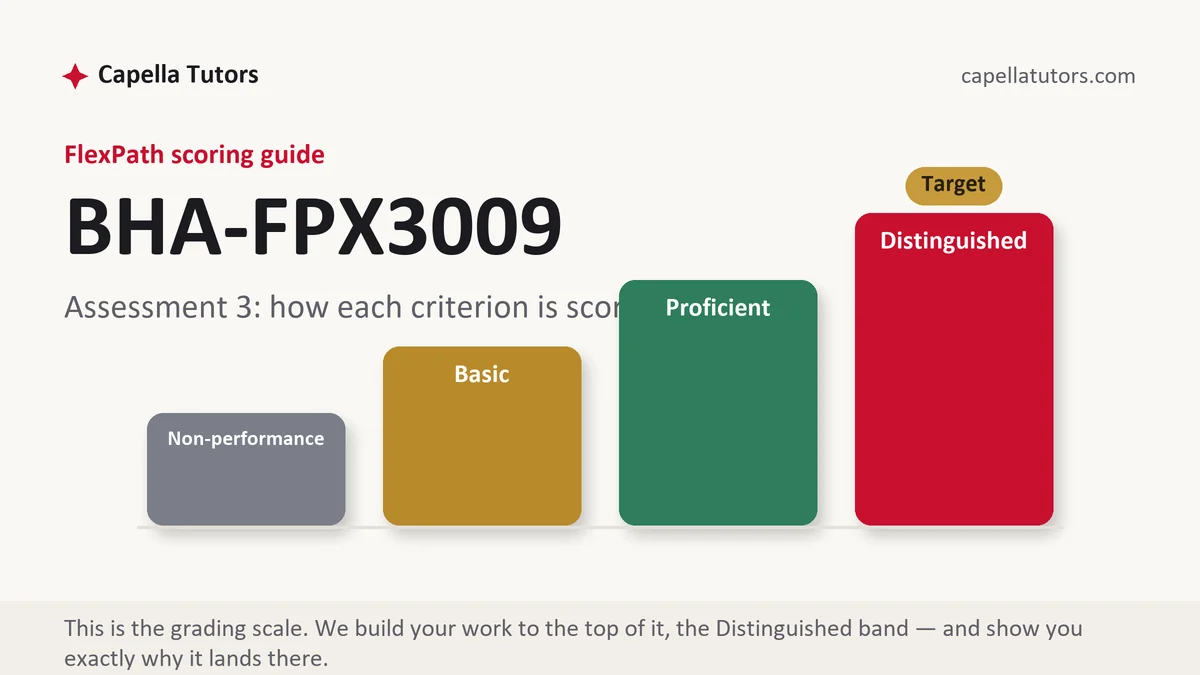
How BHA FPX 3009 Assessment 3 is scored
There are four levels per criterion in FlexPath and no letter grades anywhere, and the level language is what you write to:
| Level | What it means on a payer mix model |
|---|---|
| Distinguished | The mix is stated with shares and rates, the weighted average is shown with its weights, the modeled change reports a dollar effect per unit and per period, and the response options are limited to the three things an organization can actually move. The criterion always asks for one more move; find it and make it. |
| Proficient | The mix is described and the average is computed correctly. Accurate work whose modeled change stops at a direction. |
| Basic | A discussion of payers with percentages and no rates, concluding that commercial coverage pays better than public programs. |
| Non-performance | A required element is absent, usually the modeled change itself, which leaves the analysis criterion with nothing to grade. |
The sentence the analysis criterion is waiting for is the one that quantifies a shift nobody chose. When a local employer changes carriers, a clinic can lose several dollars on every visit without seeing one patient fewer, and that is the whole subject of the course in a line.
The BHA FPX 3009 Assessment 3 method, step by step
-
Criteria to headings, then fix the unit and the period
Decide early whether you are modeling per visit, per admission or per member month, and whether the period is a month, a quarter or a year. Mixing units halfway through is the error that makes an otherwise correct model impossible to check.
-
Build the baseline mix as a table before any prose
Segment, share of volume, average net payment per unit, and the product of the last two. The shares have to sum to one hundred percent and the products have to sum to your weighted average, and both checks belong in the paper.
-
Show the weighted average with its weights visible
Write the multiplication out segment by segment rather than reporting a single figure. A weighted average presented without its components is a number the evaluator has to take on trust, and criteria at this level are graded on visible reasoning.
-
Move one share and recompute the whole table
Shift a defensible amount, name the event that causes it, and recompute every product. Then report the change three ways: per unit, per period, and as a percentage of the baseline, because each version lands with a different reader.
-
Limit the response to what an organization can move
The realistic levers are cost structure, volume and the contract itself, and the list is shorter than most drafts assume. Say which lever you would pull, roughly what it yields against the gap you calculated, and what stands in the way.
-
Label every rate, then self-score
Give each payment figure its program and year, and mark any commercial rate as an assumption unless it came from a study or a published file. Then grade each criterion D, P, B or N and rewrite anything below D before submitting early in the week.
A structure that maps to the criteria
The targets below are planning figures our tutors use for a payer mix model at this level rather than Capella rules; expand wherever your guide places the weight.
| Section | What it must do | Guide word target |
|---|---|---|
| The organization and the unit | The service, the volume, the unit being modeled and the period the model covers. | ~150 words |
| Baseline payer mix | Each segment with its share, its average net payment and the product, summing to the average. | ~250 words |
| The modeled change | The event, the shares that move, the recomputed table and the effect stated three ways. | ~350 words |
| Why it happens | What in the local market produces a shift like this, with a dated source where one exists. | ~200 words |
| Response and limits | The lever chosen, its likely yield against the gap, and what constrains it. | ~250 words |
| References | Every rate cited with program, year and locality, current APA reconciled both ways. | as needed |
Annotated sample excerpt
An original model paragraph from our team, pitched where the top of the guide sits. Study material: take the structure and rebuild it around your own panel.
The hospital's outpatient behavioral health program runs 1,450 billable sessions a month across four segments: 26 percent commercial at 154 dollars, 31 percent the federal program for older adults and people with disabilities at 89 dollars, 37 percent the state program at 68 dollars, and 6 percent uninsured from whom the program collects an average of 19 dollars.1 Those products are 40.04, 27.59, 25.16 and 1.14, giving a weighted average of 93.93 dollars a session.2 When a regional employer moves to a narrower network the program does not participate in and four percentage points shift out of commercial coverage into the state program, the average falls to 90.49 dollars, which is 3.44 dollars a session, 4,988 dollars a month and roughly 59,900 dollars a year, all of it produced by who is paying rather than by anything the clinicians did differently.3
- 1Shares and rates appear together and sum to one hundred percent, so the model can be reproduced from the paragraph alone.
- 2The weights are shown as products rather than summarized. Visible arithmetic is what the analysis criterion is scored on.
- 3The effect is reported per session, per month and per year, and the last clause states the finding that makes the model matter.
The full premium sample for your exact assessment, written fresh to your scoring guide and issue, is free to request. Study it, revise it into your own voice, and submit work you understand.
The five mistakes that cost Distinguished
- Shares without rates. A mix expressed only as percentages cannot produce a weighted average, and the model has nowhere to go.
- An average with hidden weights. Reporting the result and not the products removes the reasoning the criterion is grading.
- A change reported as a direction. Revenue would decrease is not a finding, and the guide is asking for dollars per unit and per period.
- Units that drift mid-paper. A figure that could be per visit or per month is a figure the evaluator cannot verify.
- Responses no organization could execute. Refusing a payer, raising charges or attracting a different population are not levers, and saying so is part of the analysis.
Pre-submission checklist
- Every criterion has a section, and the unit and period are fixed in the first paragraph
- The baseline table shows segment, share, rate and product, with shares summing to 100 percent
- The weighted average is derived on the page from those products
- The modeled shift names its cause and reports the effect per unit, per period and as a percentage
- The response is limited to cost structure, volume or the contract, with a stated constraint
- Every rate carries program, year and locality, and each criterion is self-scored D
Payer mix model to build?
Give us the segments, the volumes and whatever rates the course supplied, and the model in your sample runs on those rather than on a textbook panel. Eight people handle it and one pass exists only to recompute the weighted average and the shift. Back in 24 to 48 hours, and revised free for as long as the criteria require.