This manual is for BHA FPX 3009 Assessment 2, start to submission. The assessment usually puts a single claim in front of you and asks you to follow the money through it: the charge, the contracted allowed amount, the contractual allowance nobody ever collects, the patient's deductible and coinsurance applied in the right order, and the balance the plan sends. Four or five figures, all of which have to reconcile, and most drafts get one of them wrong. The method follows, along with a structure mapped to the criteria and an annotated sample excerpt. Prefer to hand the arithmetic over? A premium original sample worked on your numbers returns in 24 to 48 hours, revised at no charge until the criteria are cleared. Capella's catalog lists the course as BHA-FPX3009, and some courserooms print BHA3009; both point to this same Assessment 2.
One honesty note before the manual: Capella revises courses and scoring guides over time, so always write to the exact scoring guide attached to your assessment in the courseroom. The course identity above is verified on capella.edu; the method and structure below are our tutors' approach to it, not Capella's official rubric text.
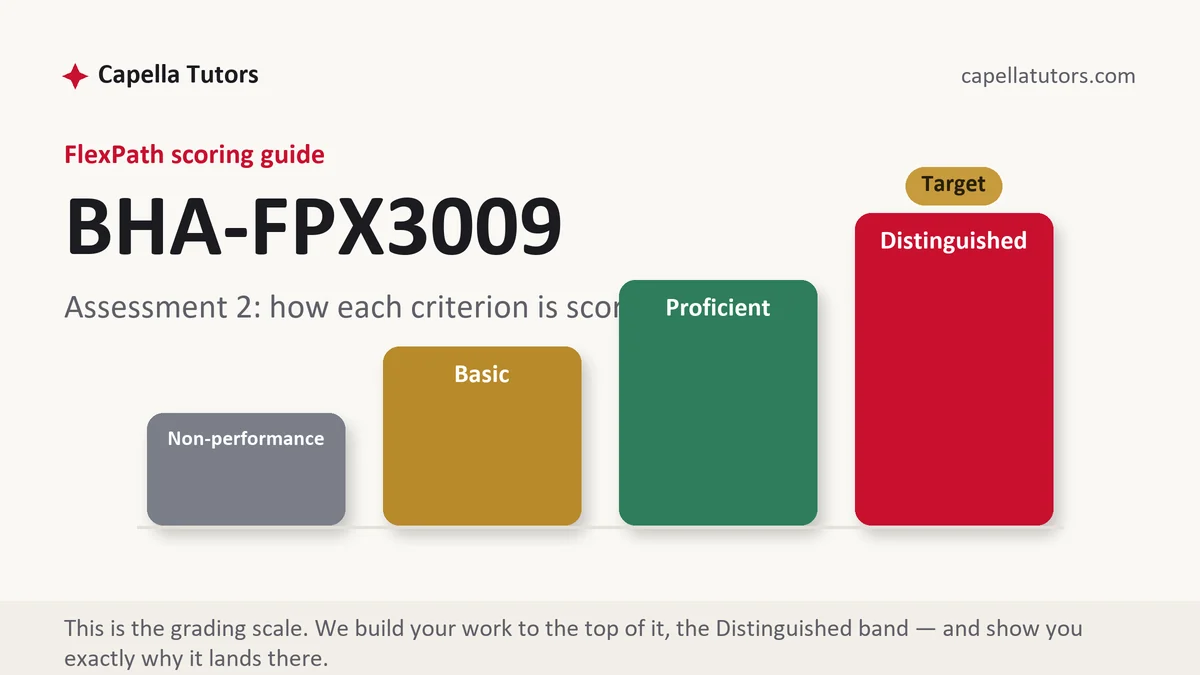
How BHA FPX 3009 Assessment 2 is scored
Every criterion in FlexPath lands on one of four levels, and the level text tells you exactly what the section has to contain:
| Level | What it means on a claim analysis |
|---|---|
| Distinguished | Every figure reconciles to the allowed amount, cost sharing is applied in the correct sequence, the benefit design terms are defined as they are used, and the analysis says what the result means for the patient and for the organization. The extra move is inside the criterion; find it and make it. |
| Proficient | The arithmetic is right and the terms are used correctly. Solid work that stops before consequence. |
| Basic | The claim explained in general terms, with the charge treated as the amount owed and the contractual allowance never mentioned. |
| Non-performance | A required figure is missing, most often the patient responsibility or the plan payment. Absence floors the criterion. |
The single most common arithmetic error is treating the deductible as an amount paid on top of the allowed charge. It comes out of the allowed amount, and once that sequence is right the rest of the claim usually falls into place.
The BHA FPX 3009 Assessment 2 method, step by step
-
Outline from the criteria, then draw the claim as a ladder
Give every criterion a section, then sketch the claim vertically before writing a word: charge at the top, allowed amount beneath it, then deductible, then coinsurance, then plan payment. A visual sequence prevents the ordering error that costs the accuracy criterion.
-
Define the benefit terms where you first use them
Deductible, coinsurance, copayment and out of pocket maximum each do a different job, and a paper that uses them loosely cannot be graded as accurate. Define each one in the sentence where the figure appears rather than in a glossary paragraph nobody reads.
-
Compute the contractual allowance and label it
Charge minus allowed amount is the contractual allowance, and it is written off rather than billed to anybody. Say that plainly, because the belief that the patient owes the difference is the single most persistent misunderstanding this course exists to correct.
-
Apply cost sharing in order, showing each step
Remaining deductible first, then the coinsurance percentage on what is left of the allowed amount, then check the running total against the out of pocket maximum. Put each multiplication on the page so a reader can follow it without rebuilding your work.
-
Prove the reconciliation in one sentence
Patient responsibility plus plan payment must equal the allowed amount, and saying so explicitly is a cheap way to demonstrate control of the arithmetic. If the two do not add, the error is almost always in the coinsurance base rather than in the percentage.
-
Say what it means, then self-score
Close with consequence: what the patient faces, what the organization collects and how long collection takes, and what the same service would cost under a different benefit design. Then grade each criterion yourself and rewrite anything under Distinguished.
A structure that maps to the criteria
Use these as planning targets our tutors apply to a claim analysis of this size, not as Capella requirements, and expand any section the guide clearly emphasizes.
| Section | What it must do | Guide word target |
|---|---|---|
| The service and the coverage | What was delivered, in which setting, and the benefit design that applies to it. | ~200 words |
| Charge and allowed amount | The list price, the contracted amount, and the contractual allowance named and explained. | ~250 words |
| Patient responsibility | Deductible then coinsurance applied in order, with the out of pocket maximum checked. | ~300 words |
| Plan payment and reconciliation | What the plan sends, and the proof that the parts sum to the allowed amount. | ~200 words |
| Consequence | What the figures mean for the patient, for collection, and under a different design. | ~250 words |
| References | Rules and rate sources cited with their year, current APA reconciled both ways. | as needed |
Annotated sample excerpt
An original model paragraph from our team, at the register the top column rewards. It is study material: take the sequence and run your own claim through it.
The hospital outpatient department charged 3,940 dollars for the diagnostic colonoscopy, and the commercial plan's contracted allowed amount for the facility component is 1,720 dollars, so 2,220 dollars is a contractual allowance that is written off and billed to nobody.1 The patient entered the encounter with 640 dollars of the deductible unmet, which comes out of the allowed amount first, leaving 1,080 dollars subject to 20 percent coinsurance, or 216 dollars, for a patient responsibility of 856 dollars and a plan payment of 864.2 Those two figures sum to the allowed amount, which is the check worth running every time, and the classification matters here as much as the arithmetic, because the same procedure billed as a preventive screening rather than as diagnostic would have moved most of that 856 dollars off the patient entirely.3
- 1Charge, allowed amount and contractual allowance appear together, with the write-off stated as a fact rather than left for the reader to infer.
- 2Cost sharing is applied in sequence with each step visible, and the coinsurance base is the post-deductible balance rather than the full allowed amount.
- 3The reconciliation is proved in one clause, then the analysis moves to consequence. Naming the classification effect is the move the top column pays for.
The full premium sample for your exact assessment, written fresh to your scoring guide and issue, is free to request. Study it, revise it into your own voice, and submit work you understand.
The five mistakes that cost Distinguished
- Billing the contractual allowance to the patient. The gap between charge and allowed amount is written off, and the whole claim collapses if that is wrong.
- Coinsurance taken on the full allowed amount. The percentage applies after the deductible comes out, and the order changes the answer.
- Figures that do not reconcile. Patient responsibility plus plan payment has to equal the allowed amount, and a reader will add them.
- Terms used interchangeably. A copayment is a flat amount and coinsurance is a share, and treating them as synonyms costs the accuracy criterion.
- Arithmetic with no consequence. The numbers are half the deliverable, and the criterion asks what they mean for the patient and the organization.
Pre-submission checklist
- Each criterion has a section, and the claim appears as an ordered sequence
- Charge, allowed amount and contractual allowance are all named and distinguished
- Deductible is applied before coinsurance, and the coinsurance base is stated
- The out of pocket maximum is checked against the running total
- Patient responsibility plus plan payment is shown to equal the allowed amount
- Consequence written, sources dated, and every criterion self-scored D
Claim arithmetic due?
Send the scenario, the benefit design and the scoring guide. Every figure in the sample reconciles before it leaves us, because one pass through the studio exists purely to recompute the numbers and confirm the interpretation is the right way round. Back in 24 to 48 hours with free revision.