This manual is for BHA FPX 3009 Assessment 1, start to submission. The assessment usually asks you to take one payment arrangement and explain how it works, who carries the financial risk under it, and what organizations do differently because of it. Every payment method is an incentive wearing a formula, and the criteria are checking whether you can read the formula and then predict the behavior. Below is the sequence our tutors follow, the structure they build, and an annotated sample excerpt. Would you rather we drafted it? A premium original sample for this exact assessment is back inside 24 to 48 hours, revised free until it satisfies the guide. Capella's catalog lists the course as BHA-FPX3009, and some courserooms print BHA3009; both point to this same Assessment 1.
One honesty note before the manual: Capella revises courses and scoring guides over time, so always write to the exact scoring guide attached to your assessment in the courseroom. The course identity above is verified on capella.edu; the method and structure below are our tutors' approach to it, not Capella's official rubric text.
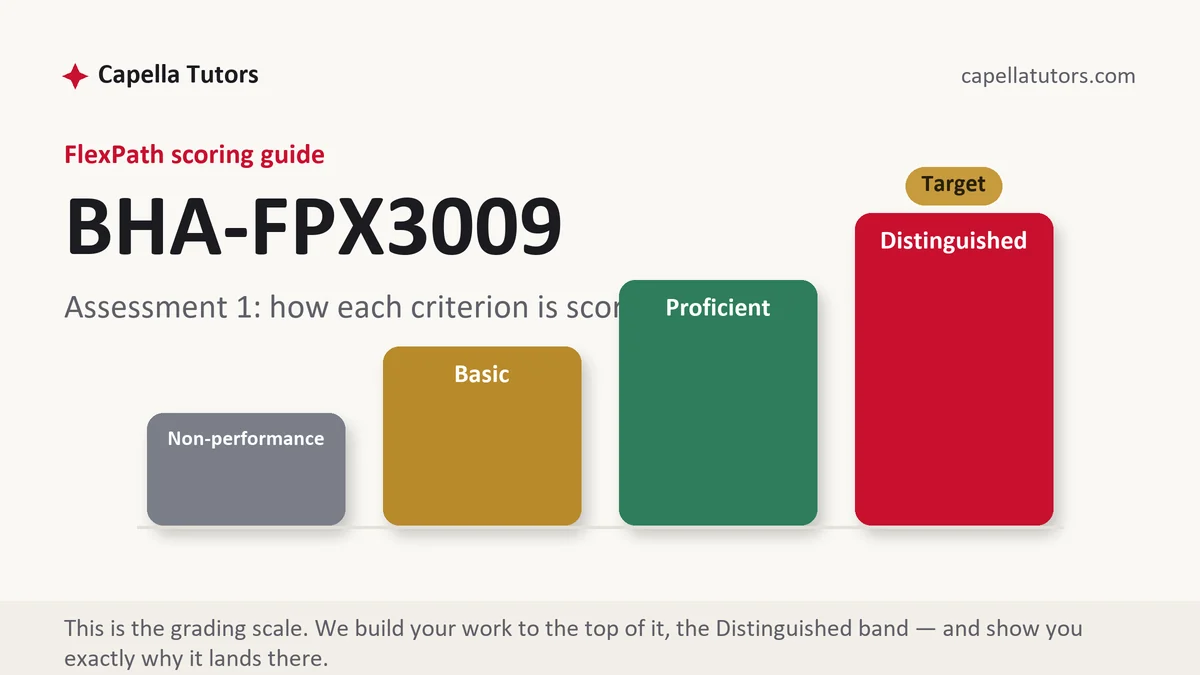
How BHA FPX 3009 Assessment 1 is scored
FlexPath places every criterion on one of four levels, and the wording of the level is the specification for the section under it:
| Level | What it means on a payment model analysis |
|---|---|
| Distinguished | The method is named precisely, the unit of payment is identified, risk is traced to a party with the trigger that moves it, and the operational behavior that follows is something a reader could observe on a Tuesday. The criterion always asks one more thing; find it and make it. |
| Proficient | The model is described accurately with its advantages and disadvantages. Correct, and one step short because the behavior stays general. |
| Basic | Five payment models explained at equal length, none of them applied to the scenario the prompt actually described. |
| Non-performance | A required element is absent, most often the risk analysis. An omitted element sits at the floor no matter how strong the rest reads. |
The habit that lifts a draft is refusing to declare a winner. A defensible answer names the service, the population and the conditions under which a model works, then names the organization type that would fail under it.
The BHA FPX 3009 Assessment 1 method, step by step
-
Headings from the guide, then one model chosen
Build the outline from the criteria, then decide which arrangement the scenario actually runs on. Give the alternatives a sentence each for contrast and spend the paper on the one that matters, because equal treatment of five models satisfies a knowledge criterion and loses every analysis criterion.
-
Name the unit the payment attaches to
Per service, per day, per admission adjusted for diagnosis and severity, per episode across settings, or per member per month. Everything else in the analysis follows from that unit, and getting it wrong in the first paragraph makes the rest of the paper internally inconsistent.
-
Trace the risk to a named party
Say who absorbs the cost when utilization runs higher than expected, and say what triggers the shift. Risk language stays abstract until you write a sentence such as the hospital absorbs every day beyond the payment window, which is a claim a reader can test.
-
Predict a behavior somebody could watch
Convert the incentive into an observable operational change: a department that grows, a service that opens on Saturdays, a role that gets hired, a meeting that starts happening. Naming the behavior is what separates a paper that learned the models from one that learned the incentives.
-
Cite rates to their publisher, with year and locality
Federal payment rules and fee schedules are published and checkable, and every figure they contain belongs to a year and usually to a geographic area. Commercial terms are private, so any commercial rate is from a study, a transparency file, or an assumption you have labeled as one.
-
Take a conditional position, then self-score
Close with a recommendation carrying a condition and a safeguard rather than a verdict. Then mark each criterion D, P, B or N, rewrite what falls short, and submit early in the week, since an attempt can sit with an evaluator for two business days.
A structure that maps to the criteria
The counts below are planning targets our tutors work to on a payment analysis at this level, not Capella rules; give more room to whichever criterion the guide weights.
| Section | What it must do | Guide word target |
|---|---|---|
| The arrangement | Who pays whom, under which method, and the unit of service the payment attaches to. | ~200 words |
| How the money moves | The mechanics from service to payment, including any adjustment for severity or setting. | ~250 words |
| Where the risk sits | The party absorbing higher than expected use, the trigger, and the size of the exposure. | ~300 words |
| Behavior and evidence | The operational change the incentive produces, with research on whether it delivered. | ~300 words |
| Conditional recommendation | Which service and population suit the model, the safeguard required, and who would fail under it. | ~200 words |
| References | Rates cited to the publishing program with year and locality, current APA both ways. | as needed |
Annotated sample excerpt
An original model paragraph from our team, written at the register the guide rewards at the top. Study material only: take the moves, write your own analysis.
Under the episode arrangement the regional system entered for elective hip and knee replacement, one price covers the surgeon, the hospital stay and the ninety days of recovery that follow, which means three organizations that bill separately now share one budget.1 Risk sits with whichever party holds the episode agreement, and it moves the moment a patient leaves for a skilled nursing facility rather than home, because the difference between those two discharge paths can consume the entire margin on the episode.2 The behavior is visible from the parking lot: a joint program under episode payment hires a navigator, runs a pre-surgical class, screens for home support weeks before admission, and starts calling the patient on day two rather than waiting for the postoperative visit.3
- 1The unit of payment and the parties are named in one sentence, so the coordination problem the model creates is visible immediately.
- 2Risk is traced to a holder and given a trigger, with the magnitude implied. Abstract risk language would have scored a level lower here.
- 3Four observable behaviors, none of them a general statement about incentives. This is the sentence the behavior criterion is waiting for.
The full premium sample for your exact assessment, written fresh to your scoring guide and issue, is free to request. Study it, revise it into your own voice, and submit work you understand.
The five mistakes that cost Distinguished
- Five models, equal length, no analysis. A survey of payment methods answers a knowledge criterion and abandons every other one in the guide.
- Risk described without an owner. Saying the arrangement shifts risk means nothing until a party and a trigger are named.
- Capitation called a discount. It transfers risk, and treating it as a price reduction misreads the whole model.
- A rate with no year and no locality. Payment rates reset annually and vary geographically, so an unlabeled figure cannot be checked.
- Naming one model as the best. The defensible answer is conditional, with the service, the population and the safeguard all named.
Pre-submission checklist
- Every criterion has its own section, in the order the guide presents them
- The payment method is named precisely, with the unit of service it attaches to
- Risk is traced to a party, with the trigger that moves it stated
- At least one observable operational behavior is named rather than described in general
- Every rate carries its program, its year and its locality
- The recommendation is conditional, and every criterion self-scored D before submission
Payment model to analyze?
Send the prompt and the scoring guide and tell us which arrangement your scenario runs on. Eight people build the sample, including a research analyst who pulls the published rules and a reviewer who checks that every rate carries its year. Delivered in 24 to 48 hours, revised free until the guide is cleared.