This manual is for BHA FPX 2110 Assessment 3, start to submission. Assessment 3 of BHA FPX 2110, Healthcare Operations and Process Improvement, is the deliverable most students underbuild. The assessment usually asks how the change will be measured and how it will be held in place, which is the section that decides whether an improvement survives past the month somebody was watching. Three measures, one owner, one report, one cadence, and one trigger for action: that is the shape the criteria are looking for, and a plan resting on staff remembering the new way has a half life of about six weeks. Below you get our tutors' method, a section plan answering the guide in order, and an annotated sample excerpt. Down to the wire? A premium original sample is delivered inside 24 to 48 hours, revised free until the guide is satisfied. Capella's catalog lists the course as BHA-FPX2110, and some courserooms print BHA2110; both point to this same Assessment 3.
One honesty note before the manual: Capella revises courses and scoring guides over time, so always write to the exact scoring guide attached to your assessment in the courseroom. The course identity above is verified on capella.edu; the method and structure below are our tutors' approach to it, not Capella's official rubric text.
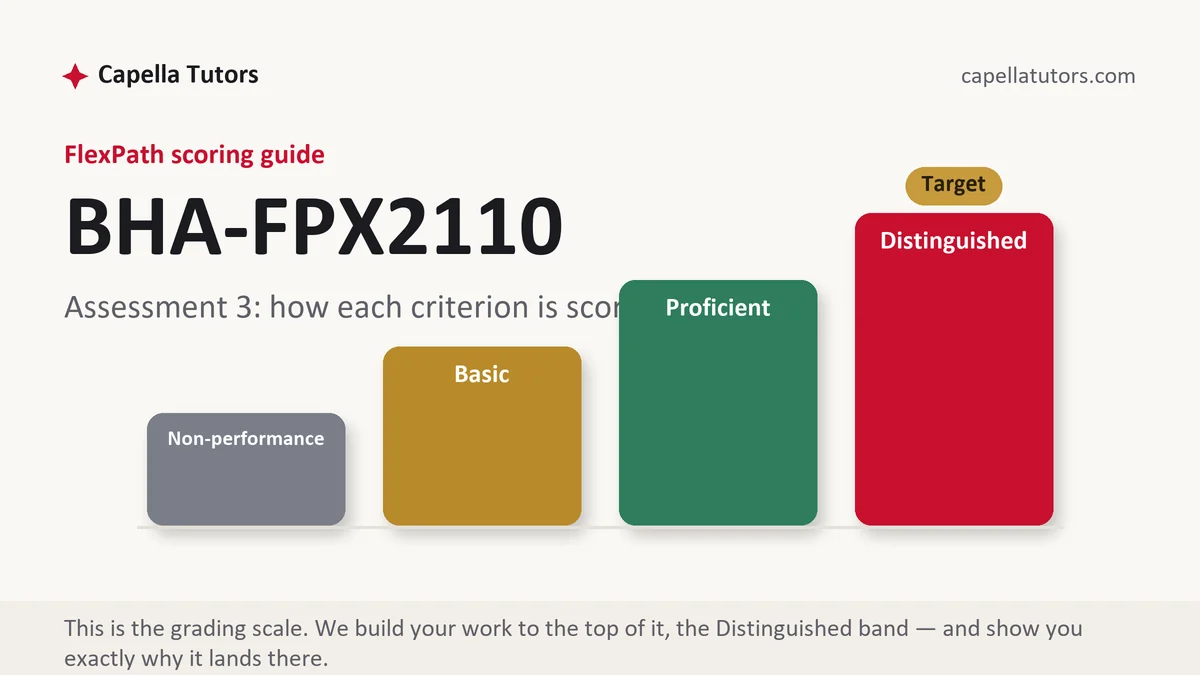
How BHA FPX 2110 Assessment 3 is scored
Criteria are graded one at a time against four levels, and the highest level in this deliverable is asking for machinery rather than intention:
| Level | What it means on a measurement and control plan |
|---|---|
| Distinguished | Outcome, process, and balancing measures are all present with numerators, denominators, sources, and owners, variation is read correctly, and the control is built into the system rather than into anybody's memory, with a stated trigger for action. |
| Proficient | A complete measurement plan with an owner and a review cadence, missing the balancing measure or the trigger. |
| Basic | A promise to monitor results monthly, with the measure named but not defined and nobody assigned. |
| Non-performance | No control plan is provided, or improvement is claimed with nothing measured before and after. |
Read variation before you react to it. A process wandering around a stable median is producing ordinary noise, and adjusting it after every bad day adds instability to something that was already stable. A shift shows itself as a run of points on one side of the median, and knowing which of the two you are looking at is a scored skill in this course.
The BHA FPX 2110 Assessment 3 method, step by step
-
Define every measure so a stranger could collect it
Name, numerator, denominator, data source, collection frequency, and the person responsible. Six fields per measure, and a measure missing any of them will not be collected the same way twice.
-
Use all three kinds of measure
The outcome measure is what you promised to move, the process measure tells you whether the change was actually delivered, and the balancing measure catches the harm you did somewhere else. Without the second one, a failed result cannot be distinguished from a change nobody made.
-
Set the target as a number with a date
Improved is not a target. Reducing median authorization turnaround from nine days to five by the end of the second quarter is a target, and it lets anyone reading the plan know whether it worked.
-
Plot the data in time order before you judge it
A run chart with the median drawn is the cheapest analysis in operations and the one that stops the most bad decisions. Read it for a run of points on one side of the median before you decide anything changed, and credit the statistical thinking to Shewhart and Deming rather than to a consultancy.
-
Build the control into the system
Standard work written down, a default set in the scheduling template, a required field, a question asked at the morning huddle, and one report a named person reads on a named day. The change has to become the easy way, because the memorable way decays.
-
Write the trigger, then self-score
Say what happens when the measure drifts back: who is notified, at what threshold, and what they do. A control plan with no trigger is a description of monitoring. Then grade yourself criterion by criterion and revise anything below the top level.
A structure that maps to the criteria
These are our planning targets for a measurement and control plan of this scope. Follow the sections and the lengths your own scoring guide sets out.
| Section | What it must do | Guide |
|---|---|---|
| The change being held | A short restatement of what was changed and what it was expected to move. | ~150 words |
| Measure definitions | Outcome, process, and balancing measures, each with numerator, denominator, source, frequency, and owner. | ~325 words |
| Target and timeframe | The number, the date, and the reason that number is the right one to aim at. | ~200 words |
| Reading the data | How the figures will be plotted, and the difference between ordinary variation and a real shift. | ~275 words |
| Control and trigger | Where the change is built in, who reviews what report on what cadence, and the threshold that prompts action. | ~275 words |
| References | Improvement bodies cited for method, statistical thinking credited to its originators, current APA. | as needed |
Annotated sample excerpt
A model excerpt from our team showing a control plan with actual machinery in it. Study the components, then build the version your own change requires.
The outcome measure is median days from referral receipt to authorization decision, drawn from the authorization log, reported weekly by the referral coordinator; the process measure is the share of new referrals with all four required clinical documents attached at intake, sampled twenty a week by the same role; and the balancing measure is the count of authorizations obtained after the appointment date, which is the failure the faster process is most likely to create.1 The control is built into the intake screen rather than into a reminder: the four documents are required fields, an incomplete referral cannot be moved to the pending queue, and the daily huddle asks one standing question about referrals older than five days, which is the only new habit the plan requires of anyone.2 The trigger is written down, because a plan without one is monitoring rather than control: if the weekly median crosses seven days twice in a row, or if two consecutive weeks show fewer than eighteen of twenty complete intakes, the practice manager reviews the queue at the Thursday operations meeting and the release is paused rather than discussed at the next quarterly review.3
- 1All three measures are defined in one paragraph with source, frequency, and owner attached, and the balancing measure is chosen as the specific harm this change could cause rather than as a formality.
- 2The control lives in the software and in one huddle question. Making the new way the easy way, and asking for only one new habit, is what the top level means by built in.
- 3The trigger names two thresholds, a person, an existing meeting, and an action. This sentence is the difference between a control plan and a paragraph about monitoring.
The full premium sample for your exact assessment, written fresh to your scoring guide and issue, is free to request. Study it, revise it into your own voice, and submit work you understand.
The five mistakes that cost Distinguished
- A measure with no denominator. A twelve percent reduction means nothing until the reader knows twelve percent of what, over which period.
- No process measure. Without it, a change that was never delivered looks identical to an idea that did not work.
- Reacting to ordinary variation. Adjusting after every bad day adds instability to a process that was already stable.
- A control that depends on memory. Reminders decay. Defaults, required fields, and standing questions survive.
- No trigger for action. A plan that says the measure will be monitored has not said what happens when it moves.
Pre-submission checklist
- Every measure carries a name, numerator, denominator, source, frequency, and owner
- Outcome, process, and balancing measures are all present
- The target is a number with a date attached
- The plan says how variation will be read before anyone reacts to it
- The control is built into a system, a default, or a standing question
- A written trigger names a threshold, a person, and an action, APA reconciled both ways
Control plan deliverable due?
Send the change you are holding in place and the criteria attached to it. The sample returns inside 24 to 48 hours with three defined measures, a target carrying a date, and a control built into a system rather than into somebody's memory. Free revision until the guide is fully met.