This manual is for BHA FPX 2110 Assessment 2, start to submission. Assessment 2 of BHA FPX 2110, Healthcare Operations and Process Improvement, is the deliverable that separates this course from a writing course. The assessment usually asks you to analyze why a process performs the way it does and to propose a change, and there is one move that decides the grade: finding the step that governs how fast the whole process moves, then changing that step rather than the annoying one. Almost every weak submission improves something real and irrelevant. The manual below sets out the method, a structure assembled criterion by criterion, and an annotated sample excerpt. Need a head start? A premium original sample arrives inside 24 to 48 hours, revised free until the criteria are met. Capella's catalog lists the course as BHA-FPX2110, and some courserooms print BHA2110; both point to this same Assessment 2.
One honesty note before the manual: Capella revises courses and scoring guides over time, so always write to the exact scoring guide attached to your assessment in the courseroom. The course identity above is verified on capella.edu; the method and structure below are our tutors' approach to it, not Capella's official rubric text.
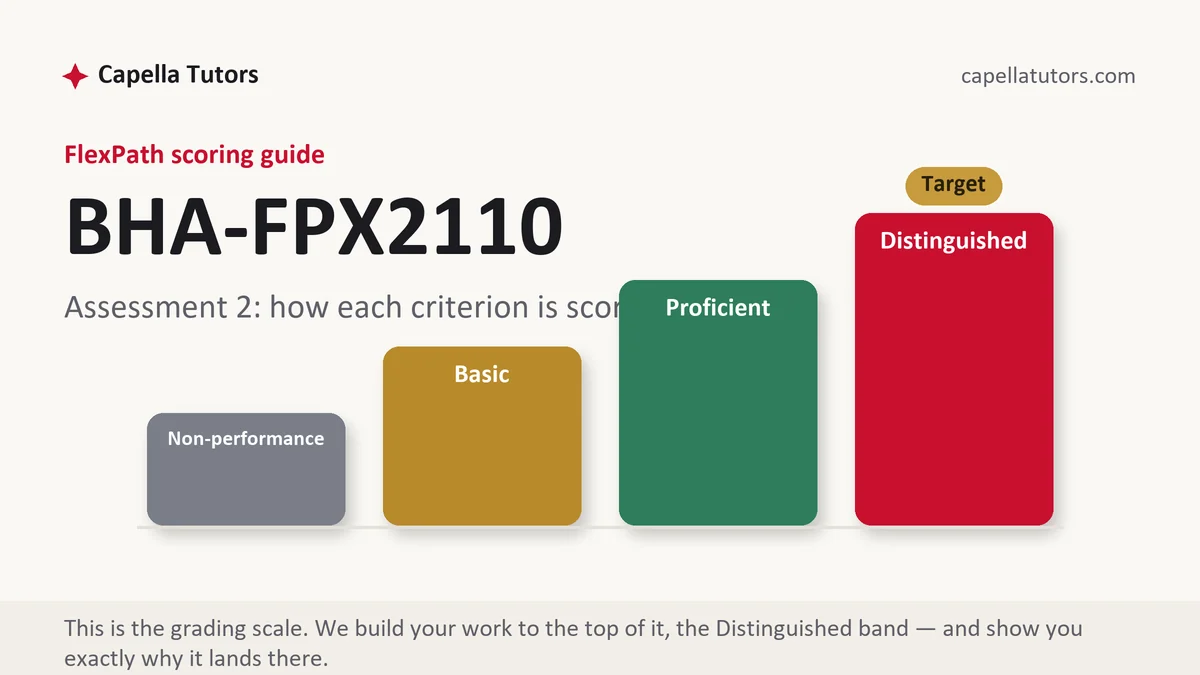
How BHA FPX 2110 Assessment 2 is scored
Each criterion stands alone at one of four levels, and the top description usually contains one clause the rest of the guide does not:
| Level | What it means on a constraint analysis |
|---|---|
| Distinguished | The limiting step is identified with evidence, the paper shows what improving a non-constraint step would return, and the proposed change is sized in minutes or cases with its assumption stated. |
| Proficient | A correct analysis and a workable change, with the constraint asserted rather than demonstrated against an alternative. |
| Basic | A real problem, a sensible fix, and no evidence that the step being fixed is the one holding the process back. |
| Non-performance | No analysis of cause is offered, or the proposal has no expected effect attached to it. |
The comparison is the whole trick. Show what the obvious improvement would return, show what the constraint improvement would return, and put the two numbers in the same paragraph. Demonstrating why the popular fix does nothing is worth more than proposing three fixes nobody sized.
The BHA FPX 2110 Assessment 2 method, step by step
-
Find the step where work arrives faster than it leaves
Capacity against demand, step by step. A step that receives twenty items an hour and completes fourteen is the constraint, and everything upstream of it turns time saved into queue rather than into throughput. Goldratt's argument about constraints is worth citing here properly.
-
Test your candidate against a rival
Pick the step everyone complains about and calculate what fixing it would return. Then calculate the constraint. Writing both figures down is how you convert an opinion about the bottleneck into evidence, and it is the paragraph the top level is describing.
-
Ask whether the constraint is capacity, sequence, or a batch
Three different causes with three different fixes. Capacity means not enough hands or machines at the peak, sequence means work waits for an approval it could have received earlier, and batching means the process holds items until it has enough of them, which converts a five-minute task into a two-hour delay.
-
Size the change before you defend it
Say what the change is expected to move, in minutes, cases, or percentage points, and name the assumption behind the estimate. An unsized proposal cannot be evaluated, and the criteria ask for an expected effect for exactly that reason.
-
Cost it and name what it displaces
Every change consumes something: an hour of a role, a slot on a machine, a room. Say what gets less attention as a result. A proposal that costs nothing is a proposal nobody believes.
-
Predict, then self-score
Write down what you expect to see and by when, before anyone runs anything, because a stated prediction is what makes the later test informative. Then grade the draft against each criterion and rewrite whatever falls short of the top level.
A structure that maps to the criteria
Our tutors' planning targets for an analysis of this size. Your scoring guide sets the sections, the order, and the length it wants.
| Section | What it must do | Guide |
|---|---|---|
| The process and its performance | A short restatement of scope, unit, and baseline, enough to carry the analysis. | ~175 words |
| Capacity against demand | Each step's capacity beside the demand arriving at it, with the peak identified. | ~275 words |
| The constraint, demonstrated | The limiting step, the evidence, and the arithmetic showing what a non-constraint fix would return. | ~300 words |
| Cause of the constraint | Capacity, sequence, or batching, with the reason this is the right diagnosis. | ~225 words |
| The proposed change | What changes, who does it, what it costs, what it displaces, and the expected effect with its assumption. | ~275 words |
| References | Peer-reviewed operations and improvement research with design and setting stated, current APA. | as needed |
Annotated sample excerpt
A model excerpt from our team, showing a constraint demonstrated against a rival rather than announced. Take the arithmetic pattern into your own process.
Sterile processing returns 96 instrument trays a day against a surgical schedule that requires 104 on Tuesdays and Thursdays, and the department's own complaint is about the transport delay between the operating rooms and decontamination, which averages 21 minutes.1 Removing that delay entirely would return about 36 tray-minutes a day and no additional trays, because the trays do not wait on transport, they wait for the two autoclaves that run a 47 minute cycle and are already loading back to back from six in the morning; the constraint is sterilizer capacity at the morning peak, and every minute saved upstream simply arrives at the same queue sooner.2 The change therefore targets the load rather than the transport: separating the two Tuesday orthopedic sets into an earlier dedicated cycle started at five, which on the current cycle time is expected to release eight trays before the first incision and should raise on-time first-case starts, an estimate that assumes the fifth-hour technician shift can be moved and not that a third autoclave appears.3
- 1Capacity and demand are placed side by side in the first sentence, and the department's own theory of the problem is named so the analysis has a rival to beat.
- 2The rival fix is priced and shown to return nothing that matters, then the real constraint is named with its cycle time. Two numbers in one paragraph is what demonstrated means here.
- 3The proposal is sized in trays, tied to the outcome anyone cares about, and its assumption is stated as a staffing move rather than a capital purchase. Naming the assumption is the last mark in this criterion.
The full premium sample for your exact assessment, written fresh to your scoring guide and issue, is free to request. Study it, revise it into your own voice, and submit work you understand.
The five mistakes that cost Distinguished
- Improving a non-constraint step. Time returned upstream of a bottleneck becomes queue, not throughput, and the criterion is written to catch exactly this.
- The constraint asserted. Without capacity and demand side by side, the reader has no reason to accept your candidate over anyone else's.
- An unsized proposal. If the change has no expected effect in minutes or cases, there is nothing to evaluate and nothing to score.
- A fix that requires capital. A proposal resting on a purchase nobody approved is a wish. Say what can be done with what exists.
- No assumption stated. Every estimate rests on something. Name it, or the estimate reads as a guess with a decimal point.
Pre-submission checklist
- Capacity and demand are stated for each step, with the peak identified
- The constraint is demonstrated against at least one rival candidate
- The arithmetic showing what a non-constraint fix returns appears in the text
- The cause is diagnosed as capacity, sequence, or batching, with a reason
- The change is sized, costed, and its assumption is named
- Sources arrive with design and setting, references reconciled both ways
Constraint analysis due?
Send the process, the criteria, and whatever figures you have, estimates included. The sample comes back inside 24 to 48 hours with capacity against demand at every step, the constraint demonstrated rather than asserted, and one review pass spent only on making the numbers in the narrative and the tables agree.