This manual is for BHA FPX 2006 Assessment 3, start to submission. Assessment 3 of BHA FPX 2006, Healthcare Regulation and Regulatory Affairs, is the stage where analysis has to turn into a document an inspector would accept. The assessment usually gives you a finding and asks for the organization's response, which means a corrective action naming what changes, who owns it, when it is complete, and how the organization will prove the change held. Most drafts write an intention instead of a correction, and the criterion is built to catch exactly that. The manual below carries the method our tutors work to, a structure keyed to the guide, and an annotated sample excerpt. Working against a deadline? A premium original sample is with you inside 24 to 48 hours, revised free until it meets the guide. Capella's catalog lists the course as BHA-FPX2006, and some courserooms print BHA2006; both point to this same Assessment 3.
One honesty note before the manual: Capella revises courses and scoring guides over time, so always write to the exact scoring guide attached to your assessment in the courseroom. The course identity above is verified on capella.edu; the method and structure below are our tutors' approach to it, not Capella's official rubric text.
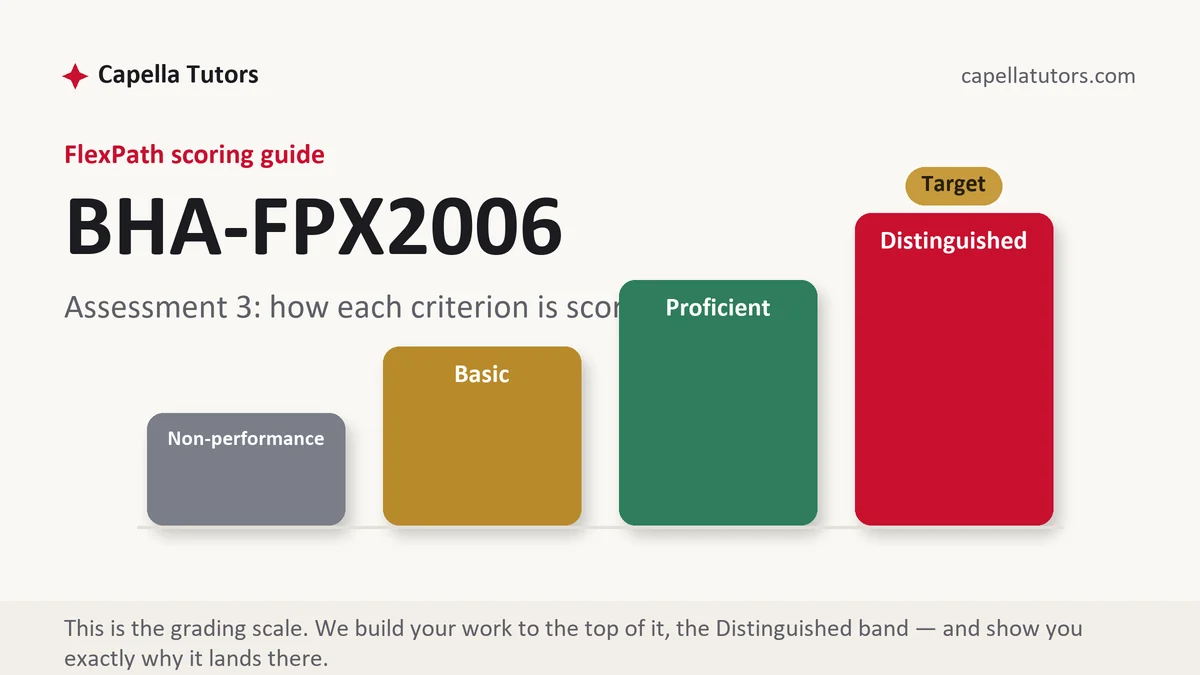
How BHA FPX 2006 Assessment 3 is scored
Four levels, one per criterion, no averaging. Read the top description as a list of required moves rather than as praise for good work:
| Level | What it means on a corrective action response |
|---|---|
| Distinguished | The correction names the change, the responsible role, a completion date, and the evidence a resurvey would see, and it reaches every place the same failure could occur rather than only the one that was observed. |
| Proficient | A complete and workable correction for the finding as written, with the systemic reach left implied. |
| Basic | A promise to retrain staff and update a policy, with no owner, no date, and nothing that could be audited. |
| Non-performance | No corrective action is provided, or the response argues with the finding instead of answering it. |
A useful test before you submit: could somebody who has never met you carry out your plan, and could a different person verify a month later that it happened? If either answer is no, the criterion is not met yet, no matter how sound the regulatory analysis above it is.
The BHA FPX 2006 Assessment 3 method, step by step
-
Answer the finding as written
Restate the finding in its own terms first, including the date and the observation. Disagreement belongs in a separate, brief paragraph if the facts genuinely warrant it, and a response that opens by disputing the surveyor tends to lose the criterion that asked for a correction.
-
Separate the immediate fix from the systemic one
Two different obligations sit inside one plan. The first repairs what was found; the second addresses every other place the same failure could occur. A response confined to the single unit or the single patient reads as a patch rather than a correction.
-
Give every action four attributes
What changes, who owns it by role, when it is complete, and how it will be verified. Write them into the sentence rather than gesturing at them, because a plan that cannot be audited is not a plan and the criterion says so in different words.
-
Build the verification into work somebody already does
An audit invented for a plan of correction lasts about six weeks. Attach the check to an existing report, an existing huddle, or an existing supervisor round, and name the frequency and the sample size.
-
Say what the evidence will look like at resurvey
An inspector returning wants documents: a signed competency record, an audit log with dates, a revised script, a training roster. Name the artifacts your plan will produce, because that sentence is often the difference between the top two levels.
-
Read it as the inspector, then self-score
Go through the plan asking what you would ask for at each line. Fill every gap, then grade yourself against each criterion and rewrite anything that is not at the top before you submit.
A structure that maps to the criteria
Our tutors' planning targets for a corrective response of this size. Follow the sections and the length your own scoring guide names.
| Section | What it must do | Guide |
|---|---|---|
| The finding | The observation, its date, and the requirement it was written against, restated accurately. | ~150 words |
| Why it happened | The process that allowed it, described without blame, so the correction has something to change. | ~250 words |
| Immediate action | What was done for the situation found, by whom, and on what date. | ~200 words |
| Systemic action | The change reaching every comparable setting, with the role, the date, and the training or tooling involved. | ~300 words |
| Monitoring and evidence | The audit, its frequency and sample, the report it lands in, and the artifacts a resurvey would review. | ~250 words |
| References | The requirement and enforcement guidance cited to their sources, current APA. | as needed |
Annotated sample excerpt
A model excerpt from our team showing a correction written so it could be verified by a stranger. Study the components, then build the version your own finding requires.
The finding is that on two occasions in March a registration clerk asked an arriving patient for insurance information and a payment method before the medical screening examination had begun, and the requirement at issue is the federal duty to provide a screening examination to anyone who comes to a dedicated emergency department requesting evaluation, without delaying it to inquire about payment.1 The systemic action is a change to the sequence rather than a reminder about it: the registration workflow now captures name, date of birth, and reason for visit only, the financial conversation is moved to a bedside step that cannot be opened until the screening examination is documented as started, and the emergency department director owns the change with completion set at the end of the current month.2 Verification runs on evidence that already exists, with the quality coordinator pulling twenty arrivals a month from the tracking log and comparing the timestamp on the screening note with the timestamp on the financial screen, reported to the department's existing monthly operations review and escalated to the compliance committee on any exception.3
- 1The finding and the requirement appear together in one sentence, so the correction that follows is visibly answering the right obligation rather than a general idea about access.
- 2The correction changes the sequence and removes the possibility, instead of asking staff to remember. A control built into the system rather than into memory is what the top level describes.
- 3The audit uses a log the organization already keeps, names the sample size, the owner, and the escalation route, and would produce something an inspector could read on a return visit.
The full premium sample for your exact assessment, written fresh to your scoring guide and issue, is free to request. Study it, revise it into your own voice, and submit work you understand.
The five mistakes that cost Distinguished
- Staff will be re-educated. Training with no owner, no roster, and no verification is the single most common way to lose this criterion.
- A fix confined to the incident. An inspector who finds one failure will ask about every comparable setting, and so will the scoring guide.
- A policy update offered as the correction. Rewriting the document changes nothing unless the workflow changes with it.
- An audit invented for the plan. Verification attached to an existing report survives; a new spreadsheet does not.
- Arguing with the finding. Dispute belongs in one short paragraph, if anywhere. The criterion asked for a correction.
Pre-submission checklist
- The finding is restated with its date and the requirement it was written against
- Immediate action and systemic action appear as separate items
- Every action carries a change, a role, a completion date, and a verification method
- The audit names a frequency, a sample, and the report it lands in
- The artifacts a resurvey would examine are named in the text
- Requirements cited to their sources, references reconciled both ways in current APA
Plan of correction due?
Send the finding, the criteria, and the setting it happened in. The sample returns inside 24 to 48 hours with the immediate and systemic actions separated, every action carrying an owner and a date, and a verification step built into a report the organization already runs.